







Question: How do I answer this after I get the confidence charts? They are coming out equal This exercise will show how you can use Monte
How do I answer this after I get the confidence charts? They are coming out equal
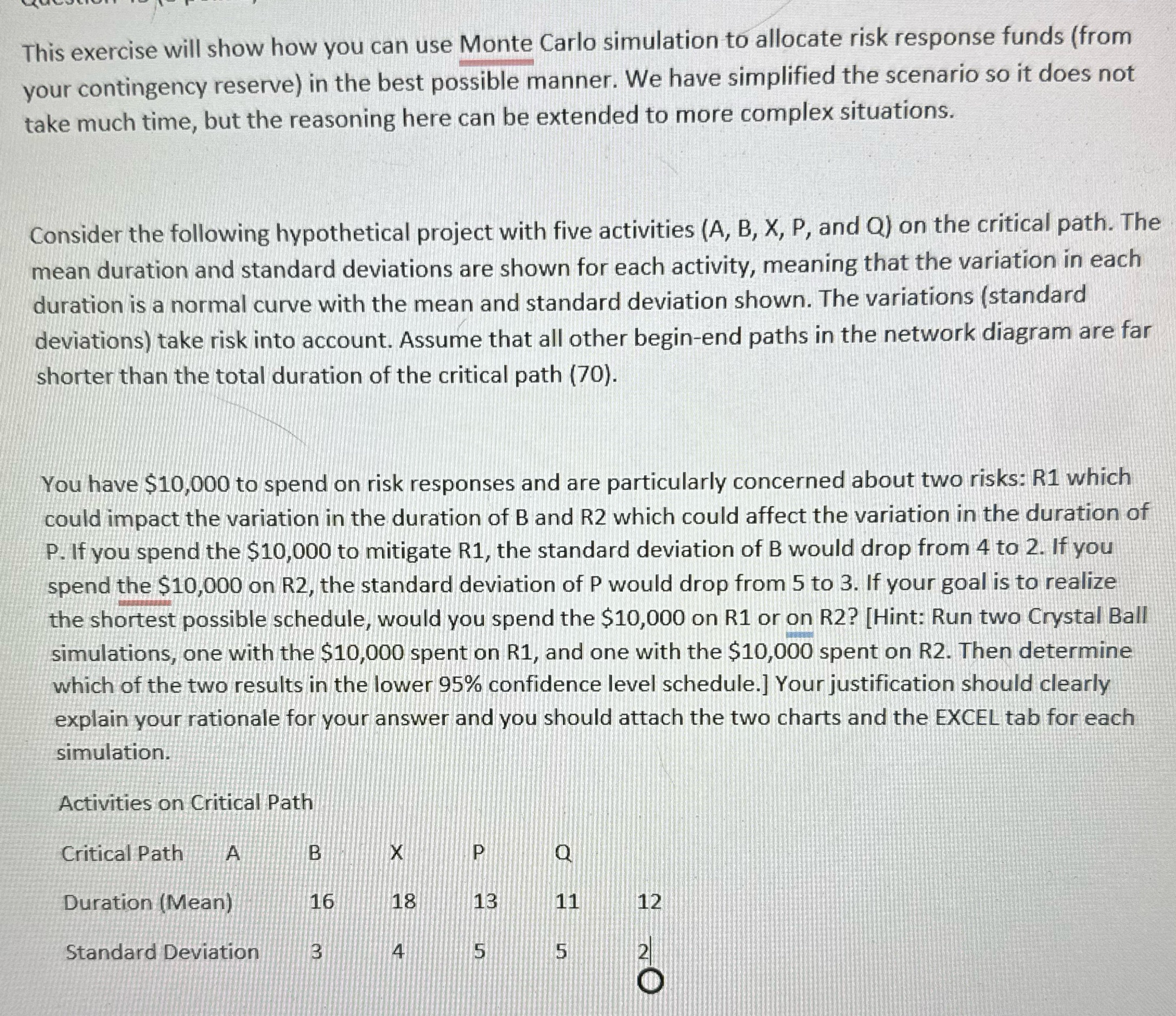
This exercise will show how you can use Monte Carlo simulation to allocate risk response funds (from your contingency reserve) in the best possible manner. We have simplified the scenario so it does not take much time, but the reasoning here can be extended to more complex situations. Consider the following hypothetical project with five activities (A, B, X, P, and Q) on the critical path. The mean duration and standard deviations are shown for each activity, meaning that the variation in each duration is a normal curve with the mean and standard deviation shown. The variations (standard deviations) take risk into account. Assume that all other begin-end paths in the network diagram are far shorter than the total duration of the critical path (70). You have $10,000 to spend on risk responses and are particularly concerned about two risks: R1 which could impact the variation in the duration of B and R2 which could affect the variation in the duration of P. If you spend the $10,000 to mitigate R1, the standard deviation of B would drop from 4 to 2. If you spend the $10,000 on R2, the standard deviation of P would drop from 5 to 3. If your goal is to realize the shortest possible schedule, would you spend the $10,000 on R1 or on R2? [Hint: Run two Crystal Ball simulations, one with the $10,000 spent on R1, and one with the $10,000 spent on R2. Then determine which of the two results in the lower 95% confidence level schedule.] Your justification should clearly explain your rationale for your answer and you should attach the two charts and the EXCEL tab for each simulation. Activities on Critical Path Critical Path A B X Duration (Mean) 16 18 13 11 12 Standard Deviation 3 4 5 5
Step by Step Solution
There are 3 Steps involved in it

Get step-by-step solutions from verified subject matter experts
 Study Help