







Question: How do I answer this case study and explain the details of the Excel file (at the bottom)? Requirements: Part B (Stochastic Model, 50 points):
How do I answer this case study and explain the details of the Excel file (at the bottom)?
Requirements: Part B (Stochastic Model, 50 points):
Case 13.2 (Call Center Staffing at Vacations Inc.) of Chapter 13 on page 732 of the electronic Textbook. Please answer the following questions with detailed work.
(1) On average, how many customers per hour does each sales person process?
(2) What is the expected value of each call to VIs toll-free line?
(3) Suppose VI pays its phone reps $12 per hour. How many phone reps should it employ if it wants to maximize profit?
For both Part A and Part B, please type the detailed work in Word document and attach the related spreadsheets. Each group submits a digital copy of your case analysis
Case Study from Textbook: "732 Chapter 13 Queuing Theory Call Center Staffing at Vacations Inc. Vacations Inc. (VI) markets time-share condominiums throughout North America. One way the company generates sales leads is by offering a chance to win a free mini vacation to anyone who fills out an information card and places it in boxes VI has distributed at various restaurants and shopping malls. All those who fill out the card and indicate an adequate income level subsequently receive a letter from VI indicating they have indeed won the mini vacation. To claim their prize, all the winner needs to do is call VIs toll-free number. When the winner calls the number, they learn that their mini-vacation consists of a free dinner, entertainment, and two-night stay at one of VIs time-share properties; but they must agree to sit through a 2-hourproperty tour and sales presentation.
About half the people who call VIs toll-free number to claim their prize wind up rejecting the offer after they learn about the 2-hour property tour. About 40% of those who call accept the mini-vacation and do the property tour but dont buy anything. The remaining 10% of those who call the toll-free number accept the mini-vacation and ultimately purchase a time-share. Each mini vacation that VI awards costs the company about $250. Each sale of a time-share generates a net profit of $7,000 for VI after all commissions and other costs (including the $250 for the buyers mini vacation) have been paid.
VIs call center operates from 10 a.m. to 10 p.m. daily with 4 sales representatives and receives calls at a rate of 50 per hour following a Poisson distribution. It takes an average of 4 minutes to handle each call with actual times being exponentially distributed. The phone system VI uses can keep up to 10 callers on hold at any time. Assume those who receive a busy signal dont call back.
a. On average, how many customers per hour does each salesperson process?
b. What is the expected value of each call to VIs toll-free line?
c. Suppose VI pays its phone reps $12 per hour.
How many phone reps should it employ if it wants to maximize profit?"
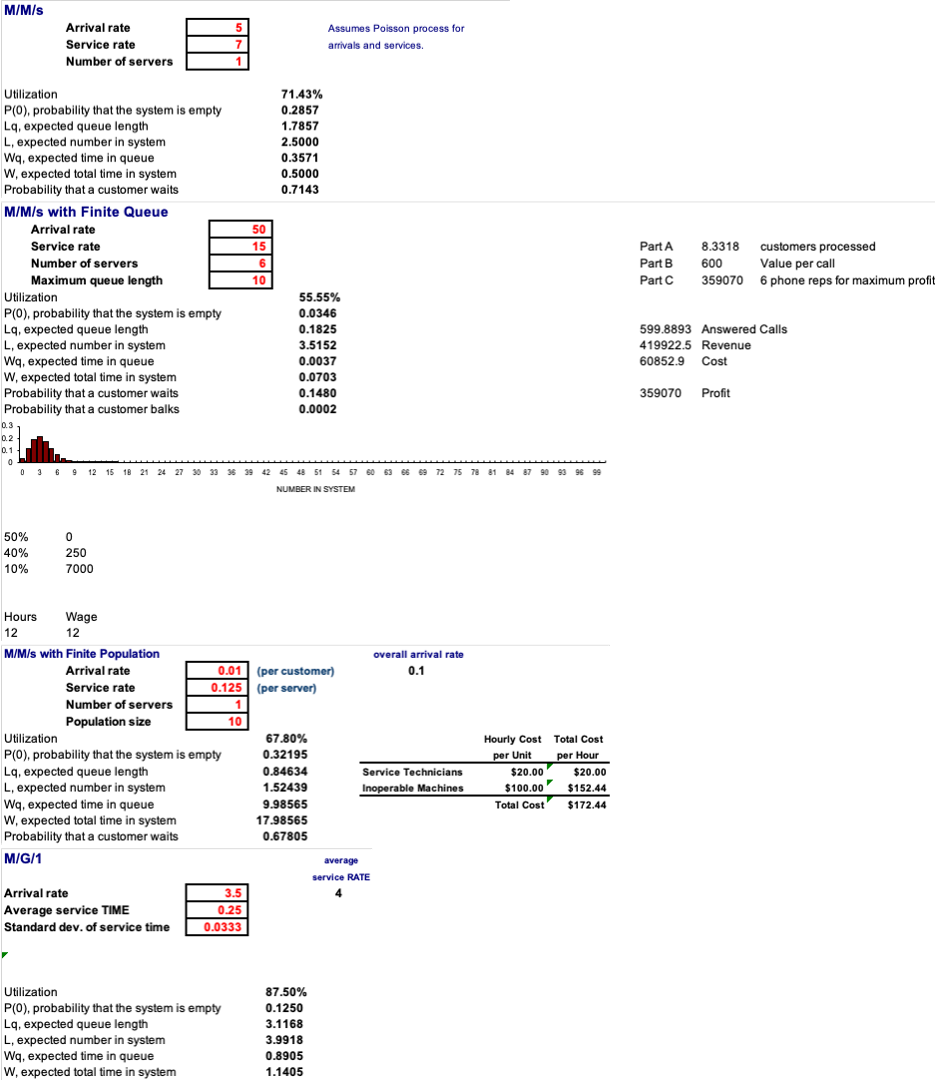
M/M/s \begin{tabular}{l|r|} Arrival rate & 5 \\ Service rate & 7 \\ \cline { 2 - 2 } Number of servers & 1 \\ & \end{tabular} Assumes Poisson process for arrivals and services. UtilizationP(0),probabilitythatthesystemisemptyLq,expectedqueuelengthL,expectednumberinsystemWq,expectedtimeinqueueW,expectedtotaltimeinsystemProbabilitythatacustomerwaits71.43%0.28571.78572.50000.35710.50000.7143 M/M/s with Finite Queue Arrival rate Service rate Number of servers Maximum queue length \begin{tabular}{|r|} \hline 50 \\ \hline 15 \\ \hline 6 \\ \hline 10 \\ \hline \end{tabular} Part A 8.3318 customers processed Part B 600 Value per call Part C 3590706 phone reps for maximum profit Utilization P(0), probability that the system is empty Lq, expected queue length 599.8893 Answered Calls L, expected number in system 419922.5 Revenue Wq, expected time in queue 60852.9 Cost W, expected total time in system Probability that a customer waits 0.1480 359070 Profit Probability that a customer balks 0.0002 NUMBER IN SYSTEM Hours Wage 1212 M/M/s with Finite Population Arrival rate Service rate Number of servers Population size \begin{tabular}{|r|} \hline 0.01 \\ \hline 0.125 \\ \hline 1 \\ \hline 10 \\ \hline \end{tabular} UtilizationP(0),probabilitythatthesystemisemptyLq,expectedqueuelengthL,expectednumberinsystemWq,expectedtimeinqueueW,expectedtotaltimeinsystem87.50%0.12503.11683.99180.89051.1405
Step by Step Solution
There are 3 Steps involved in it

Get step-by-step solutions from verified subject matter experts
 Study Help