







Question: How do I do question 3.3? 3) Pure rotational spectroscopy. The following transitions were measured in the pure rotational spectra of three isotopologues of the
 How do I do question 3.3?
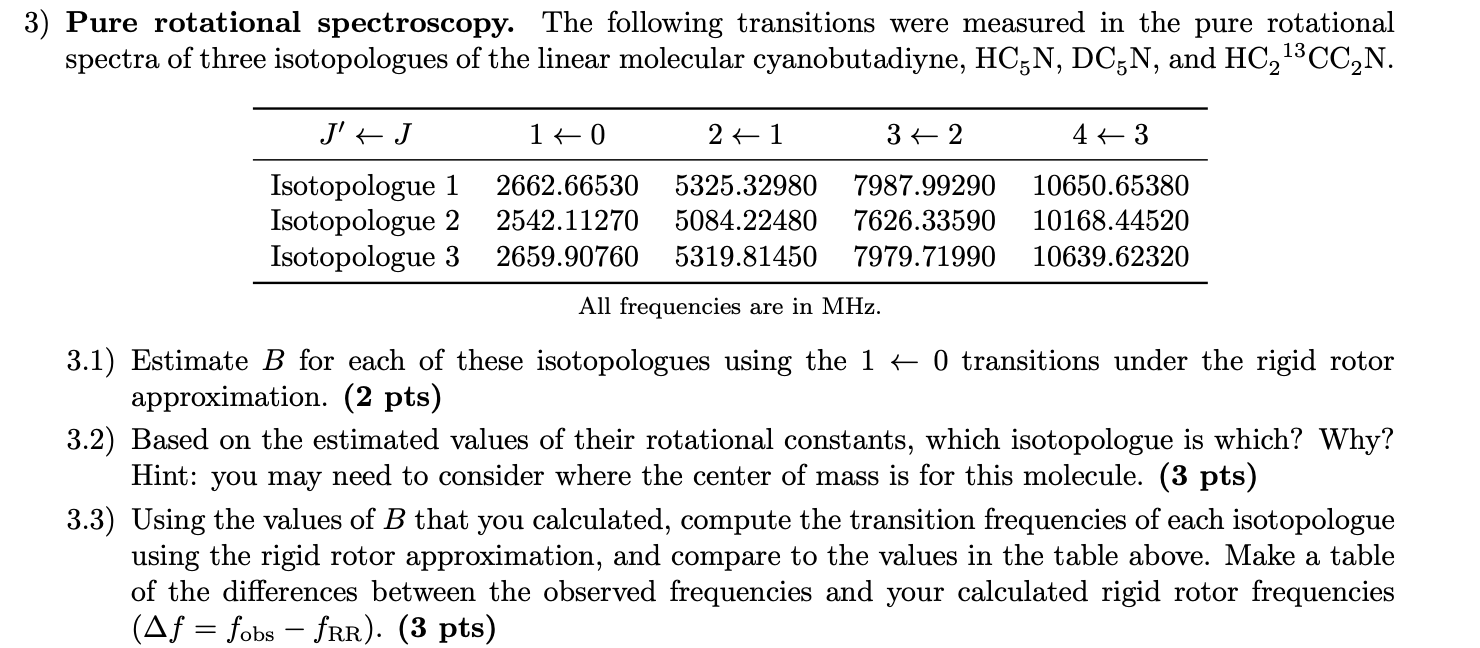
3) Pure rotational spectroscopy. The following transitions were measured in the pure rotational spectra of three isotopologues of the linear molecular cyanobutadiyne, HC5N, DC5N, and HC213CCN. J'+ J 10 2+1 3+ 2 443 Isotopologue 1 2662.66530 Isotopologue 2 2542.11270 Isotopologue 3 2659.90760 5325.32980 5084.22480 5319.81450 7987.99290 7626.33590 7979.71990 10650.65380 10168.44520 10639.62320 All frequencies are in MHz. 3.1) Estimate B for each of these isotopologues using the 1% 0 transitions under the rigid rotor approximation. (2 pts) 3.2) Based on the estimated values of their rotational constants, which isotopologue is which? Why? Hint: you may need to consider where the center of mass is for this molecule. (3 pts) 3.3) Using the values of B that you calculated, compute the transition frequencies of each isotopologue using the rigid rotor approximation, and compare to the values in the table above. Make a table of the differences between the observed frequencies and your calculated rigid rotor frequencies (Af = fobs FRR). (3 pts)
Step by Step Solution
There are 3 Steps involved in it

Get step-by-step solutions from verified subject matter experts
 Study Help