







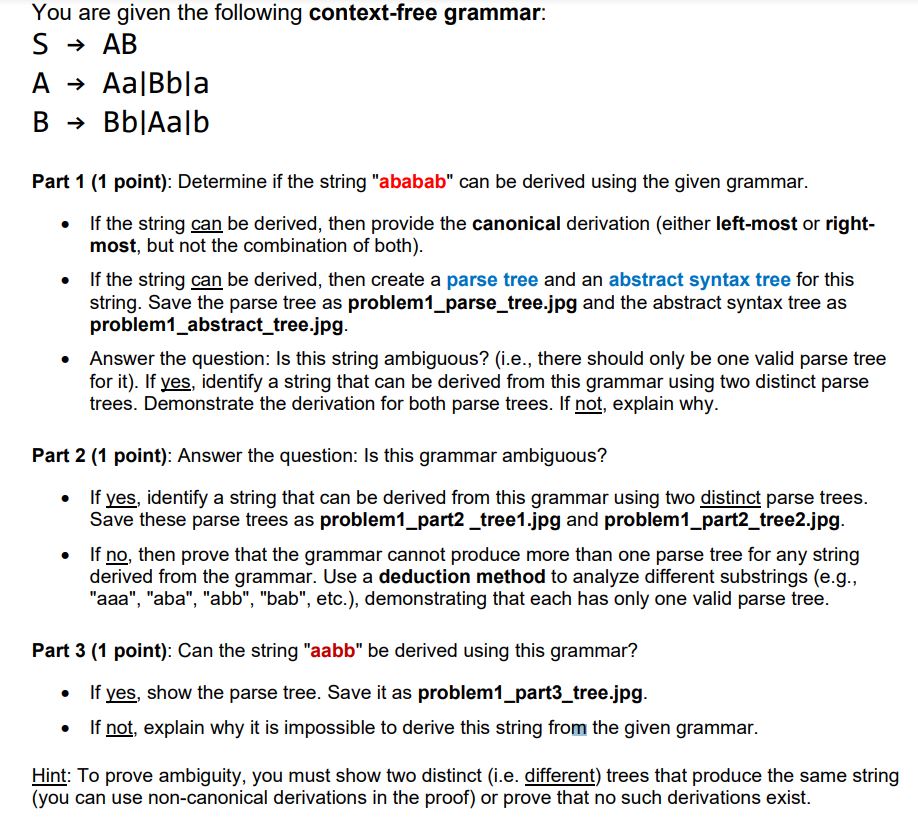
Question: How do I do this? You are given the following context - free grammar: S A B A Aa | Bbla B Bb | Aalb
How do I do this? You are given the following contextfree grammar:
AaBbla
BbAalb
Part point: Determine if the string "ababab" can be derived using the given grammar.
If the string can be derived, then provide the canonical derivation either leftmost or right
most, but not the combination of both
If the string can be derived, then create a parse tree and an abstract syntax tree for this
string. Save the parse tree as problemparsetree.jpg and the abstract syntax tree as
problemabstracttree.jpg
Answer the question: Is this string ambiguous? ie there should only be one valid parse tree
for it If yes, identify a string that can be derived from this grammar using two distinct parse
trees. Demonstrate the derivation for both parse trees. If not, explain why.
Part point: Answer the question: Is this grammar ambiguous?
If yes, identify a string that can be derived from this grammar using two distinct parse trees.
Save these parse trees as problemparttreejpg and problemparttreejpg
If no then prove that the grammar cannot produce more than one parse tree for any string
derived from the grammar. Use a deduction method to analyze different substrings eg
"aaa", "aba", "abb", "bab", etc. demonstrating that each has only one valid parse tree.
Part point: Can the string "aabb" be derived using this grammar?
If yes, show the parse tree. Save it as problemparttree.jpg
If not, explain why it is impossible to derive this string from the given grammar.
Hint: To prove ambiguity, you must show two distinct ie different trees that produce the same string
you can use noncanonical derivations in the proof or prove that no such derivations exist.
Step by Step Solution
There are 3 Steps involved in it
1 Expert Approved Answer
Step: 1 Unlock

Question Has Been Solved by an Expert!
Get step-by-step solutions from verified subject matter experts
Step: 2 Unlock
Step: 3 Unlock
 Study Help