







Question: How do I find the vibrations in the data chart in Part A? Do I write down the time it took for 10 vibrations (bobs)
How do I find the vibrations in the data chart in Part A? Do I write down the time it took for 10 vibrations (bobs) to happen since it says "10 vibrations" or is the vibrations just the number of times it bobbed unit it stopped?
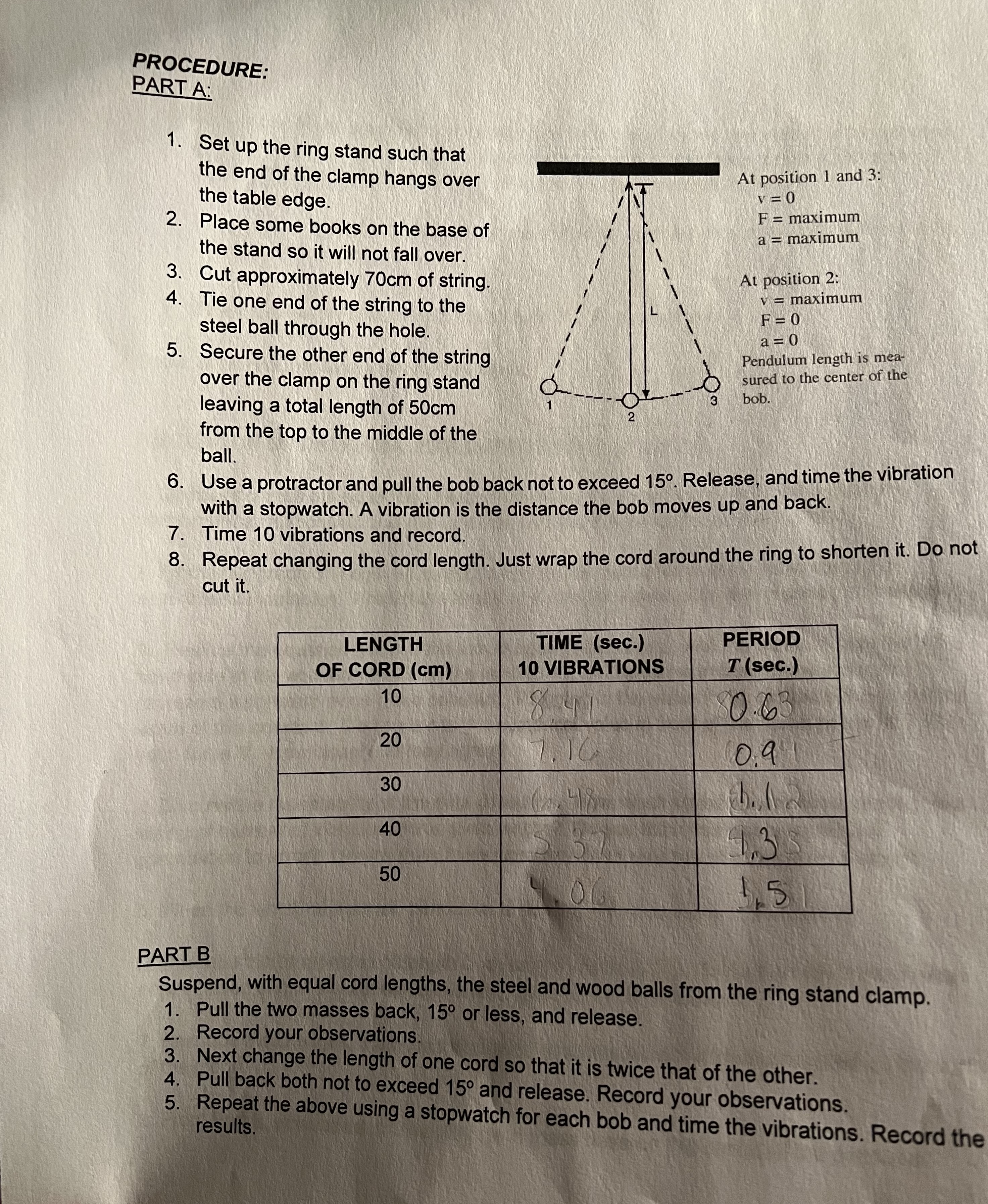
PROCEDURE: PART A: 1. Set up the ring stand such that the end of the clamp hangs over At position 1 and 3: the table edge. V=0 F = maximum 2. Place some books on the base of a = maximum the stand so it will not fall over. 3. Cut approximately 70cm of string. At position 2: 4. Tie one end of the string to the v = maximum F - 0 steel ball through the hole. a - 0 5. Secure the other end of the string Pendulum length is mea- over the clamp on the ring stand sured to the center of the bob. leaving a total length of 50cm from the top to the middle of the ball. 6. Use a protractor and pull the bob back not to exceed 150. Release, and time the vibration with a stopwatch. A vibration is the distance the bob moves up and back. 7. Time 10 vibrations and record. 8. Repeat changing the cord length. Just wrap the cord around the ring to shorten it. Do not cut it. LENGTH TIME (sec.) PERIOD OF CORD (cm) 10 VIBRATIONS T (sec.) 10 20 0.9 30 418 40 1.3 50 PART B Suspend, with equal cord lengths, the steel and wood balls from the ring stand clamp. 1. Pull the two masses back, 150 or less, and release. 2. Record your observations. 3. Next change the length of one cord so that it is twice that of the other. 4. Pull back both not to exceed 150 and release. Record your observations. results. 5. Repeat the above using a stopwatch for each bob and time the vibrations. Record the
Step by Step Solution
There are 3 Steps involved in it

Get step-by-step solutions from verified subject matter experts
 Study Help