







Question: How do I prove these thms using these definition? Definition. Let (X, J) be a topological space, A a subset of X, and p a
How do I prove these thms using these definition?
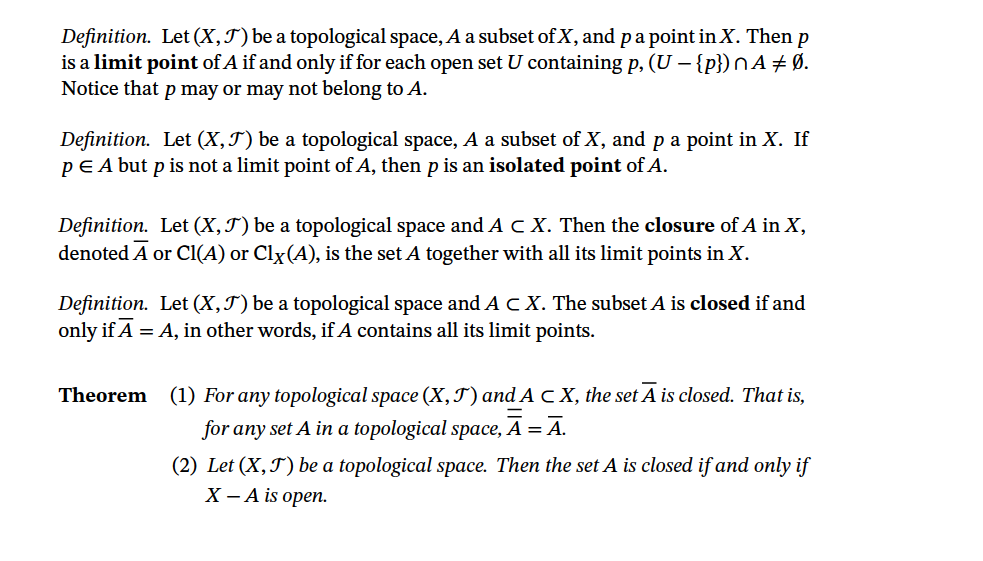
Definition. Let (X, J) be a topological space, A a subset of X, and p a point in X. Then p is a limit point of A if and only if for each open set U containing p, (U -{p}) nA # 0. Notice that p may or may not belong to A. Definition. Let (X, J) be a topological space, A a subset of X, and p a point in X. If p E A but p is not a limit point of A, then p is an isolated point of A. Definition. Let (X, J) be a topological space and A C X. Then the closure of A in X, denoted A or CI(A) or Clx(A), is the set A together with all its limit points in X. Definition. Let (X, J) be a topological space and A C X. The subset A is closed if and only if A = A, in other words, if A contains all its limit points. Theorem (1) For any topological space (X, J) and A C X, the set A is closed. That is, for any set A in a topological space, A = A. (2) Let (X, J) be a topological space. Then the set A is closed if and only if X - A is open
Step by Step Solution
There are 3 Steps involved in it

Get step-by-step solutions from verified subject matter experts
 Study Help