







Question: How do I solve P3 -P2 is needed its under here. A B C E F G H K L M N P 20% Consider
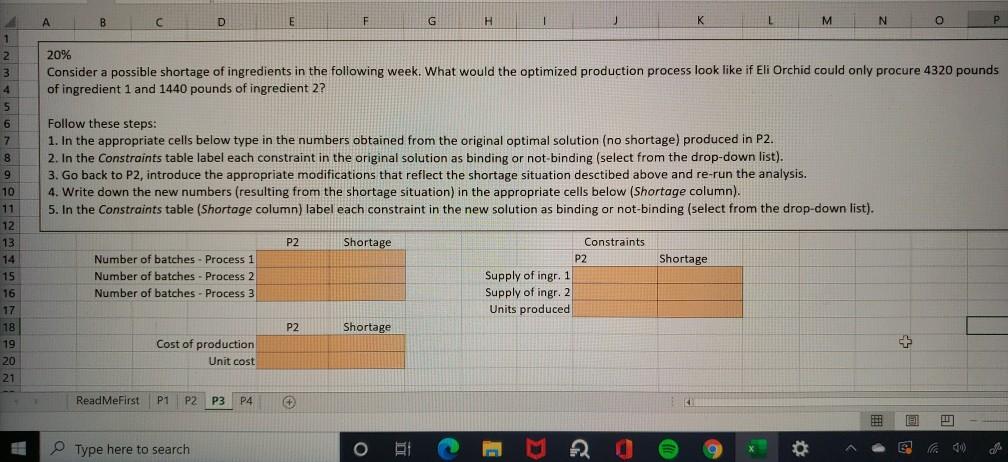
How do I solve P3 -P2 is needed its under here.
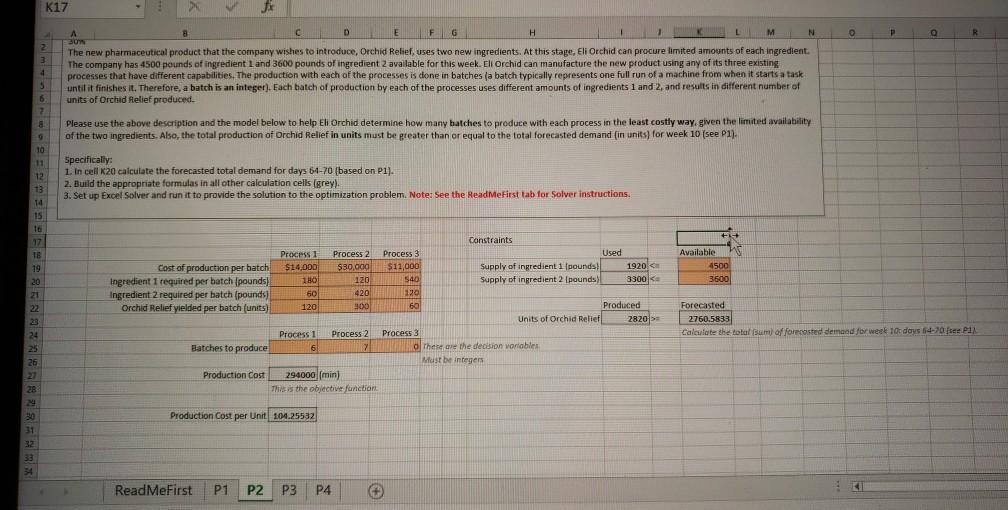
A B C E F G H K L M N P 20% Consider a possible shortage of ingredients in the following week. What would the optimized production process look like if Eli Orchid could only procure 4320 pounds of ingredient 1 and 1440 pounds of ingredient 2? 1 1 2 3 4 5 6 7 8 9 10 11 12 13 14 15 16 17 18 19 20 21 Follow these steps: 1. In the appropriate cells below type in the numbers obtained from the original optimal solution (no shortage) produced in P2. 2. In the Constraints table label each constraint in the original solution as binding or not-binding (select from the drop-down list). 3. Go back to P2, introduce the appropriate modifications that reflect the shortage situation desctibed above and re-run the analysis. 4. Write down the new numbers (resulting from the shortage situation) in the appropriate cells below (Shortage column). 5. In the Constraints table (Shortage column) label each constraint in the new solution as binding or not-binding (select from the drop-down list). P2 Shortage Shortage Number of batches - Process 1 Number of batches - Process 2 Number of batches - Process 3 Constraints P2 Supply of ingr. 1 Supply of ingr. 2 Units produced P2 Shortage Cost of production Unit cost ReadMeFirst P1 P2 P3 P4 BE Type here to search OBI K17 fi E L M N A 301 O P 2 3 4 5 6 2 8 9 10 11 12 13 14 15 16 D F G H The new pharmaceutical product that the company wishes to introduce, Orchid Relief, uses two new ingredients. At this stage, Eli Orchid can procure limited amounts of each ingredient. The company has 4500 pounds of ingredient 1 and 3600 pounds of ingredient 2 available for this week. Eli Orchid can manufacture the new product using any of its three existing processes that have different capabilities. The production with each of the processes is done in batches (a batch typically represents one full run of a machine from when it starts a task until it finishes it. Therefore, a batch is an integer). Each batch of production by each of the processes uses different amounts of ingredients 1 and 2, and results in different number of units of Orchid Relief produced. Please use the above description and the model below to help Eli Orchid determine how many batches to produce with each process in the least costly way, given the limited availability of the two ingredients. Also, the total production of Orchid Relief in units must be greater than or equal to the total forecasted demand (in units for week 10 (see P1). Specifically: 1. In cell K20 calculate the forecasted total demand for days 61-70 {based on P1). 2. Build the appropriate formulas in all other calculation cells (grey). 3. Set up Excel Solver and run it to provide the solution to the optimization problem. Note: See the ReadMeFirst tab for Solver instructions. Process $14,000 180 60 120 Process 2 $30,000 120 420 Constraints Used Supply of ingredient 1 pounds! Supply of ingredient 2 pounds 18 19 20 21 22 23 24 Process 3 $11,000 540 120 60 cost of production per batch Ingredient 1 required per batch (pounds) Ingredient 2 required per batch (pounds) Orchid Relief yielded per batch (units) 1920 3300 Available 4500 3600 200 Produced Units of Orchid Relief 2820 Forecasted 2760.5833 Calculate the total sum of forecasted demand for week 10 days 14-70 free 2:11 Process 3 Process 1 6 Process 2 7 Batches to produce There the decision variable Must be integers 26 Production Cost 294000 (min) This is the objective function 2B 24 Production Cost per Unit 104.25532 31 32 53 34 ReadMeFirst P1 P2 P3 P4
Step by Step Solution
There are 3 Steps involved in it
1 Expert Approved Answer
Step: 1 Unlock

Question Has Been Solved by an Expert!
Get step-by-step solutions from verified subject matter experts
Step: 2 Unlock
Step: 3 Unlock
 Study Help