



Question: How do I solve this? 1. QP9 R X N Y C=] uf Z figure 4 In your laboratory kit you find an unlabeled inductor.
How do I solve this?
1.
![How do I solve this?1. QP9 R X N Y C=] uf](https://dsd5zvtm8ll6.cloudfront.net/si.experts.images/questions/2024/09/66f6d0b99bc71_32166f6d0b9692e1.jpg)
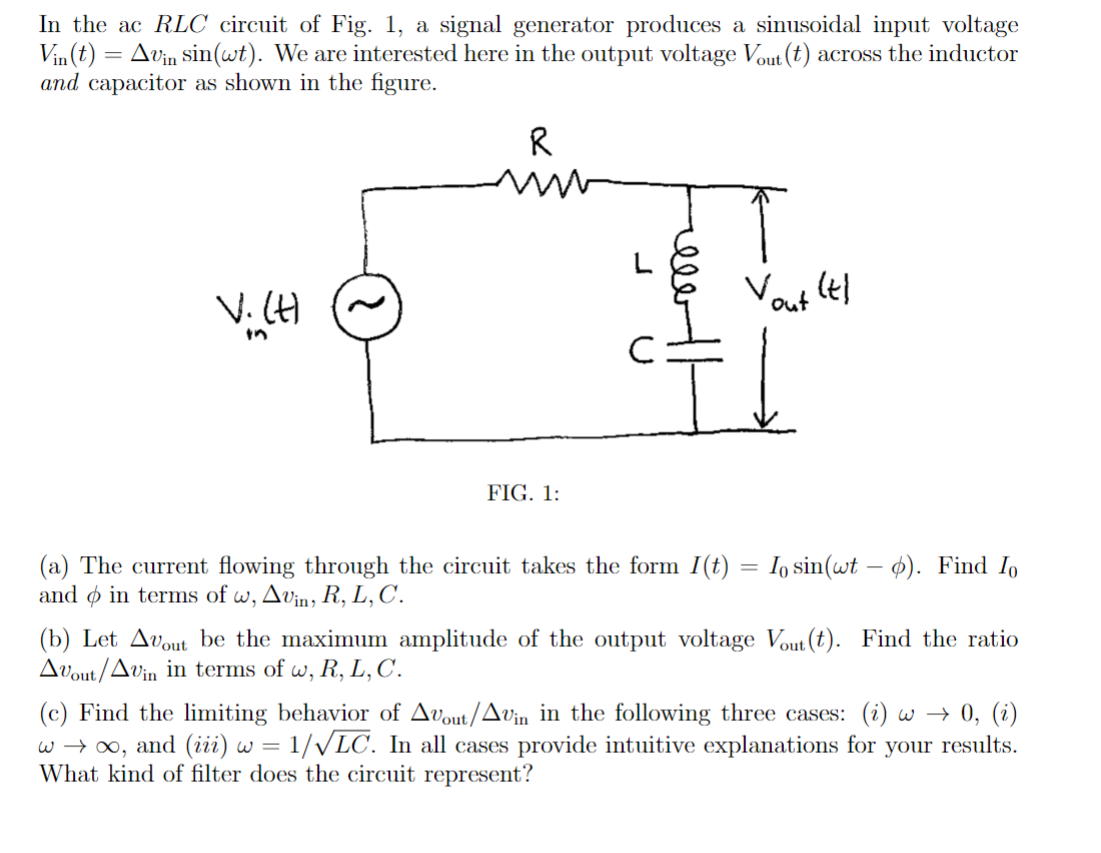
QP9 R X N Y C=] uf Z figure 4 In your laboratory kit you find an unlabeled inductor. Let R be its internal resistance and L be its inductance. You quickly determine R to be 35 Ohms using your ohmmeter. Curiosity drives you to go to the help lab where you find a 1000 Hz signal generator and a 1 microfarad capacitor. Your affinity for the smell of melting solder then drives you to construct the circuit shown in figure 4. Using your AC voltmeter, you measure the RMS voltage between points X and Z to be 10.1 volts. The RMS voltage between Y and Z is then measured to be 15.5 volts. (a) What is the RMS current in the circuit? (b) What are the two values of L (in henries) that are consistent with these data? (c) For each value of L from part (b) predict the voltmeter reading between X and Y. Therefore, one can make this final measurement to deduce the correct value of L.In the ac RLC circuit of Fig. 1, a signal generator produces a sinusoidal input voltage Vin(t) = Avin sin(wt). We are interested here in the output voltage Vout (t) across the inductor and capacitor as shown in the figure. R L V. (H Vout (+1 in C FIG. 1: (a) The current flowing through the circuit takes the form I(t) = lo sin(wt - Q). Find Io and o in terms of w, Avin, R, L, C. (b) Let Avout be the maximum amplitude of the output voltage Vout(t). Find the ratio Avout / Avin in terms of w, R, L, C. (c) Find the limiting behavior of About/ Avin in the following three cases: (i) w - 0, (i) w -+ oo, and (iii) w = 1/VLC. In all cases provide intuitive explanations for your results. What kind of filter does the circuit represent
Step by Step Solution
There are 3 Steps involved in it

Get step-by-step solutions from verified subject matter experts