







Question: How do I solve this? 53. A circular coil enclosing M an area of 100 cm is made B of 200 turns of copper wire
How do I solve this?
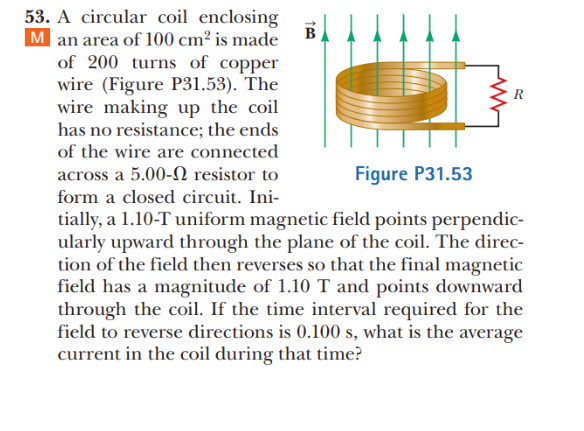
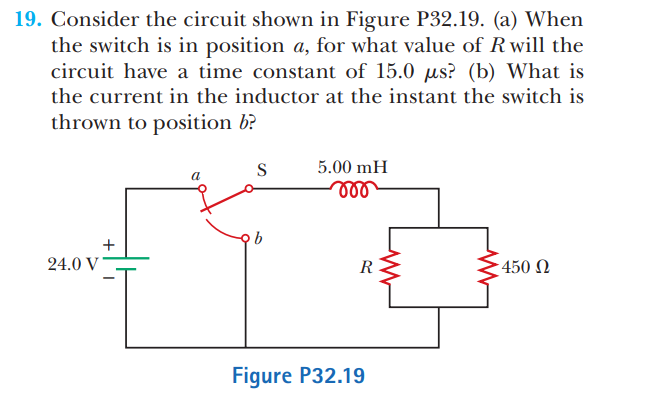
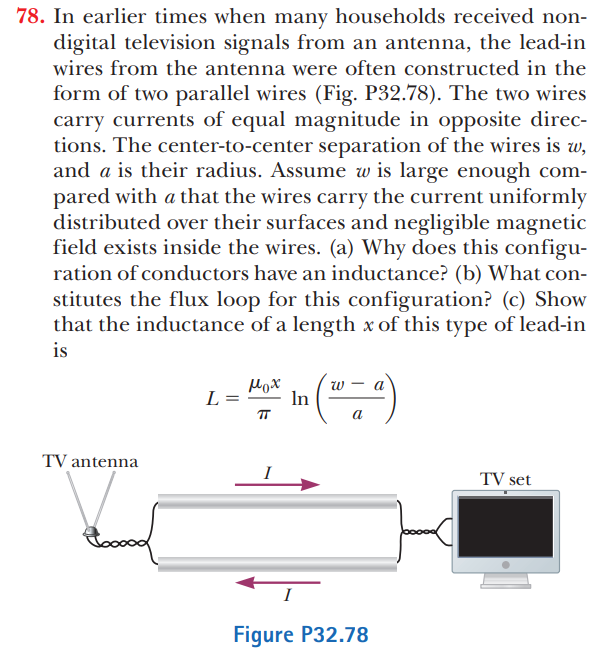
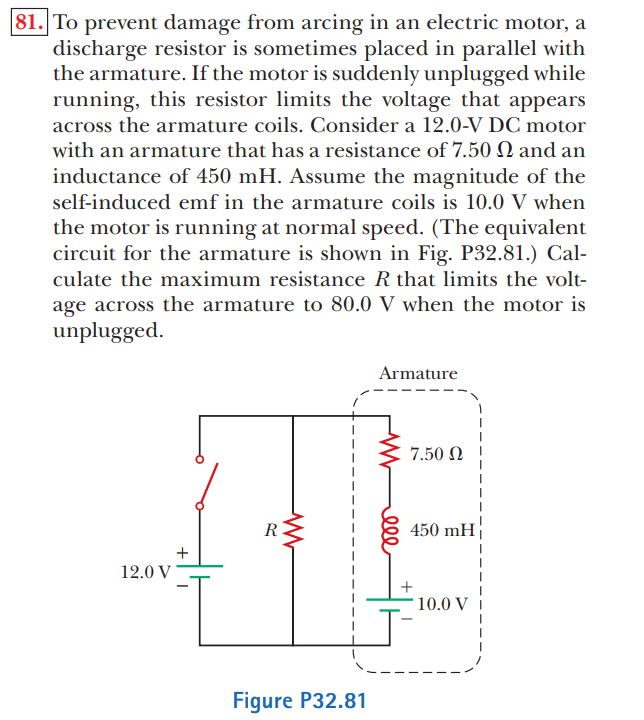
53. A circular coil enclosing M an area of 100 cm is made B of 200 turns of copper wire (Figure P31.53). The R wire making up the coil has no resistance; the ends of the wire are connected across a 5.00-Q resistor to Figure P31.53 form a closed circuit. Ini- tially, a 1.10-T uniform magnetic field points perpendic ularly upward through the plane of the coil. The direc- tion of the field then reverses so that the final magnetic field has a magnitude of 1.10 T and points downward through the coil. If the time interval required for the field to reverse directions is 0.100 s, what is the average current in the coil during that time?19. Consider the circuit shown in Figure P3219. (a) When the switch is in position a, for what value of Rwiil the Circuit have a time constant of 15.0 ns? (b) What is the current in the inductor at the instant the switch is thrown to position b? 450 I). Figure P32.19 78. In earlier times when many households received non- digital television signals from an antenna, the lead-in wires from the antenna were often constructed in the form of two parallel wires (Fig. P3278). The two wires carry currents of equal magnitude in opposite direc- tions. The center-to-center separation of the wires is w, and a is their radius. Assume w is large enough com- pared with a that the wires carry the current uniformly distributed over their surfaces and negligible magnetic field exists inside the wires. (a) Why does this congu- ration of conductors have an inductance? (b) What con- stitutes the flux 100p for this configuration? (c) Show that the inductance of a length x of this type of lead-in 15 x _ L=iln(w a) 71' I V antenna Figure P32.78 81. To prevent damage from arcing in an electric motor, a discharge resistor is sometimes placed in parallel with the armature. If the motor is suddenly unplugged while running, this resistor limits the voltage that appears across the armature coils. Consider a 12.0-V DC motor with an armature that has a resistance of 7.50 D and an inductance of 450 mH. Assume the magnitude of the self-induced emf in the armature coils is 10.0 V when the motor is running at normal speed. (The equivalent circuit for the armature is shown in Fig. P32.81.) Cal- culate the maximum resistance R that limits the volt- age across the armature to 80.0 V when the motor is unplugged. Figure P32.81
Step by Step Solution
There are 3 Steps involved in it

Get step-by-step solutions from verified subject matter experts
 Study Help