







Question: How do I solve this first task? Evergreen Inc. was formed in 2 0 1 4 as a company specialized in producing baby skin -
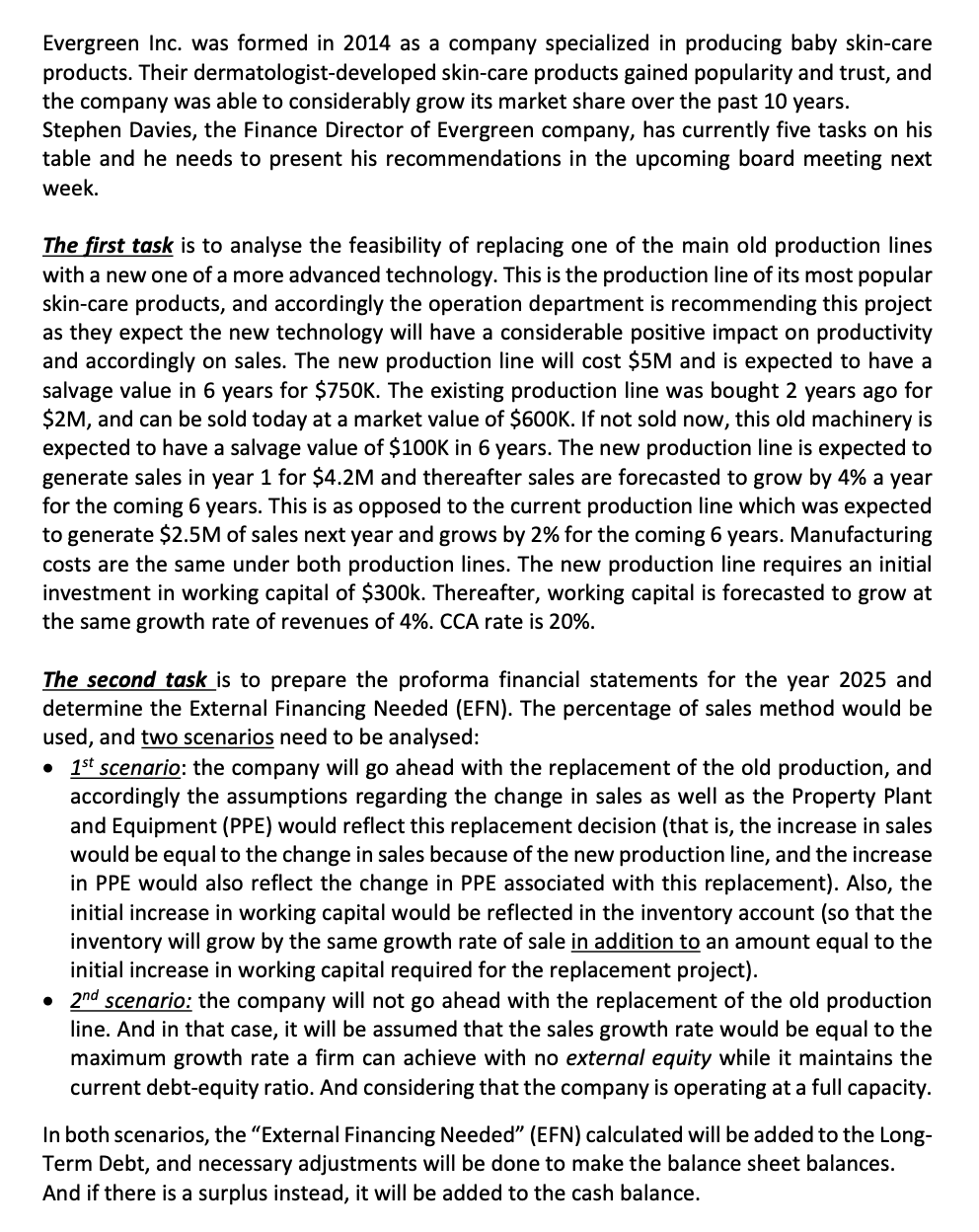
How do I solve this first task? Evergreen Inc. was formed in as a company specialized in producing baby skincare products. Their dermatologistdeveloped skincare products gained popularity and trust, and the company was able to considerably grow its market share over the past years. Stephen Davies, the Finance Director of Evergreen company, has currently five tasks on his table and he needs to present his recommendations in the upcoming board meeting next week.
The first task is to analyse the feasibility of replacing one of the main old production lines with a new one of a more advanced technology. This is the production line of its most popular skincare products, and accordingly the operation department is recommending this project as they expect the new technology will have a considerable positive impact on productivity and accordingly on sales. The new production line will cost $ mathrmM and is expected to have a salvage value in years for $ mathrm~K The existing production line was bought years ago for $ mathrmM and can be sold today at a market value of $ mathrm~K If not sold now, this old machinery is expected to have a salvage value of $ mathrm~K in years. The new production line is expected to generate sales in year for $ mathrmM and thereafter sales are forecasted to grow by a year for the coming years. This is as opposed to the current production line which was expected to generate $ mathrmM of sales next year and grows by for the coming years. Manufacturing costs are the same under both production lines. The new production line requires an initial investment in working capital of $k Thereafter, working capital is forecasted to grow at the same growth rate of revenues of CCA rate is
The second task is to prepare the proforma financial statements for the year and determine the External Financing Needed EFN The percentage of sales method would be used, and two scenarios need to be analysed:
underlinetext st scenario: the company will go ahead with the replacement of the old production, and accordingly the assumptions regarding the change in sales as well as the Property Plant and Equipment PPE would reflect this replacement decision that is the increase in sales would be equal to the change in sales because of the new production line, and the increase in PPE would also reflect the change in PPE associated with this replacement Also, the initial increase in working capital would be reflected in the inventory account so that the inventory will grow by the same growth rate of sale in addition to an amount equal to the initial increase in working capital required for the replacement project
underlinetext nd scenario: the company will not go ahead with the replacement of the old production line. And in that case, it will be assumed that the sales growth rate would be equal to the maximum growth rate a firm can achieve with no external equity while it maintains the current debtequity ratio. And considering that the company is operating at a full capacity.
In both scenarios, the "External Financing Needed" EFN calculated will be added to the LongTerm Debt, and necessary adjustments will be done to make the balance sheet balances. And if there is a surplus instead, it will be added to the cash balance. Also note that:
The unlevered cost of capital in an allequity scenarioand that's for the company's current business as well as the suggested new product
The company's projected cost of debt interest rate for the year
The company's current weighted average cost of capital WACC
The tax rate
Dividend payout ratio in
Questions:
Put yourself in Stephen David's shoes, and attempt accomplishing all five tasks, as follows:
For the first task:
a Calculate the NPV & the IRR of the replacement of the production line.
b Determine whether the company should proceed with this project or not and why?
Ps Use the company's current WACC.
For the second task:
a Prepare the proforma financial statements for the year under the two scenarios mentioned in the second task and calculate the EFN or surplus
Ps Prepare the proforma financial statements for the two scenarios even if you have concluded that the replacement decision is not feasible
b Add the EFN to the LongTerm Debt or add the surplus to the cash balance in case a surplus use the same current Dividend Payout ratio in your projections, and make the balance sheet balances.
In the third task,
a Calculate the percentage of debt under the first scenario in task total liabilities total assets and determine if it exceeds
b If it exceeds make a different suggestion for covering the EFN so that to abide by the maximu
Step by Step Solution
There are 3 Steps involved in it
1 Expert Approved Answer
Step: 1 Unlock

Question Has Been Solved by an Expert!
Get step-by-step solutions from verified subject matter experts
Step: 2 Unlock
Step: 3 Unlock
 Study Help