







Question: How do I solve this? In an electron-positron collider, the electron is accelerated to an energy of 5.11 MeV. The electron mass is 511 keV/c2.
How do I solve this?
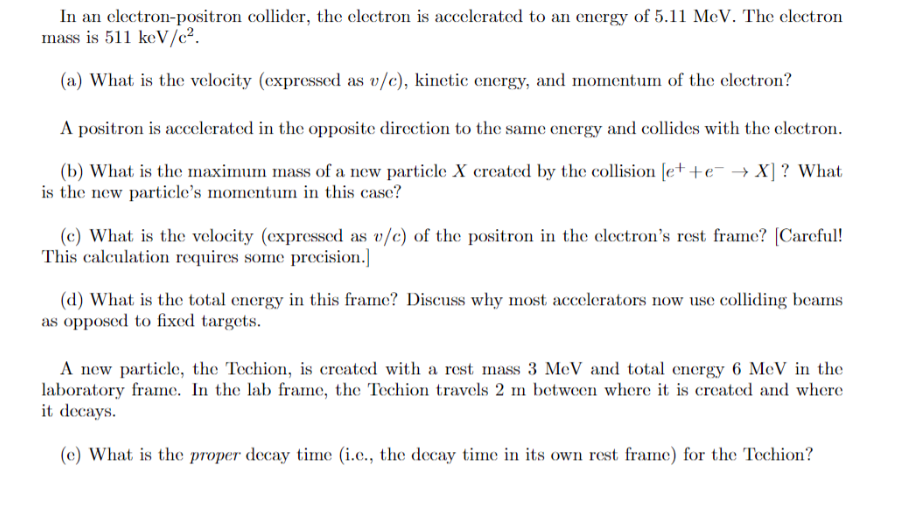
In an electron-positron collider, the electron is accelerated to an energy of 5.11 MeV. The electron mass is 511 keV/c2. (a) What is the velocity (expressed as v/c), kinetic energy, and momentum of the electron? A positron is accelerated in the opposite direction to the same energy and collides with the electron. (b) What is the maximum mass of a new particle X created by the collision [ette- -> X] ? What is the new particle's momentum in this case? (c) What is the velocity (expressed as v/c) of the positron in the electron's rest frame? [Careful! This calculation requires some precision.] (d) What is the total energy in this frame? Discuss why most accelerators now use colliding beams as opposed to fixed targets. A new particle, the Techion, is created with a rest mass 3 MeV and total energy 6 MeV in the laboratory frame. In the lab frame, the Techion travels 2 m between where it is created and where it decays. (c) What is the proper decay time (i.c., the decay time in its own rest frame) for the Techion
Step by Step Solution
There are 3 Steps involved in it

Get step-by-step solutions from verified subject matter experts
 Study Help