







Question: How do I solve this? l. (15 points) Suppose that you are asked to investigate the hypothesis that a grade on a nal exam in
How do I solve this?
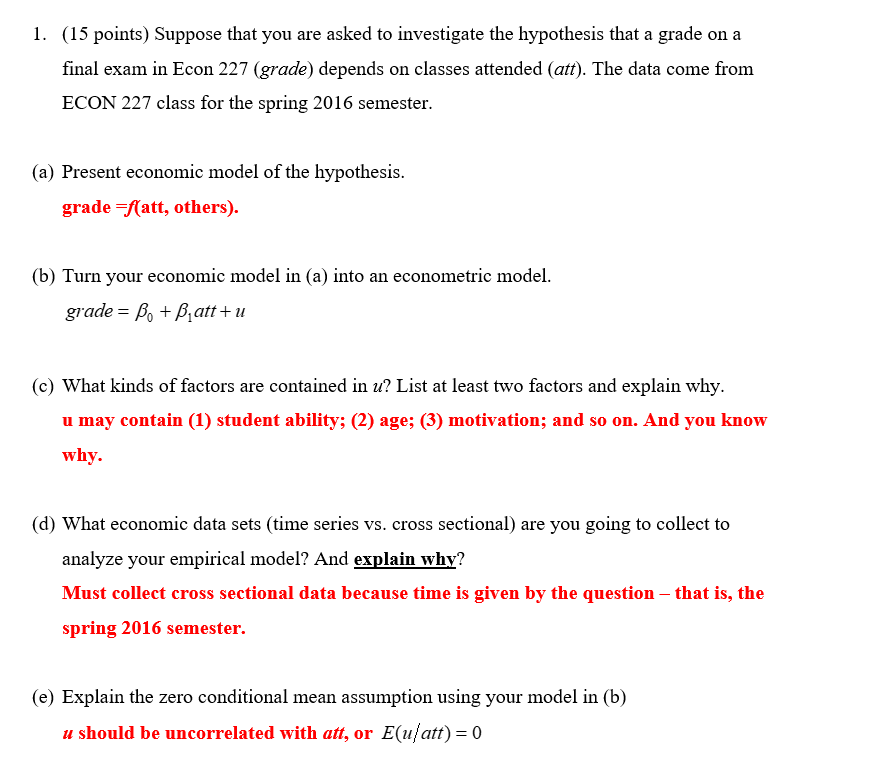
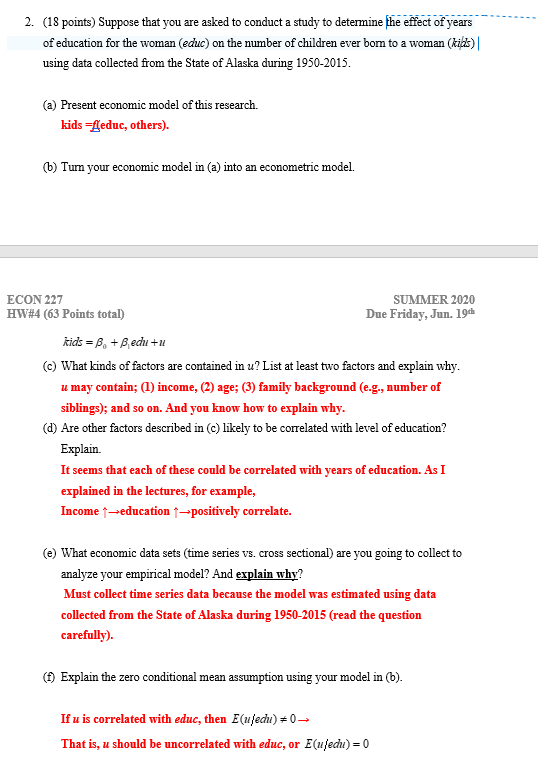
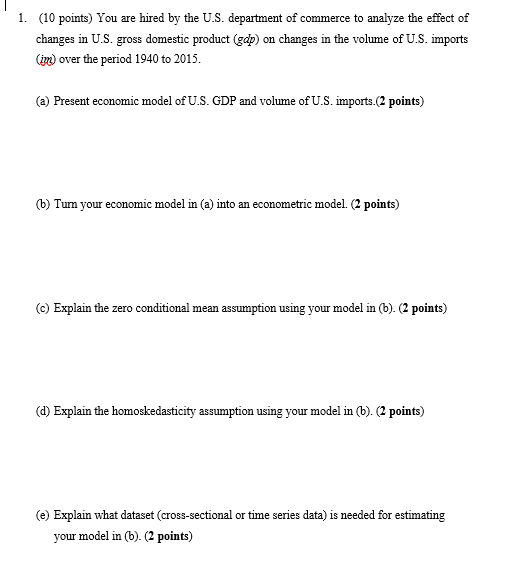
l. (15 points) Suppose that you are asked to investigate the hypothesis that a grade on a nal exam in Econ 22? (grade) depends on classes attended (aft). The data come from ECON 221' class for the spring 2016 semester. (a) Present economic model of the hypothesis. grade =att, others). (b) Turn your economic model in (a) into an econometric model. grade 2 ,3.) + la'Jr a: (c) What kinds of factors are contained in H? List at least two factors and explain why. u may contain (1) student ability; (2} age; (3} motivation; and so on. And you know why. ((1) What economic data sets (time series vs. cross sectional) are you going to collect to analyze your empirical model? And eIElain why? Must collect cross sectional data because time is given by the question that is, the spring 2016 semester. (e) Explain the zero conditional mean assumption using your model in (b) u should be uncorrelated with at, or E (31/ art) 2 U 2. (18 points) Suppose that you are asked to conduct a study to determine the effect of years of education for the woman (educ) on the number of children ever born to a woman (kick) | using data collected from the State of Alaska during 1950-2015. (a) Present economic model of this research. kids =fleduc, others). (b) Turn your economic model in (a) into an econometric model. ECON 227 SUMMER 2020 HW#4 (63 Points total) Due Friday, Jun. 19 kids = B, + Bedu + 1 (c) What kinds of factors are contained in w? List at least two factors and explain why. u may contain; (1) income, (2) age; (3) family background (e-g., number of siblings); and so on. And you know how to explain why. (d) Are other factors described in (c) likely to be correlated with level of education? Explain. It seems that each of these could be correlated with years of education. As I explained in the lectures, for example, Income f-education t-positively correlate. (e) What economic data sets (time series vs. cross sectional) are you going to collect to analyze your empirical model? And explain why? Must collect time series data because the model was estimated using data collected from the State of Alaska during 1950-2015 (read the question carefully). (f) Explain the zero conditional mean assumption using your model in (b). If u is correlated with educ, then E(w/ed) = 0- That is, u should be uncorrelated with educ, or E(ujechi) = 01. (10 points) You are hired by the U.S. department of commerce to analyze the effect of changes in U.S. gross domestic product (gep) on changes in the volume of U.S. imports (iw) over the period 1940 to 2015. (a) Present economic model of U.S. GDP and volume of U.S. imports.(2 points) (b) Turn your economic model in (a) into an econometric model. (2 points) (c) Explain the zero conditional mean assumption using your model in (b). (2 points) (d) Explain the homoskedasticity assumption using your model in (b). (2 points) (e) Explain what dataset (cross-sectional or time series data) is needed for estimating your model in (b). (2 points)
Step by Step Solution
There are 3 Steps involved in it

Get step-by-step solutions from verified subject matter experts
 Study Help