







Question: how do you do longhand? (a) Identify the claim and state Ho and Ha (b) Find the critical? value(s) and identify the rejection region(s).? (c)
how do you do longhand?
(a) Identify the claim and state Ho and Ha
(b) Find the critical? value(s) and identify the rejection region(s).?
(c) Find the standardized test statistic.?
(d) Decide whether to reject or fail to reject the null hypothesis.?
(e) Interpret the decision in the context of the original claim.
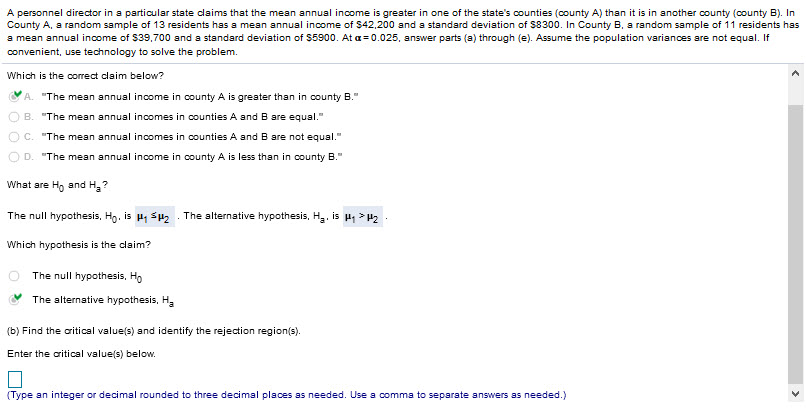
A personnel director in a particular state claims that the mean annual income is greater in one of the state's counties (county A) than it is in another county (county B). In County A, a random sample of 13 residents has a mean annual income of $42,200 and a standard deviation of $8300. In County B, a random sample of 11 residents has a mean annual income of $39,700 and a standard deviation of $5900. At a =0.025, answer parts (a) through (e). Assume the population variances are not equal. If convenient, use technology to solve the problem. Which is the correct claim below? A A. "The mean annual income in county A is greater than in county B." Q B. "The mean annual incomes in counties A and B are equal." O C. "The mean annual incomes in counties A and B are not equal." O D. "The mean annual income in county A is less than in county B." What are Ho and He? The null hypothesis, Ho, is , Spy . The alternative hypothesis, Hy, is My > Hz Which hypothesis is the claim? O The null hypothesis, Ho The alternative hypothesis, Ha (b) Find the critical value(s) and identify the rejection region(s). Enter the critical value(s) below. (Type an integer or decimal rounded to three decimal places as needed. Use a comma to separate answers as needed.)
Step by Step Solution
There are 3 Steps involved in it

Get step-by-step solutions from verified subject matter experts
 Study Help