







Question: how do you find joint probability and then use that for independence? 2. COnsider the experiment of tossing an imbalanced coin three times. Suppose that
how do you find joint probability and then use that for independence?
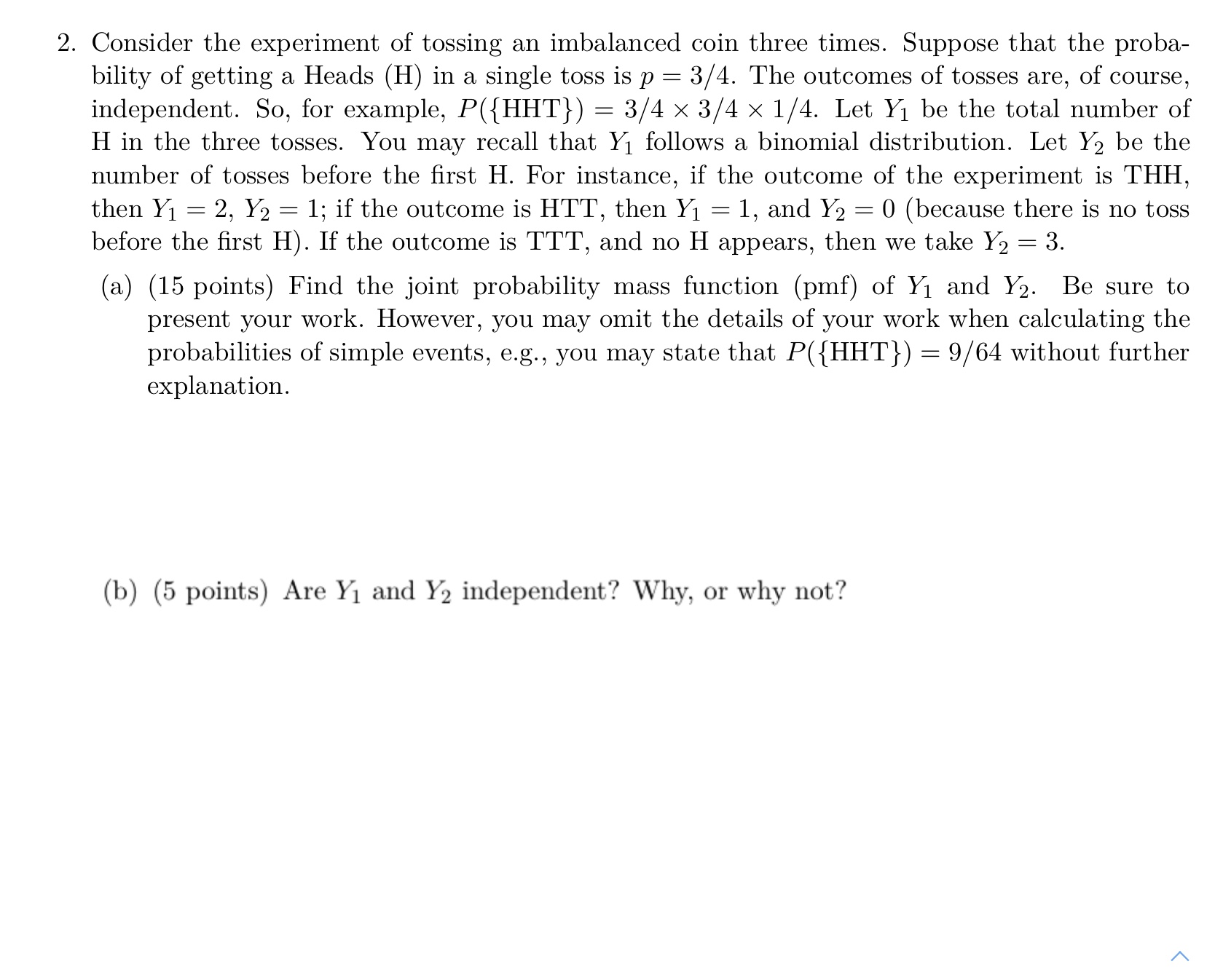
2. COnsider the experiment of tossing an imbalanced coin three times. Suppose that the proba bility of getting a Heads (H) in a single toss is p = 3/4. The outcomes of tosses are, of course, independent. So, for example, P({HHT}) = 3/4 x 3/4 x 1/4. Let Y1 be the total number of H in the three tosses. You may recall that Y1 follows a binomial distribution. Let Y2 be the number of tosses before the rst H. For instance, if the outcome of the experiment is THH, then Y1 = 2, Y2 = 1; if the outcome is HTT, then Y1 = 1, and Y2 = 0 (because there is no toss before the rst H). If the outcome is TTT, and no H appears, then we take Y2 = 3. (a) (15 points) Find the joint probability mass function (pmf) of Y1 and Y2. Be sure to present your work. However, you may omit the details of your work when calculating the probabilities of simple events, e.g., you may state that P({HHT}) = 9/64 without further explanation. (b) (5 points) Are Y1 and Y2 independent? Why, or why not
Step by Step Solution
There are 3 Steps involved in it

Get step-by-step solutions from verified subject matter experts
 Study Help