







Question: How does a web browser know the destination port to connect to reach a web server? (b) Explain in detail how TCP provides congestion control.
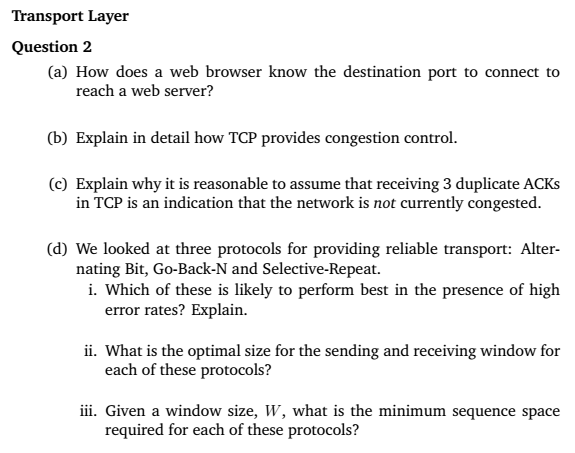
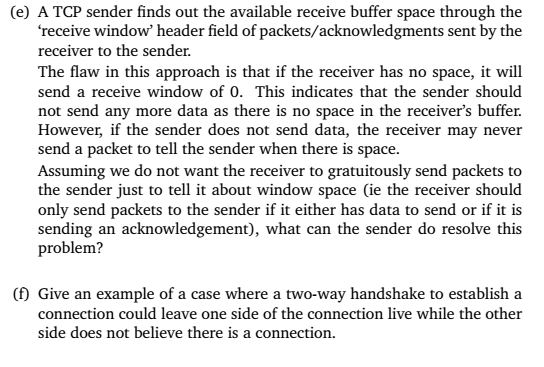
How does a web browser know the destination port to connect to reach a web server? (b) Explain in detail how TCP provides congestion control. (c) Explain why it is reasonable to assume that receiving 3 duplicate ACKs in TCP is an indication that the network is not currently congested. (d) We looked at three protocols for providing reliable transport: Alternating Bit, Go-Back-N and Selective-Repeat. i. Which of these is likely to perform best in the presence of high error rates? Explain. ii. What is the optimal size for the sending and receiving window for each of these protocols? iii. Given a window size, W, what is the minimum sequence space required for each of these protocols? (e) A TCP sender finds out the available receive buffer space through the 'receive window5 header field of packets/acknowledgments sent by the receiver to the sender. The flaw in this approach is that if the receiver has no space, it will send a receive window of 0. This indicates that the sender should not send any more data as there is no space in the receiver's buffer. However, if the sender does not send data, the receiver may never send a packet to tell the sender when there is space. Assuming we do not want the receiver to gratuitously send packets to the sender just to tell it about window space (ie the receiver should only send packets to the sender if it either has data to send or if it is sending an acknowledgement), what can the sender do resolve this problem? (f) Give an example of a case where a two-way handshake to establish a connection could leave one side of the connection live while the other side does not believe there is a connection
Step by Step Solution
There are 3 Steps involved in it

Get step-by-step solutions from verified subject matter experts
 Study Help