







Question: How does each productivity variables (labor, capital and management) apply in the article? What other current problems have encouraged the localization of supply chains? OM

How does each productivity variables (labor, capital and management) apply in the article?
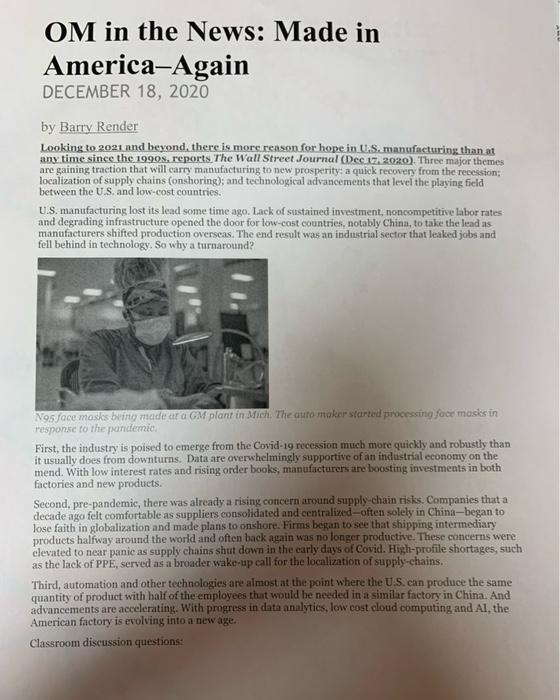
OM in the News: Made in America-Again DECEMBER 18, 2020 by Barry Render Looking to 2021 and beyond there is more reason for hope in U.S. manufacturing than at any time since the 1990s, reports. The Wall Street Journal (Dec 12. 2020). Three major themes are gaining traction that will carry manufacturing to new prosperity: a quick recovery from the recession; localization of supply chains (onshoring); and technological advancements that level the playing field between the US and low-cost countries. U.S. manufacturing lost its lead some time ago. Lack of sustained investment, noncompetitive labor rates and degrading infrastructure opened the door for low-cost countries, notably China, to take the lead as manufacturers shifted production overseas. The end result was an industrial sector that leaked jobs and fell behind in technology. So why a turnaround? N95 face mocks being made ara GM plant in Mich. The auto moker started processing face masks in response to the pandemic First, the industry is poised to emerge from the Covid-19 recession much more quickly and robustly than it usually does from downturns. Data are overwhelmingly supportive of an industrial economy on the mend. With low interest rates and rising order books, manufacturers are boosting investments in both factories and new products. Second, pre-pandemic, there was already a rising concern around supply chain risks. Companies that a decade ago felt comfortable as suppliers consolidated and centralized-often solely in China-began to lose faith in globalization and made plans to onshore. Firms began to see that shipping intermediary products halfway around the world and often back again was no longer productive. These concerns were elevated to near panic as supply chains shut down in the early days of Covid. High-profile shortages, such as the lack of PPE, served as a broader wake-up call for the localization of supply-chains. Third, automation and other technologies are almost at the point where the U.S. can produce the same quantity of product with half of the employees that would be needed in a similar factory in China. And advancements are accelerating. With progress in data analytics, low cost cloud computing and Al the American factory is evolving into a new age. Classroom discussion questions: 1. Chapter in your Heizer/Render/Munson Om text describes 3 productivity variables. How does each apply in this article? 2. What other current problems have encouraged the localization of supply chains
What other current problems have encouraged the localization of supply chains?
Step by Step Solution
There are 3 Steps involved in it
1 Expert Approved Answer
Step: 1 Unlock

Question Has Been Solved by an Expert!
Get step-by-step solutions from verified subject matter experts
Step: 2 Unlock
Step: 3 Unlock
 Study Help