







Question: How does the general equation theta = Acoshmx + Bsinhmx end up as the particular solution shown as 17-36? (As in working) Fundamentals of momentum,
How does the general equation theta = Acoshmx + Bsinhmx end up as the particular solution shown as 17-36? (As in working)
Fundamentals of momentum, heat and mass transfer, chapter 17
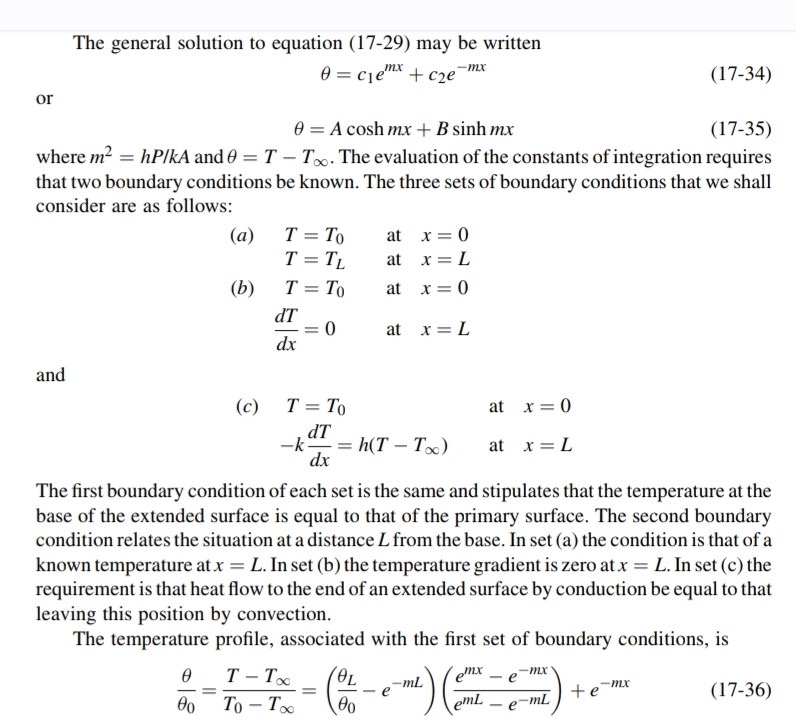
The general solution to equation (17-29) may be written =c1emx+c2emx or =Acoshmx+Bsinhmx where m2=hP/kA and =TT. The evaluation of the constants of integration requires that two boundary conditions be known. The three sets of boundary conditions that we shall consider are as follows: (a) T=T0 at x=0 T=TL at x=L (b) T=T0 at x=0 dxdT=0 at x=L and (c) T=T0kdxdT=h(TT)atatx=0x=L The first boundary condition of each set is the same and stipulates that the temperature at the base of the extended surface is equal to that of the primary surface. The second boundary condition relates the situation at a distance L from the base. In set (a) the condition is that of a known temperature at x=L. In set (b) the temperature gradient is zero at x=L. In set (c) the requirement is that heat flow to the end of an extended surface by conduction be equal to that leaving this position by convection. The temperature profile, associated with the first set of boundary conditions, is 0=T0TTT=(0LemL)(emLemLemxemx)+emx
Step by Step Solution
There are 3 Steps involved in it

Get step-by-step solutions from verified subject matter experts
 Study Help