







Question: How does the reading relate to new product development? Be creative if necessary. Do you disagree with the analysis or is there a piece missing?
- How does the reading relate to new product development? Be creative if necessary.
- Do you disagree with the analysis or is there a piece missing?
- Is there a part you didn't understand?
- Did the reading change your thinking? How?
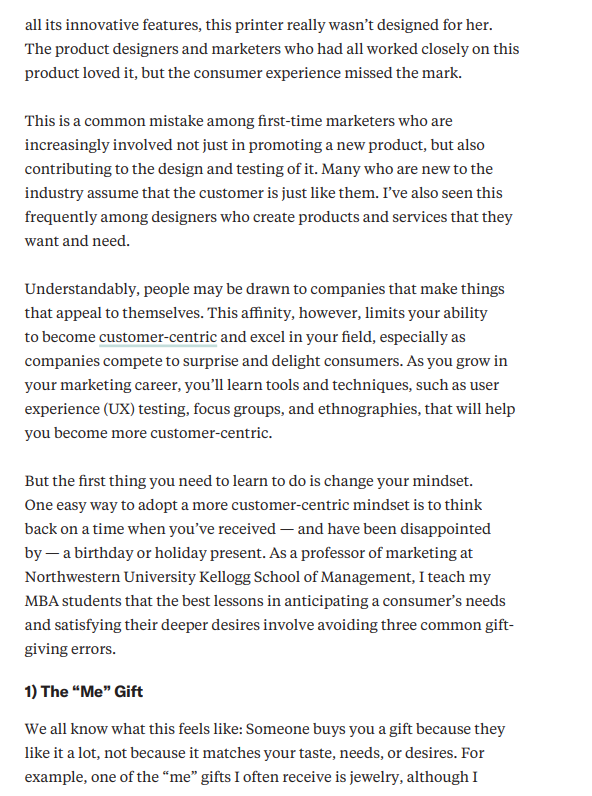
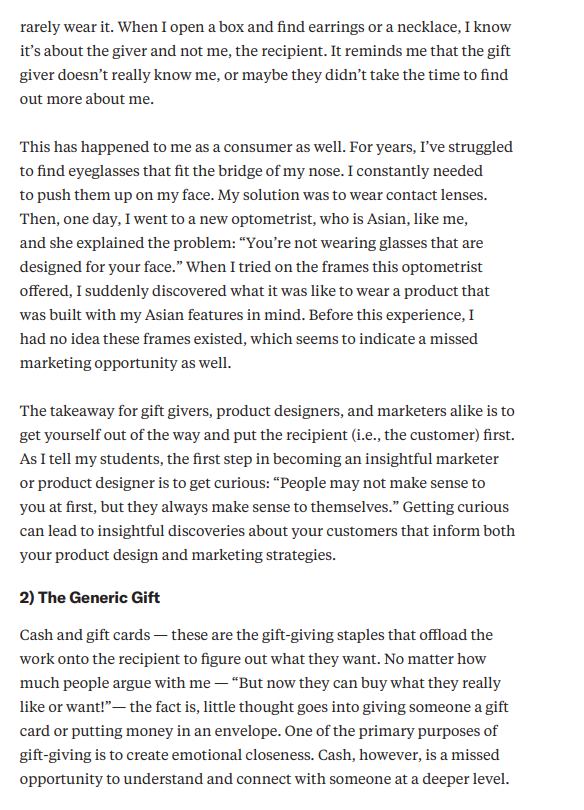
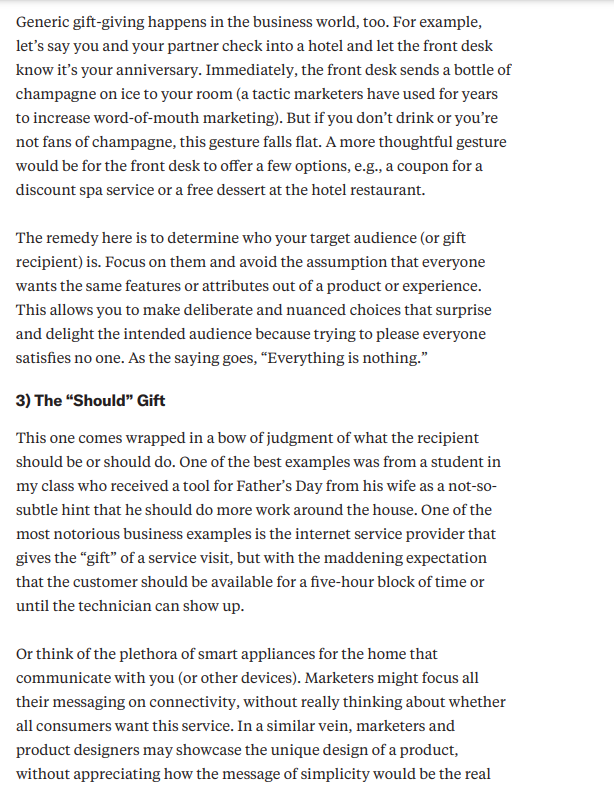
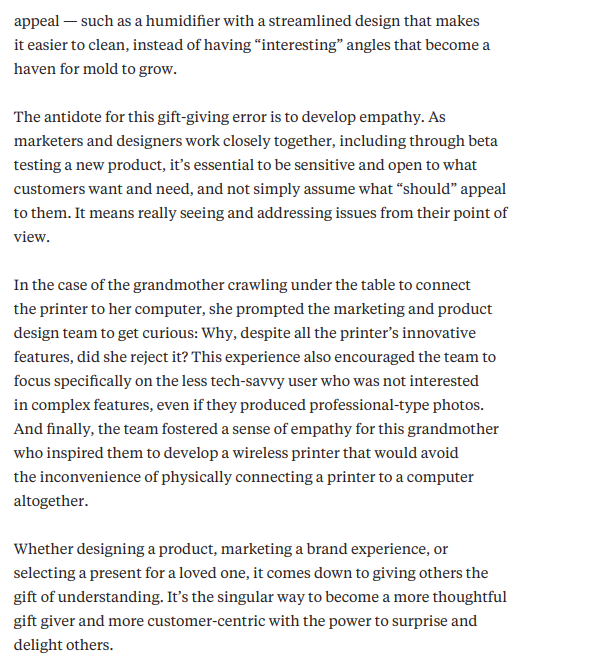
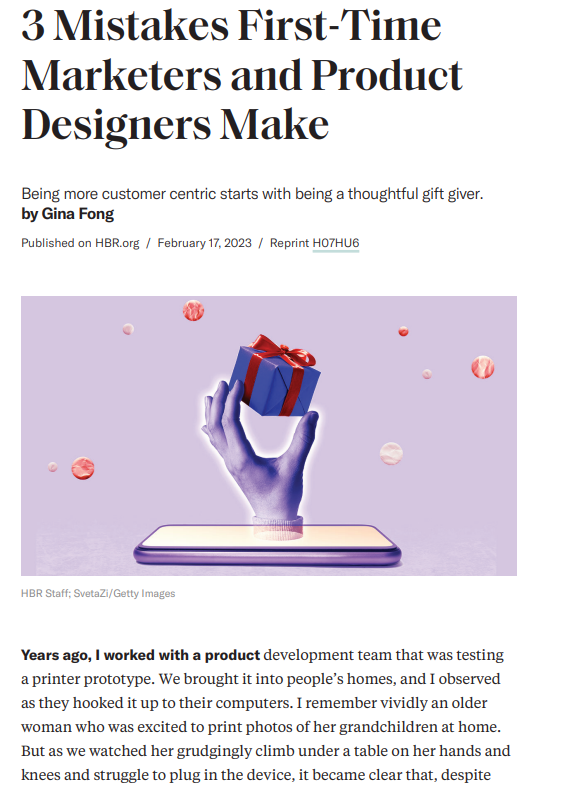
all its innovative features, this printer really wasn't designed for her. The product designers and marketers who had all worked closely on this product loved it, but the consumer experience missed the mark. This is a common mistake among first-time marketers who are increasingly involved not just in promoting a new product, but also contributing to the design and testing of it. Many who are new to the industry assume that the customer is just like them. I've also seen this frequently among designers who create products and services that they want and need. Understandably, people may be drawn to companies that make things that appeal to themselves. This affinity, however, limits your ability to become customer-centric and excel in your field, especially as companies compete to surprise and delight consumers. As you grow in your marketing career, you''ll learn tools and techniques, such as user experience (UX) testing, focus groups, and ethnographies, that will help you become more customer-centric. But the first thing vou need to learn to do is change your mindset. One easy way to adopt a more customer-centric mindset is to think back on a time when you've received and have been disappointed by a birthday or holiday present. As a professor of marketing at Northwestern University Kellogg School of Management, I teach my MBA students that the best lessons in anticipating a consumer's needs and satisfying their deeper desires involve avoiding three common gift- giving errors. 1) The \"Me\" Gift We all know what this feels like: Someone buys vou a gift because they like it a lot, not because it matches your taste, needs, or desires. For example, one of the "me\" gifts I often receive is jewelry, although I rarely wear it. When I open a box and find earrings or a necklace, I know it's about the giver and not me, the recipient. It reminds me that the gift giver doesn't really know me, or maybe they didn't take the time to find out more about me. This has happened to me as a consumer as well. For years, I've struggled to find eyeglasses that fit the bridge of my nose. [ constantly needed to push them up on my face. My solution was to wear contact lenses. Then, one day, I went to a new optometrist, who is Asian, like me, and she explained the problem: \"You're not wearing glasses that are designed for your face.\" When I tried on the frames this optometrist offered, I suddenly discovered what it was like to wear a product that was built with my Asian features in mind. Before this experience, I had no idea these frames existed, which seems to indicate a missed marketing opportunity as well. The takeaway for gift givers, product designers, and marketers alike is to get yourself out of the way and put the recipient (i.e., the customer) first. As [ tell my students, the first step in becoming an insightful marketer or product designer is to get curious: \"People may not make sense to you at first, but they always make sense to themselves.\" Getting curious can lead to insightful discoveries about your customers that inform both your product design and marketing strategies. 2) The Generic Gift Cash and gift cards these are the gift-giving staples that offload the work onto the recipient to figure out what they want. No matter how much people argue with me \"But now they can buy what they really like or want!\" the fact is, little thought goes into giving someone a gift card or putting money in an envelope. One of the primary purposes of gift-giving is to create emotional closeness. Cash, however, is a missed opportunity to understand and connect with someone at a deeper level. Generic gift-giving happens in the business world, too. For example, let's say you and your partner check into a hotel and let the front desk know it's your anniversary. Immediately, the front desk sends a bottle of champagne on ice to your room (a tactic marketers have used for years to increase word-of-mouth marketing). But if you don't drink or you're not fans of champagne, this gesture falls flat. A more thoughtful gesture would be for the front desk to offer a few options, e.g., a coupon for a discount spa service or a free dessert at the hotel restaurant. The remedy here is to determine who your target audience (or gift recipient) is. Focus on them and avoid the assumption that everyone wants the same features or attributes out of a product or experience. This allows you to make deliberate and nuanced choices that surprise and delight the intended audience because trying to please everyone satisfies no one. As the saying goes, \"Everything is nothing.\" 3) The \"Should\" Gift This one comes wrapped in a bow of judgment of what the recipient should be or should do. One of the best examples was from a student in my class who received a tool for Father's Day from his wife as a not-so- subtle hint that he should do more work around the house. One of the most notorious business examples is the internet service provider that gives the "gift\" of a service visit, but with the maddening expectation that the customer should be available for a five-hour block of time or until the technician can show up. Or think of the plethora of smart appliances for the home that communicate with you (or other devices). Marketers might focus all their messaging on connectivity, without really thinking about whether all consumers want this service. In a similar vein, marketers and product designers may showcase the unique design of a product, without appreciating how the message of simplicity would be the real appeal such as a humidifier with a streamlined design that makes it easier to clean, instead of having \"interesting\" angles that become a haven for mold to grow. The antidote for this gift-giving error is to develop empathy. As marketers and designers work closely together, including through beta testing a new product, it's essential to be sensitive and open to what customers want and need, and not simply assume what \"should\" appeal to them. It means really seeing and addressing issues from their point of view. In the case of the grandmother crawling under the table to connect the printer to her computer, she prompted the marketing and product design team to get curious: Why, despite all the printer's innovative features, did she reject it? This experience also encouraged the team to focus specifically on the less tech-savvy user who was not interested in complex features, even if they produced professional-type photos. And finally, the team fostered a sense of empathy for this grandmother who inspired them to develop a wireless printer that would avoid the inconvenience of physically connecting a printer to a computer altogether. Whether designing a product, marketing a brand experience, or selecting a present for a loved one, it comes down to giving others the gift of understanding. It's the singular way to become a more thoughtful gift giver and more customer-centric with the power to surprise and delight others. Gina Fong is a Clinical Assistant Professor of Marketing at The Kellogg School of Management at Northwestern Universityand a consumer anthropologist at Fong Insight. She coaches teams to understand the insight into their customers to build cherished brands and transforms the classroom into a curiosity gymnasium to inspire her students to think with their head, heart, and gut. 3 Mistakes First-Time Marketers and Product Designers Make Being more customer centric starts with being a thoughtful gift giver. by Gina Fong Published on HBR.org [ February 17, 2023 [/ Reprint HOTHUS
Step by Step Solution
There are 3 Steps involved in it

Get step-by-step solutions from verified subject matter experts
 Study Help