



Question: How IKEA Innovates - Inside IKEA'S Digital Transformation IKEA was founded in Sweden in 1943; IKEA is a Swedish company that designs and sells ready-to
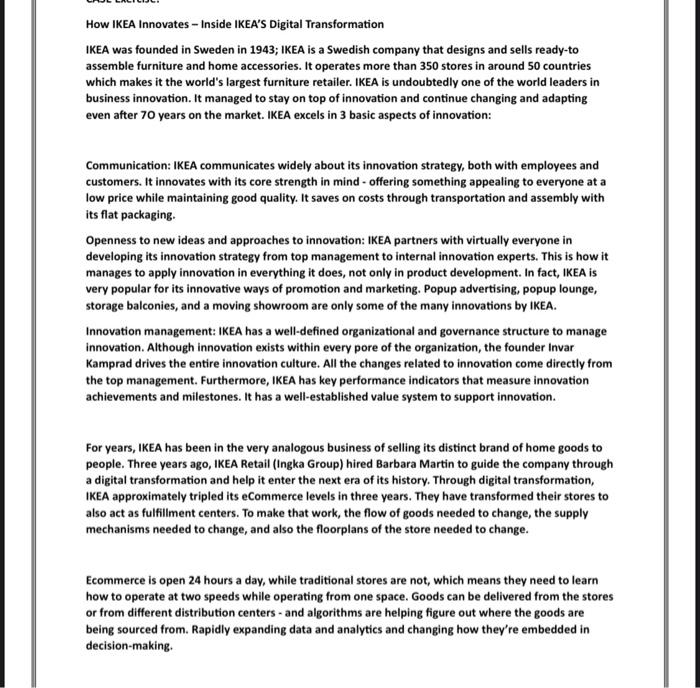
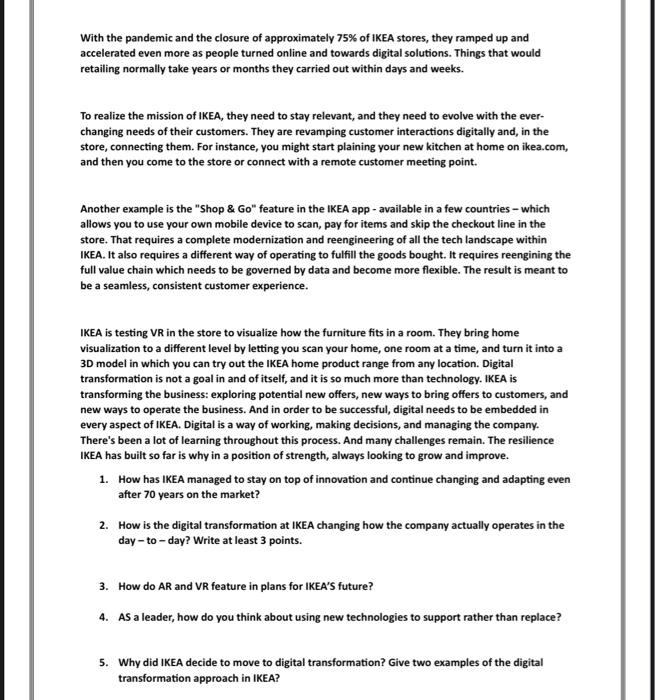
How IKEA Innovates - Inside IKEA'S Digital Transformation IKEA was founded in Sweden in 1943; IKEA is a Swedish company that designs and sells ready-to assemble furniture and home accessories. It operates more than 350 stores in around 50 countries which makes it the world's largest furniture retailer. IKEA is undoubtedly one of the world leaders in business innovation. It managed to stay on top of innovation and continue changing and adapting even after 70 years on the market. IKEA excels in 3 basic aspects of innovation: Communication: IKEA communicates widely about its innovation strategy, both with employees and customers. It innovates with its core strength in mind - offering something appealing to everyone at a low price while maintaining good quality. It saves on costs through transportation and assembly with its flat packaging. Openness to new ideas and approaches to innovation: IKEA partners with virtually everyone in developing its innovation strategy from top management to internal innovation experts. This is how it manages to apply innovation in everything it does, not only in product development. In fact, IKEA is very popular for its innovative ways of promotion and marketing. Popup advertising, popup lounge, storage balconies, and a moving showroom are only some of the many innovations by IKEA. Innovation management: IKEA has a well-defined organizational and governance structure to manage innovation. Although innovation exists within every pore of the organization, the founder Invar Kamprad drives the entire innovation culture. All the changes related to innovation come directly from the top management. Furthermore, IKEA has key performance indicators that measure innovation achievements and milestones. It has a well-established value system to support innovation. For years, IKEA has been in the very analogous business of selling its distinct brand of home goods to people. Three years ago, IKEA Retail (Ingka Group) hired Barbara Martin to guide the company through a digital transformation and help it enter the next era of its history. Through digital transformation, IKEA approximately tripled its eCommerce levels in three years. They have transformed their stores to also act as fulfillment centers. To make that work, the flow of goods needed to change, the supply mechanisms needed to change, and also the floorplans of the store needed to change. Ecommerce is open 24 hours a day, while traditional stores are not, which means they need to learn how to operate at two speeds while operating from one space. Goods can be delivered from the stores or from different distribution centers - and algorithms are helping figure out where the goods are being sourced from. Rapidly expanding data and analytics and changing how they're embedded in decision-making. With the pandemic and the closure of approximately 75% of IKEA stores, they ramped up and accelerated even more as people turned online and towards digital solutions. Things that would retailing normally take years or months they carried out within days and weeks. To realize the mission of IKEA, they need to stay relevant, and they need to evolve with the everchanging needs of their customers. They are revamping customer interactions digitally and, in the store, connecting them. For instance, you might start plaining your new kitchen at home on ikea.com, and then you come to the store or connect with a remote customer meeting point. Another example is the "Shop 8 Go" feature in the IKEA app-available in a few countries - which aliows you to use your own mobile device to scan, pay for items and skip the checkout line in the store. That requires a complete modernization and reengineering of all the tech landscape within IKEA. It also requires a different way of operating to fulfill the goods bought. It requires reengining the full value chain which needs to be governed by data and become more flexible. The result is meant to be a seamless, consistent customer experience. IKEA is testing VR in the store to visualize how the furniture fits in a room. They bring home visualization to a different level by letting you scan your home, one room at a time, and turn it into a 3D model in which you can try out the IKEA home product range from any location. Digital transformation is not a goal in and of itself, and it is so much more than technology. IKEA is transforming the business: exploring potential new offers, new ways to bring offers to customers, and new ways to operate the business. And in order to be successful, digital needs to be embedded in every aspect of IKEA. Digital is a way of working, making decisions, and managing the company. There's been a lot of learning throughout this process. And many challenges remain. The resilience IKEA has built so far is why in a position of strength, always looking to grow and improve. 1. How has IKEA managed to stay on top of innovation and continue changing and adapting even after 70 years on the market? 2. How is the digital transformation at IKEA changing how the company actually operates in the day - to - day? Write at least 3 points. 3. How do AR and VR feature in plans for IKEA'S future? 4. AS a leader, how do you think about using new technologies to support rather than replace? 5. Why did IKEA decide to move to digital transformation? Give two examples of the digital transformation approach in IKEA
Step by Step Solution
There are 3 Steps involved in it

Get step-by-step solutions from verified subject matter experts