







Question: How long is the inversion group? Which locus or loci does the inversion loop include F2 Progeny Class Gamete from Trihybrid AB B+C Recombinant or
How long is the inversion group? Which locus or loci does the inversion loop include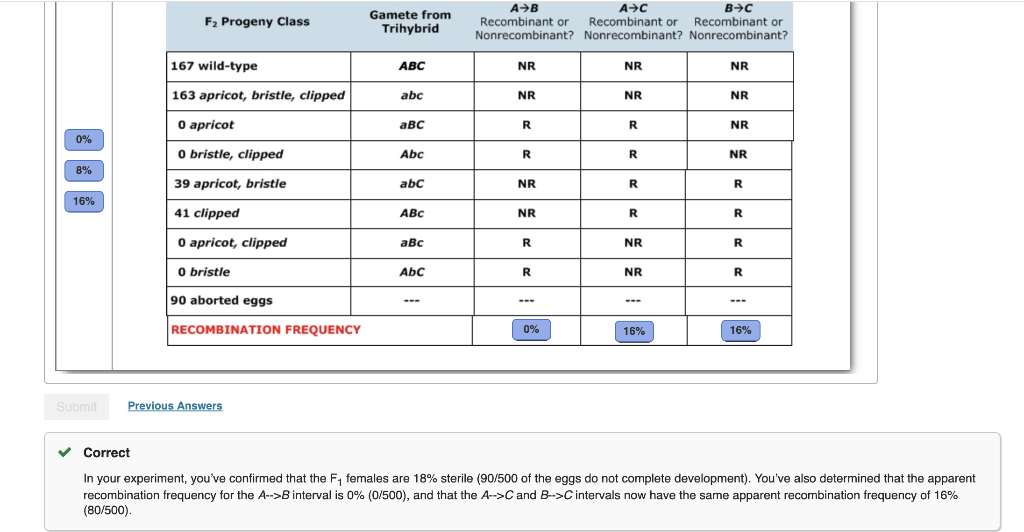
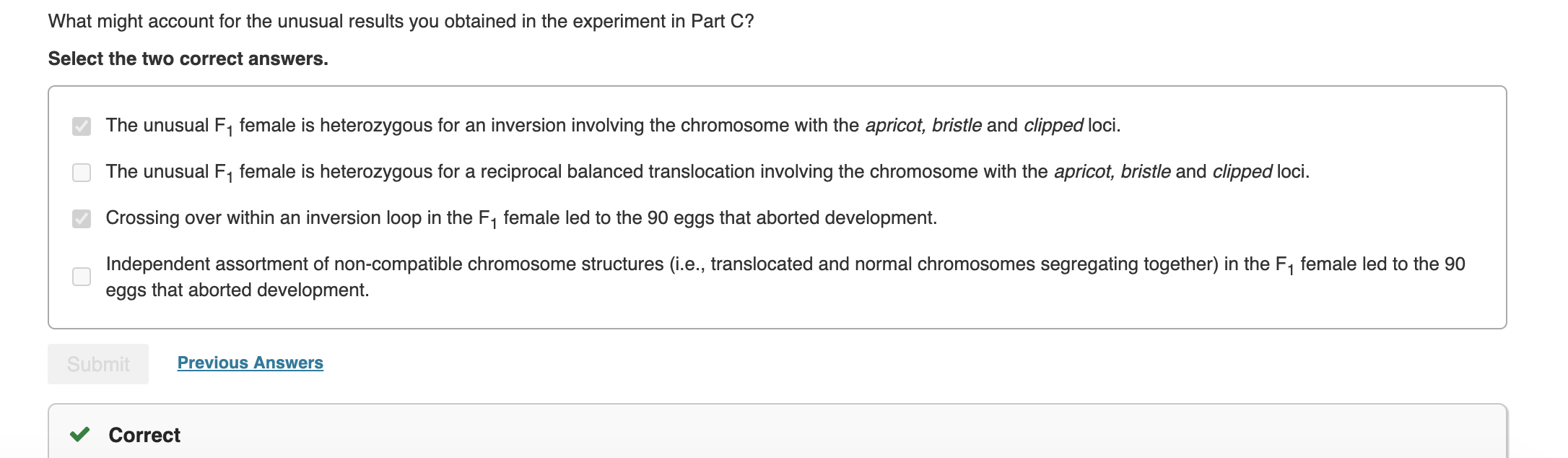
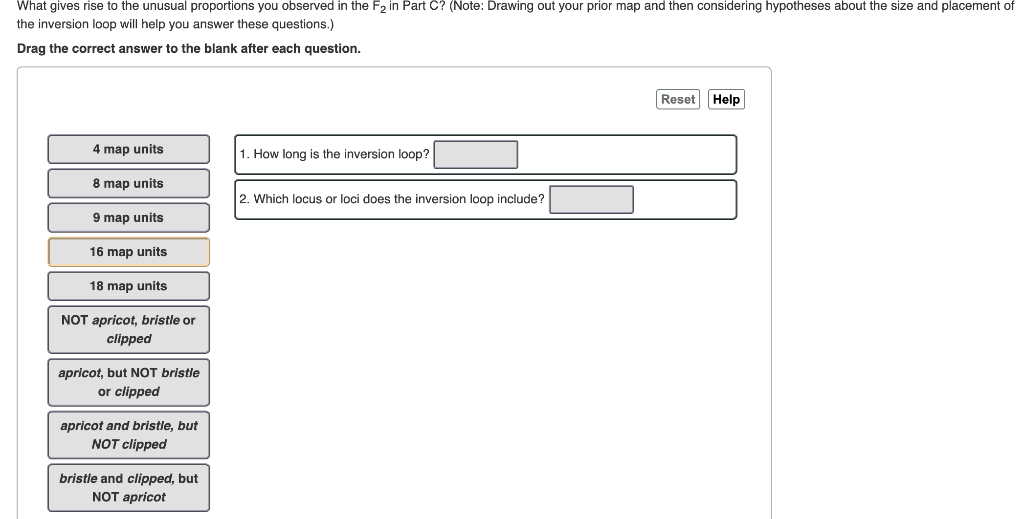
F2 Progeny Class Gamete from Trihybrid AB B+C Recombinant or Recombinant or Recombinant or Nonrecombinant? Nonrecombinant? Nonrecombinant? 167 wild-type ABC NR NR NR 163 apricot, bristle, clipped abc NR NR NR O apricot R R NR 0% O bristle, clipped Abc R R NR 8% 39 apricot, bristle abc NR R R R 16% 41 clipped ABC NR R R 0 apricot, clipped R NR R O bristle Abc R NR R 90 aborted eggs RECOMBINATION FREQUENCY 0% 16% 16% Submit Previous Answers Correct In your experiment, you've confirmed that the F, females are 18% sterile (90/500 of the eggs do not complete development). You've also determined that the apparent recombination frequency for the A-->B interval is 0% (0/500), and that the A-->C and B-->Cintervals now have the same apparent recombination frequency of 16% (80/500) What might account for the unusual results you obtained in the experiment in Part C? Select the two correct answers. The unusual Fy female is heterozygous for an inversion involving the chromosome with the apricot, bristle and clipped loci. The unusual F1 female is heterozygous for a reciprocal balanced translocation involving the chromosome with the apricot, bristle and clipped loci. Crossing over within an inversion loop in the F1 female led to the 90 eggs that aborted development. Independent assortment of non-compatible chromosome structures (i.e., translocated and normal chromosomes segregating together) in the F1 female led to the 90 eggs that aborted development. Submit Previous Answers Correct What gives rise to the unusual proportions you observed in the F2 in Part C? (Note: Drawing out your prior map and then considering hypotheses about the size and placement of the inversion loop will help you answer these questions.) Drag the correct answer to the blank after each question. Reset Help 4 map units 1. How long is the inversion loop? 8 map units 2. Which locus or loci does the inversion loop include? 9 map units 16 map units 18 map units NOT apricot, bristle or clipped apricot, but NOT bristle or clipped apricot and bristle, but NOT clipped bristle and clipped, but NOT apricot F2 Progeny Class Gamete from Trihybrid AB B+C Recombinant or Recombinant or Recombinant or Nonrecombinant? Nonrecombinant? Nonrecombinant? 167 wild-type ABC NR NR NR 163 apricot, bristle, clipped abc NR NR NR O apricot R R NR 0% O bristle, clipped Abc R R NR 8% 39 apricot, bristle abc NR R R R 16% 41 clipped ABC NR R R 0 apricot, clipped R NR R O bristle Abc R NR R 90 aborted eggs RECOMBINATION FREQUENCY 0% 16% 16% Submit Previous Answers Correct In your experiment, you've confirmed that the F, females are 18% sterile (90/500 of the eggs do not complete development). You've also determined that the apparent recombination frequency for the A-->B interval is 0% (0/500), and that the A-->C and B-->Cintervals now have the same apparent recombination frequency of 16% (80/500) What might account for the unusual results you obtained in the experiment in Part C? Select the two correct answers. The unusual Fy female is heterozygous for an inversion involving the chromosome with the apricot, bristle and clipped loci. The unusual F1 female is heterozygous for a reciprocal balanced translocation involving the chromosome with the apricot, bristle and clipped loci. Crossing over within an inversion loop in the F1 female led to the 90 eggs that aborted development. Independent assortment of non-compatible chromosome structures (i.e., translocated and normal chromosomes segregating together) in the F1 female led to the 90 eggs that aborted development. Submit Previous Answers Correct What gives rise to the unusual proportions you observed in the F2 in Part C? (Note: Drawing out your prior map and then considering hypotheses about the size and placement of the inversion loop will help you answer these questions.) Drag the correct answer to the blank after each question. Reset Help 4 map units 1. How long is the inversion loop? 8 map units 2. Which locus or loci does the inversion loop include? 9 map units 16 map units 18 map units NOT apricot, bristle or clipped apricot, but NOT bristle or clipped apricot and bristle, but NOT clipped bristle and clipped, but NOT apricot
Step by Step Solution
There are 3 Steps involved in it

Get step-by-step solutions from verified subject matter experts
 Study Help