Question: How many balancing mounts should be made each month ensuring demand is met and costs are optimized within the constraints described in the case? Under
How many balancing mounts should be made each month ensuring demand is met and costs are optimized within the constraints described in the case?
Under the new production plan, how many employees should be hired, and in what areas should they work?
What are the total component parts and finished mount inventory carrying costs in the new plan?
What is the standard cost of an assembled balancing amount according to the new plan?
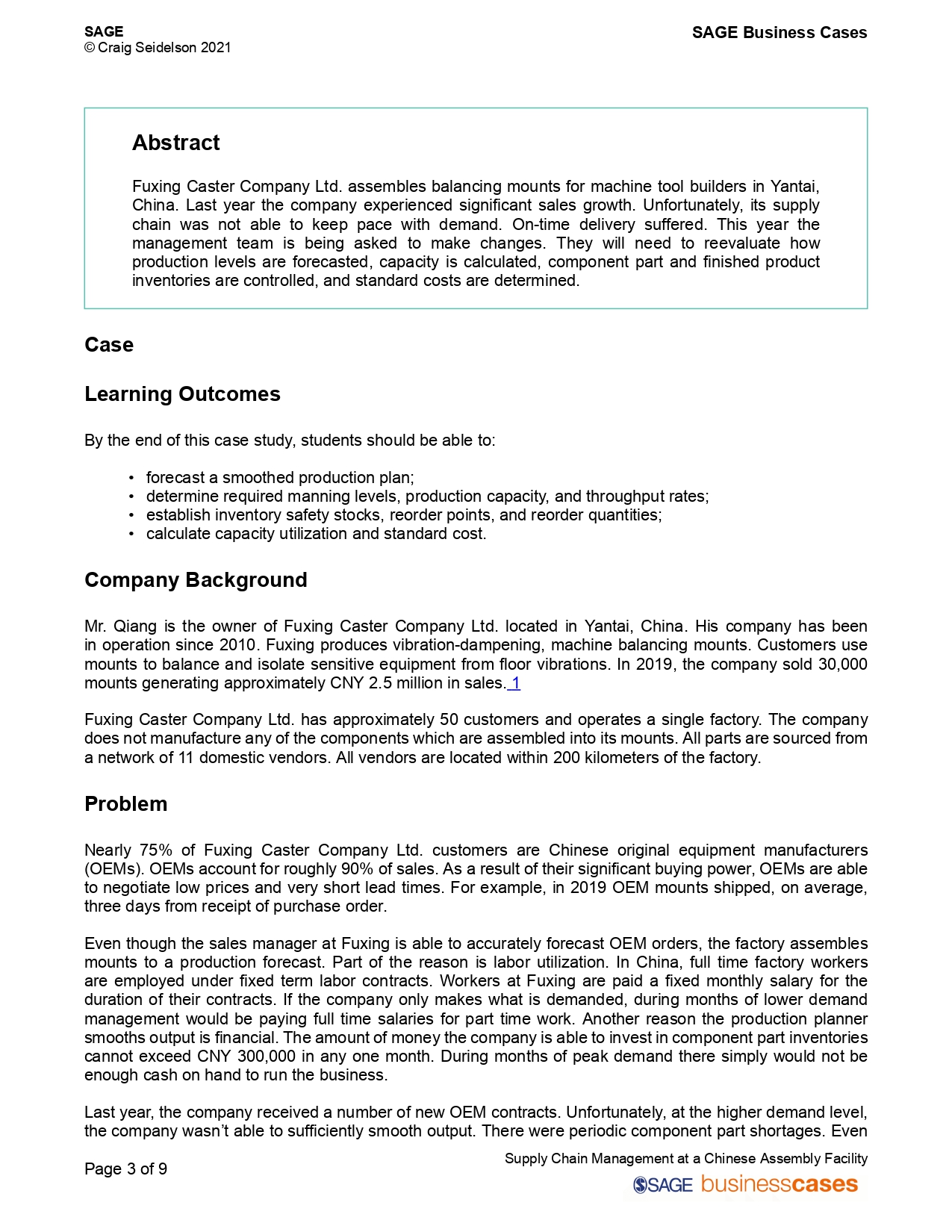
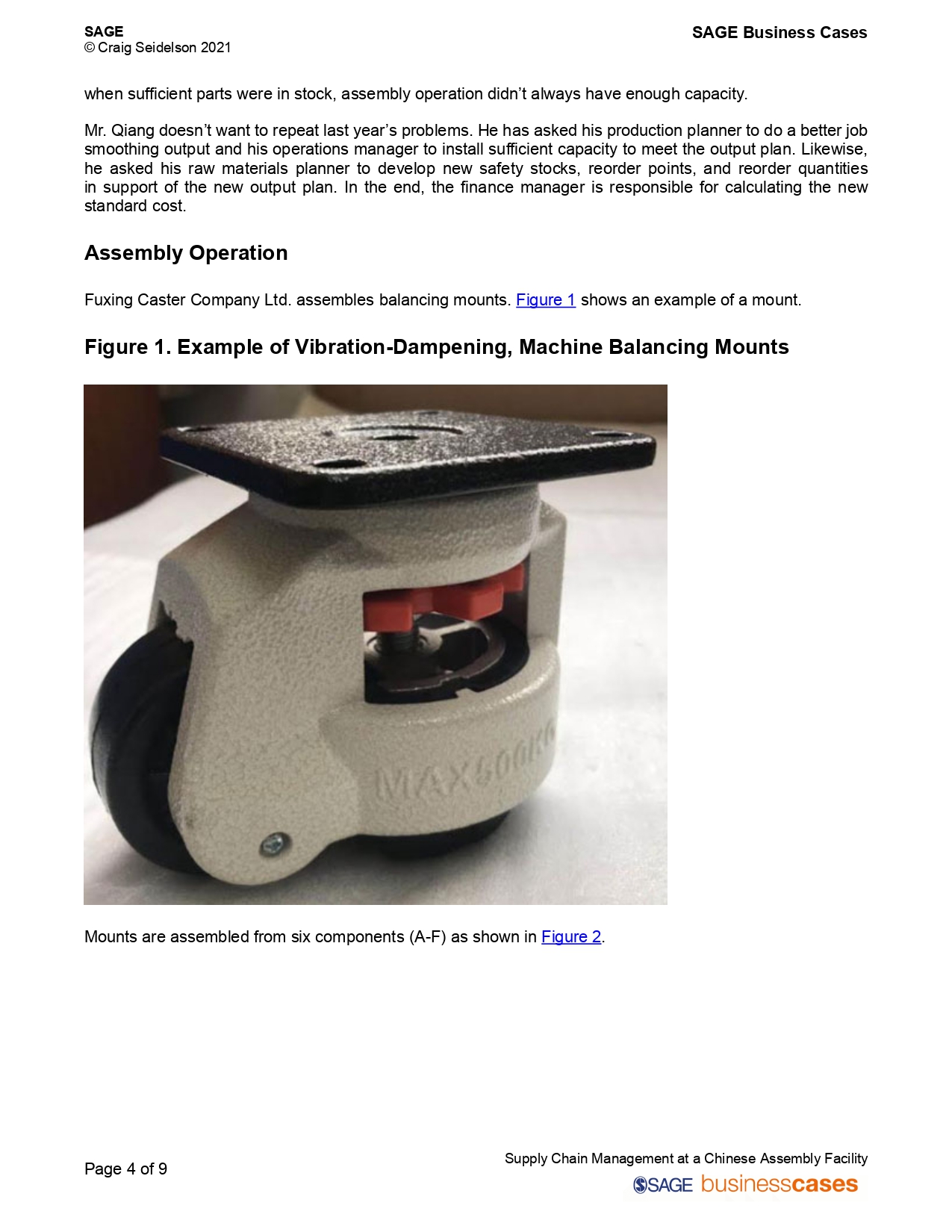
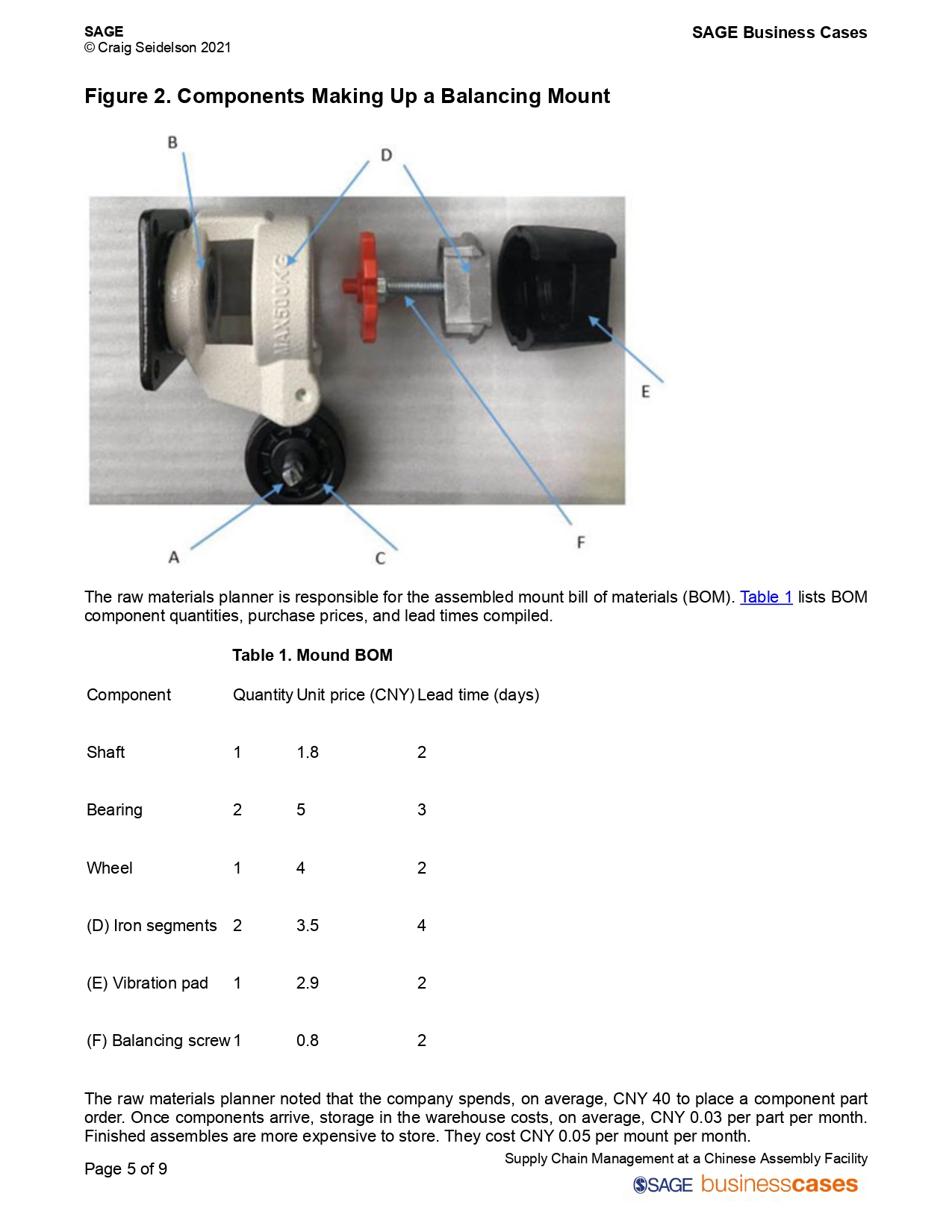
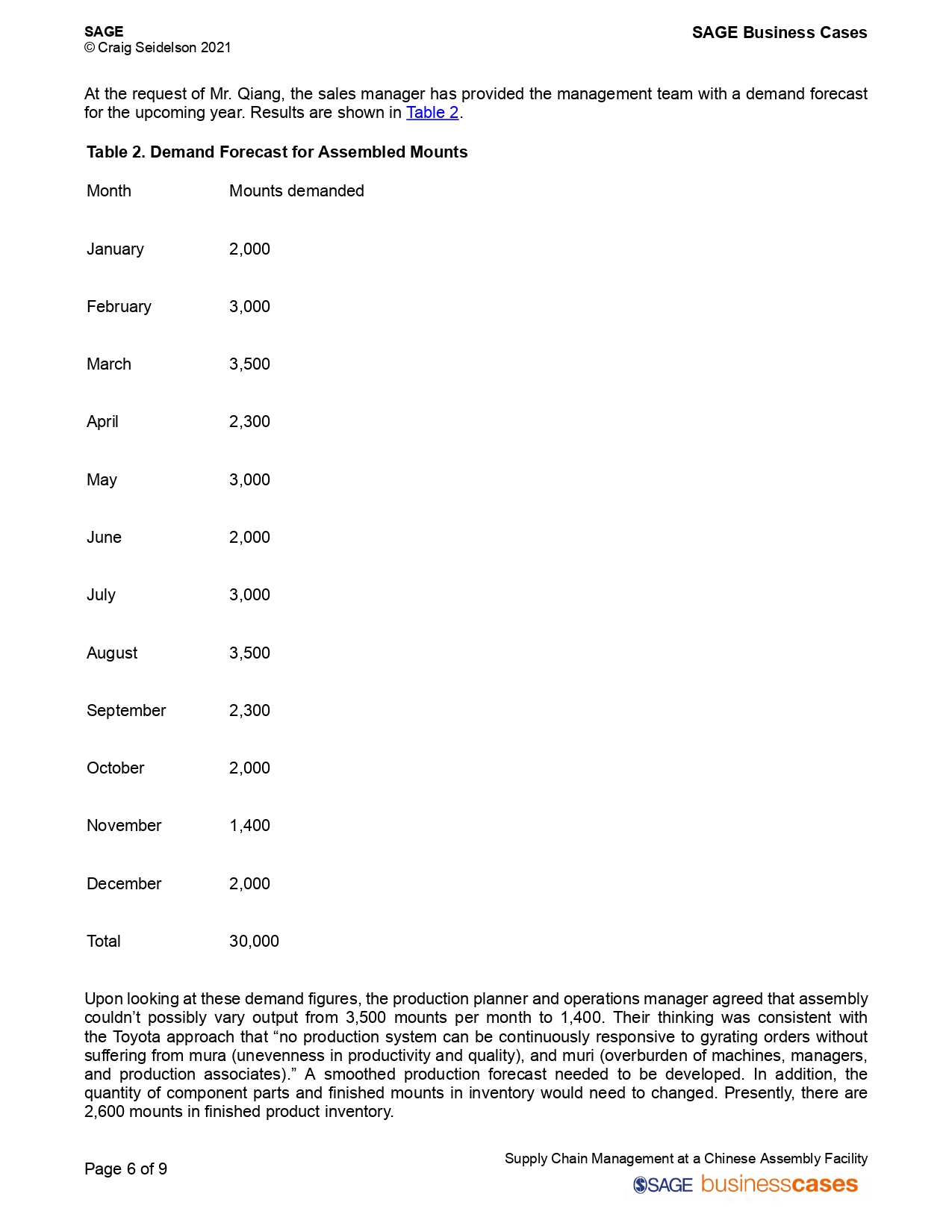
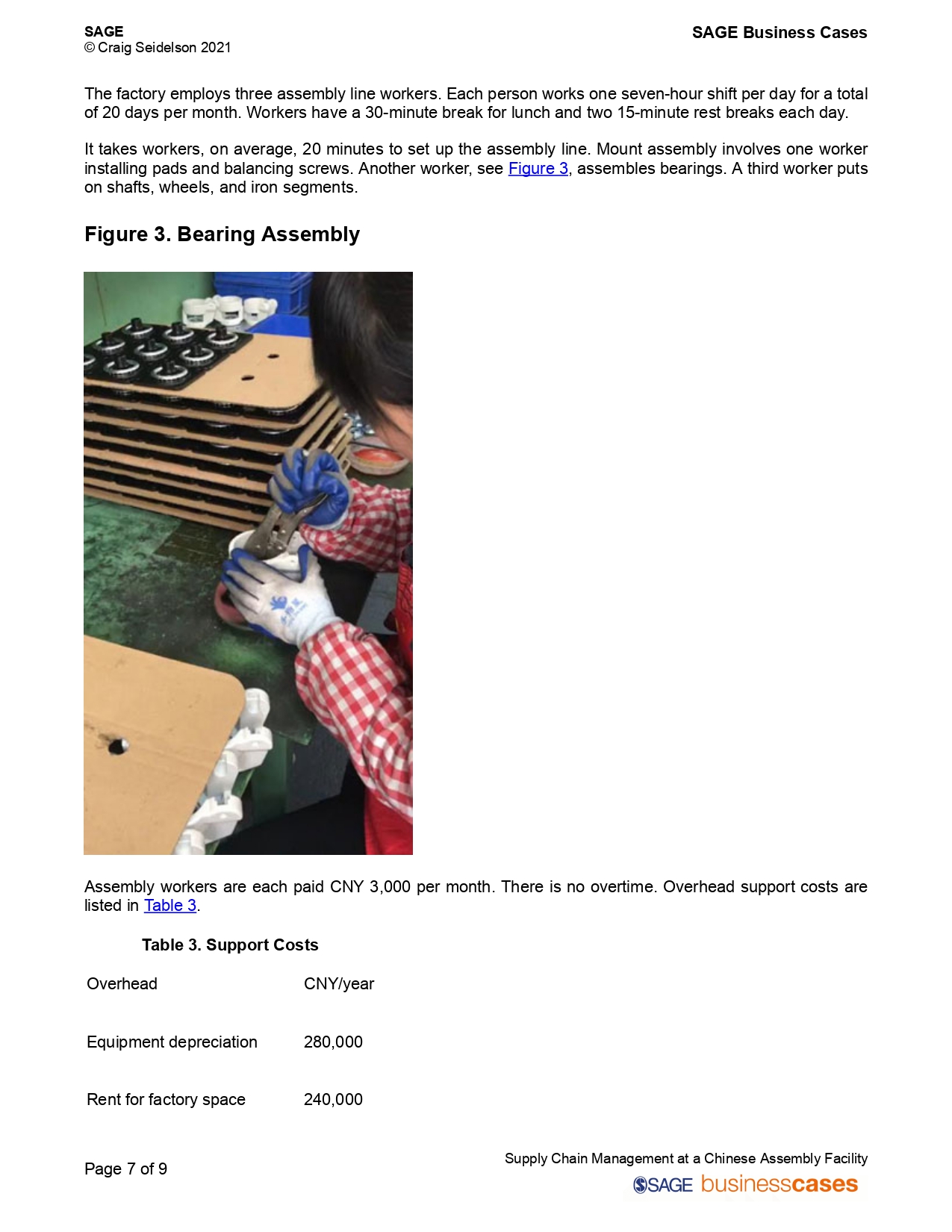
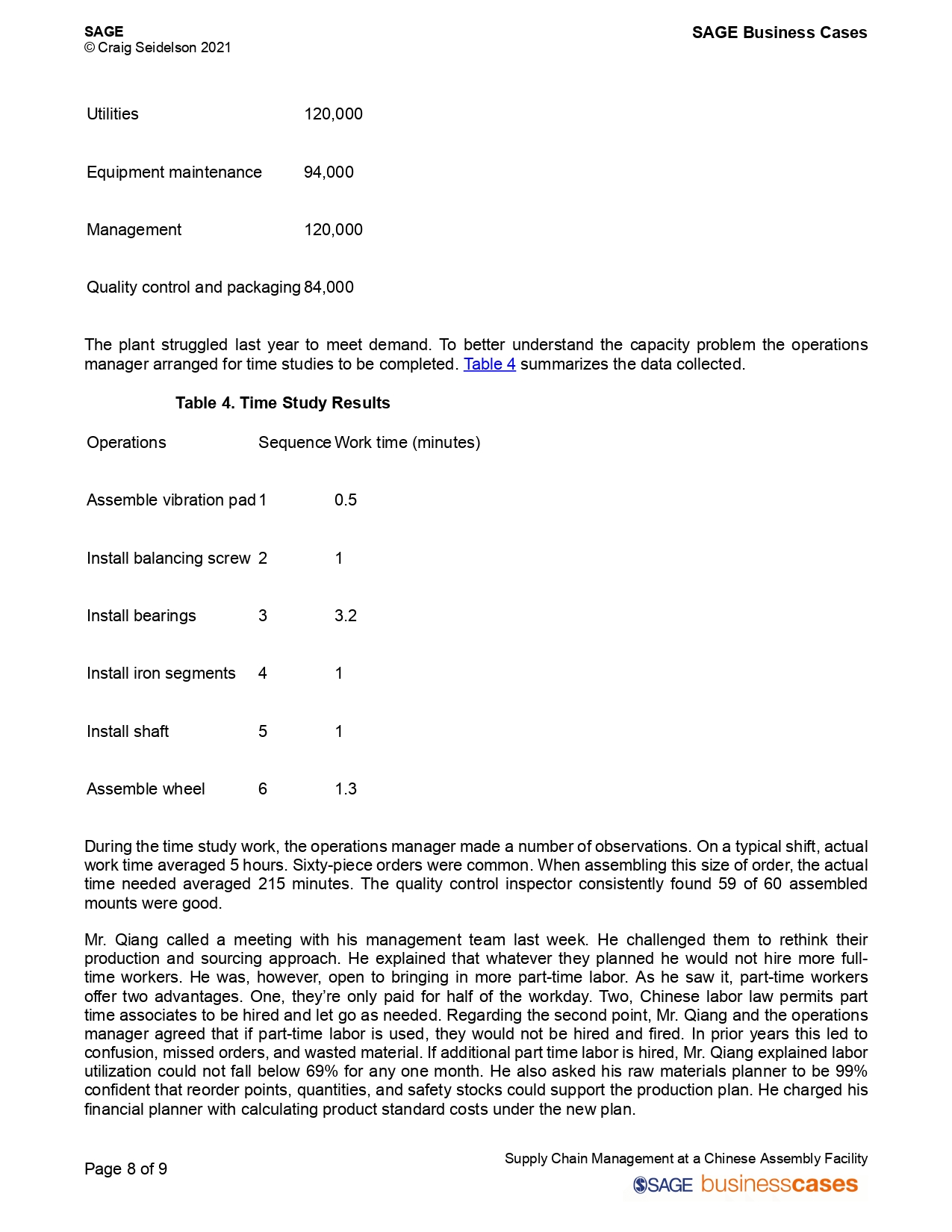
SAGE SAGE Business Cases Craig Seidelson 2021 Abstract Fuxing Caster Company Ltd. assembles balancing mounts for machine tool builders in Yantai, China. Last year the company experienced signicant sales growth. Unfortunately, its supply chain was not able to keep pace with demand. Ontime delivery suffered. This year the management team is being asked to make changes. They will need to reevaluate how production levels are forecasted, capacity is calculated, component part and nished product inventories are controlled, and standard costs are determined. Case Learning Outcomes By the end of this case study, students should be able to: - forecast a smoothed production plan; - determine required manning levels, production capacity, and throughput rates; - establish inventory safety stocks, reorder points, and reorder quantities; - calculate capacity utilization and standard cost. Company Background Mr. Qiang is the owner of Fuxing Caster Company Ltd. located in Yantai, China. His company has been in operation since 2010. Fuxing produces vibration-dampening, machine balancing mounts. Customers use mounts to balance and isolate sensitive equipment from oor vibrations. In 2019, the company sold 30,000 mounts generating approximately CNY 2.5 million in sales. _1 Fuxing Caster Company Ltd. has approximately 50 customers and operates a single factory. The company does not manufacture any of the components which are assembled into its mounts. All parts are sourced from a network of 11 domestic vendors. All vendors are located within 200 kilometers of the factory. Problem Nearly 75% of Fuxing Caster Company Ltd. customers are Chinese original equipment manufacturers (OEMs). OEMs account for roughly 90% of sales. As a result of their signicant buying power, OEMs are able to negotiate low prices and very short lead times. For example, in 2019 OEM mounts shipped, on average, three days from receipt of purchase order. Even though the sales manager at Fuxing is able to accurately forecast OEM orders, the factory assembles mounts to a production forecast. Part of the reason is labor utilization. In China, full time factory workers are employed under xed term labor contracts. Workers at Fuxing are paid a xed monthly salary for the duration of their contracts. If the company only makes what is demanded, during months of lower demand management would be paying full time salaries for part time work. Another reason the production planner smooths output is nancial. The amount of money the company is able to invest in component part inventories cannot exceed CNY 300,000 in any one month. During months of peak demand there simply would not be enough cash on hand to run the business. Last year, the company received a number of new DEM contracts. Unfortunately, at the higher demand level, the company wasn't able to sufciently smooth output. There were periodic component part shortages. Even Supply Chain Management at a Chinese Assembly Facility Page 3 of9 . SAGE busmesscases SAGE SAGE Business Cases @ Craig Seidelson 2021 when sufficient parts were in stock, assembly operation didn't always have enough capacity. Mr. Qiang doesn't want to repeat last year's problems. He has asked his production planner to do a better job smoothing output and his operations manager to install sufficient capacity to meet the output plan. Likewise, he asked his raw materials planner to develop new safety stocks, reorder points, and reorder quantities in support of the new output plan. In the end, the finance manager is responsible for calculating the new standard cost. Assembly Operation Fuxing Caster Company Lid. assembles balancing mounts. Figure 1 shows an example of a mount. Figure 1. Example of Vibration-Dampening, Machine Balancing Mounts MAXGOGH Mounts are assembled from six components (A-F) as shown in Figure 2. Page 4 of 9 Supply Chain Management at a Chinese Assembly Facility SAGE businesscasesSAGE Craig Seidelson 2021 Figure 2. Components Making Up a Balancing Mount A SAGE Business Cases The raw materials planner is responsible for the assembled mount bill of materials (BOM). Table 1 lists BOM component quantities, purchase prices, and lead times compiled. Table 1. Mound BOM Component Quantity Unit price (CNY) Lead time (days) Shaft 1 1.8 Bearing 2 5 Wheel 1 4 (D) Iron segments 2 3.5 (E) Vibration pad 1 2.9 (F) Balancing screw1 0.8 The raw materials planner noted that the company spends, on average, CNY 40 to place a component part order. Once components arrive, storage in the warehouse costs, on average, CNY 0.03 per part per month. Finished assembles are more expensive to store. They cost CNY 0.05 per mount per month. Page 5 of 9 Supply Chain Management at a Chinese Assembly Facility @SAGE businesscases SAGE SAGE Business Cases Craig Seidelson 2021 At the request of Mr. Qiang, the sales manager has provided the management team with a demand forecast for the upcoming year. Results are shown in Table 2. Table 2. Demand Forecast for Assembled Mounts Month Mounts demanded January 2,000 February 3,000 March 3,500 April 2,300 May 3,000 June 2,000 July 3,000 August 3,500 September 2,300 October 2,000 November 1,400 December 2,000 Total 30,000 Upon looking at these demand figures, the production planner and operations manager agreed that assembly couldn't possibly vary output from 3,500 mounts per month to 1,400. Their thinking was consistent with the Toyota approach that "no production system can be continuously responsive to gyrating orders without suffering from mura (unevenness in productivity and quality), and muri (overburden of machines, managers, and production associates)." A smoothed production forecast needed to be developed. In addition, the quantity of component parts and finished mounts in inventory would need to changed. Presently, there are 2,600 mounts in finished product inventory. Page 6 of 9 Supply Chain Management at a Chinese Assembly Facility SAGE businesscasesSAGE SAGE Business Cases Craig Seidelson 2021 The factory employs three assembly line workers. Each person works one sevenhour shift per day for a total of 20 days per month. Workers have a 30-minute break for lunch and two 15-minute rest breaks each day. It takes workers, on average, 20 minutes to set up the assembly line. Mount assembly involves one worker installing pads and balancing screws. Another worker, see Figure 3, assembles bearings. A third worker puts on shafts, wheels, and iron segments. Figure 3. Bearing Assembly Assembly workers are each paid CNY 3,000 per month. There is no overtime. Overhead support costs are listed in Table 3. Table 3. Support Costs Overhead CNnyear Equipment depreciation 280,000 Rent for factory space 240,000 Supply Chain Management at a Chinese Assembly Facility Page 7 of 9 . @SAGE busmesscases SAGE SAGE Business Cases (6) Craig Seidelson 2021 Utilities 120,000 Equipment maintenance 94,000 Management 120,000 Quality control and packaging 84,000 The plant struggled last year to meet demand. To better understand the capacity problem the operations manager arranged for time studies to be completed. Table 4 summarizes the data collected. Table 4. Time Study Results Operations SequenceWork time (minutes) Assemble vibration pad'l 0.5 Install balancing screw 2 1 Install bearings 3 3.2 Install iron segments 4 1 Install shaft 5 'l Assemble wheel 6 1.3 During the time study work, the operations manager made a number of observations. On a typical shift, actual work time averaged 5 hours. Sixty-piece orders were common. When assembling this size of order, the actual time needed averaged 215 minutes. The quality control inspector consistently found 59 of 60 assembled mounts were good. Mr. Oiang called a meeting with his management team last week. He challenged them to rethink their production and sourcing approach. He explained that whatever they planned he would not hire more full- time workers. He was, however, open to bringing in more part-time labor. As he saw it, part-time workers offer two advantages. One, they're only paid for half of the workday. Two, Chinese labor law permits part time associates to be hired and let go as needed. Regarding the second point, Mr. Qiang and the operations manager agreed that if part-time labor is used, they would not be hired and red. In prior years this led to confusion, missed orders, and wasted material. If additional parttime laboris hired, Mr. Qiang explained labor utilization could not fall below 69% for any one month. He also asked his raw materials planner to be 99% condent that reorder points, quantities, and safety stocks could support the production plan. He charged his nancial planner with calculating product standard costs under the new plan. Supply Chain Management at a Chinese Assembly Facility Page 8 of 9 . SAGE busmesscases SAGE SAGE Business Cases (6) Craig Seidelson 2021 Discussion Questions 1. How many balancing mounts should be made each month ensuring demand is met and costs are optimized within the constraints described in the case? 2. Under the new production plan, how many employees should be hired and in what areas should they work? 3. What are the total component parts and nished mount inventory carrying costs in the new plan? 4. What is the standard cost of an assembled balancing mount according to the new plan? Note L For proprietary reasons, numbers in this case are not actual. At the time of this use, CNY 7 is equal to approximately USD 1. https:ffdx.doi.orgf10.413519781529754728 Supply Chain Management at a Chinese Assembly Facility Page 9 of 9 . SAGE busmesscases
Step by Step Solution
There are 3 Steps involved in it
1 Expert Approved Answer
Step: 1 Unlock
Question Has Been Solved by an Expert!
Get step-by-step solutions from verified subject matter experts
Step: 2 Unlock
Step: 3 Unlock
Students Have Also Explored These Related General Management Questions!









 Study Help