







Question: How many code symbols can be formed using 5 out of 6 letters A, B, C, D, E, F so that the letters a) cannot
How many code symbols can be formed using 5 out of 6 letters A, B, C, D, E, F so
that the letters a) cannot be repeated b) can be repeated c) cannot be repeated
but must begin with E d) cannot be repeated but end with CAB.
7. From 20 raffle tickets in a hat, four tickets are to be selected in order. The holder
of the first ticket wins a car, the second a motor cycle, the third a bicycle and the
fourth a skateboard. In how many different ways can these prizes be awarded?
8. In how many different ways, 2 Mathematics, 2 Economics and 2 History books can
be selected from 9 Mathematics, 8 Economics and 7 History books?
9. Let there be 3 red, 2 yellow and 2 green signal flags. How many different signals
are possible if we wish to make signals by arranging all of them vertically on a staff?
The prices of three commodities A, B and C are `x, `y and `z per unit respectively. P
purchases 4 units of C and sells 3 units of A and 5 units of B. Q purchases 3 units of B
and sells 2 units of A and 1 unit of C. R purchases 1 unit of A and sells 4 units of B and
6 units of C. In the process P, Q and R earn `6,000 , `5,000 and `13,000 respectively.
By using matrix inversion method, nd the prices per unit of A, B and C.
5. The sum of three numbers is 20. If we multiply the first by 2 and add the second
number and subtract the third we get 23. If we multiply the first by 3 and add second
and third to it, we get 46. By using matrix inversion method find the numbers.
6. Weekly expenditure in an office for three weeks is given as follows. Assuming that
the salary in all the three weeks of different categories of staff did not vary, calculate
the salary for each type of staff, using matrix inversion method
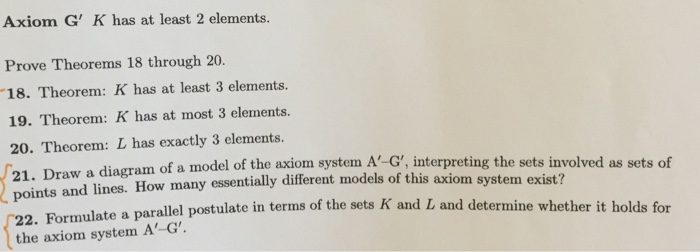
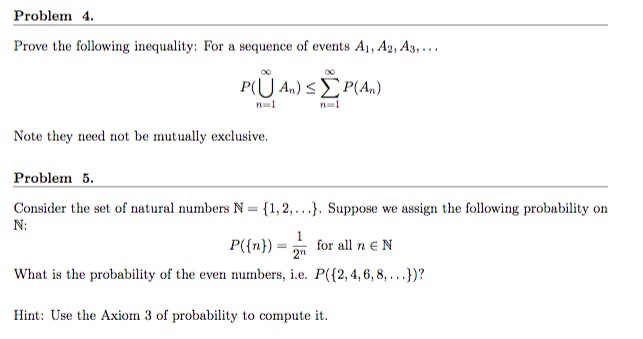
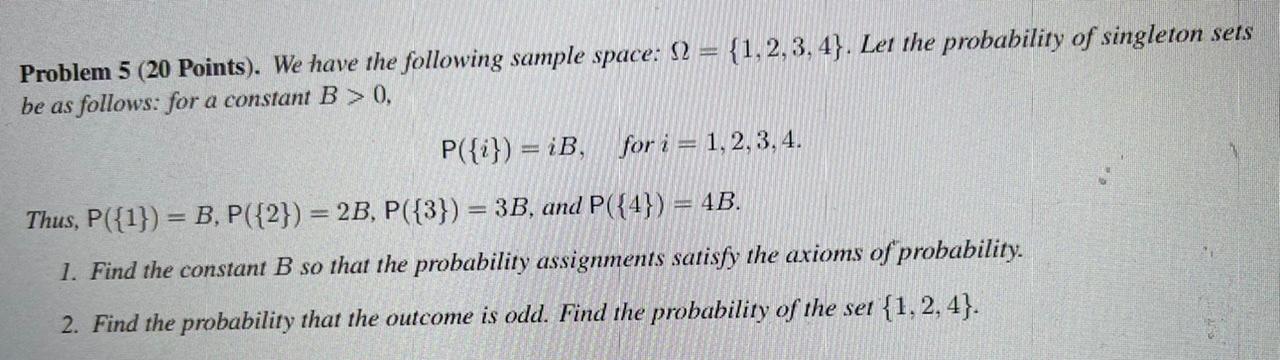
Axiom G' K has at least 2 elements. Prove Theorems 18 through 20. 18. Theorem: K has at least 3 elements. 19. Theorem: K has at most 3 elements. 20. Theorem: L has exactly 3 elements. 21. Draw a diagram of a model of the axiom system A'-G', interpreting the sets involved as sets of points and lines. How many essentially different models of this axiom system exist? 22. Formulate a parallel postulate in terms of the sets K and L and determine whether it holds for the axiom system A'-G'.Problem 4. Prove the following inequality: For a sequence of events Al, A2, As, .. . P(U An) S EP(An) Note they need not be mutually exclusive. Problem 5. Consider the set of natural numbers N = {1, 2,...}. Suppose we assign the following probability on N: P({n)) =: 1 for all n E N What is the probability of the even numbers, i.e. P({2, 4,6,8, ...})? Hint: Use the Axiom 3 of probability to compute it.Problem 5 (20 Points). We have the following sample space: $2 - {1, 2, 3, 4}. Let the probability of singleton sets be as follows: for a constant B > 0, P({i}) =iB, fori = 1,2,3, 4. Thus, P({1}) = B, P({2}) = 2B, P({3}) = 3B, and P({4}) - 4B. 1. Find the constant B so that the probability assignments satisfy the axioms of probability. 2. Find the probability that the outcome is odd. Find the probability of the set { 1, 2, 4}
Step by Step Solution
There are 3 Steps involved in it

Get step-by-step solutions from verified subject matter experts
 Study Help