



Question: How much remains? Consider numbers that are not in decimal form (that is, base 10) but instead are represented in base 3. That is, every
How much remains? Consider numbers that are not in decimal form (that is, base 10) but instead are represented in base 3. That is, every digit of the number is 0, 1, or 2. The first digit after the decimalpoint tells how many 1/31s you have; the next tells how many 1/32s you have; the nth place after the decimal point tells how many 1/3ns you have. So, 0.212 (base 3), for example, represents 2(1/3) 1(1/3)2 2(1/3)3 2/3 1/9 2/27 or 23/27. Show that the points that remain in the Cantor Set are exactly those numbers whose base 3 decimal expansion can be written with only 0s and 2s. (Note that, just as 0.0999 ... 0.1 base 10, 0.0222 ... 0.1 base 3, so put all numbers in the ending 2s form rather than in the ending 0s form.) Since any sequence of 0s and 2s corresponds to a decimal number in the Cantor Set, show that there are more numbers in the Cantor Set than there are natural numbers. In fact, the cardinality of the Cantor Set is the same as the cardinality of the real numbers.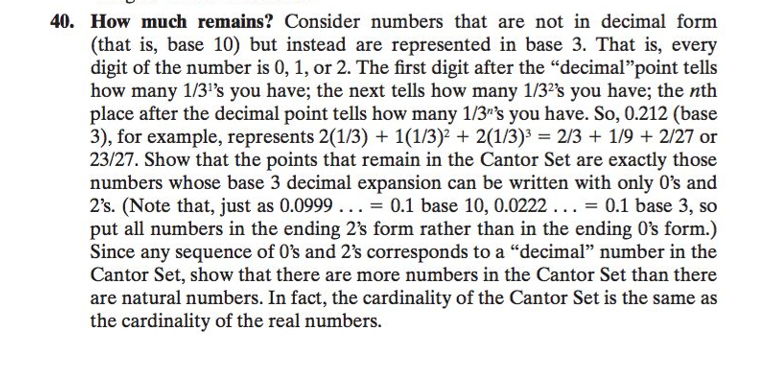
40. How much remains? Consider numbers that are not in decimal form (that is, base 10) but instead are represented in base 3. That is, every digit of the number is 0, 1, or 2. The first digit after the decimal"point tells how many 1/31's you have; the next tells how many 1/32's you have; the nth place after the decimal point tells how many 1/3's you have. So, 0.212 (base 3), for example, represents 2(1/3) + 1(1/3)2 + 2(1/3)3 = 2/3 + 1/9 + 2/27 or 23/27. Show that the points that remain in the Cantor Set are exactly those numbers whose base 3 decimal expansion can be written with only O's and 2's. (Note that, just as 0.0999... = 0.1 base 10, 0.0222... = 0.1 base 3, so put all numbers in the ending 2's form rather than in the ending O's form.) Since any sequence of O's and 2's corresponds to a decimal number in the Cantor Set, show that there are more numbers in the Cantor Set than there are natural numbers. In fact, the cardinality of the Cantor Set is the same as the cardinality of the real numbers. 40. How much remains? Consider numbers that are not in decimal form (that is, base 10) but instead are represented in base 3. That is, every digit of the number is 0, 1, or 2. The first digit after the decimal"point tells how many 1/31's you have; the next tells how many 1/32's you have; the nth place after the decimal point tells how many 1/3's you have. So, 0.212 (base 3), for example, represents 2(1/3) + 1(1/3)2 + 2(1/3)3 = 2/3 + 1/9 + 2/27 or 23/27. Show that the points that remain in the Cantor Set are exactly those numbers whose base 3 decimal expansion can be written with only O's and 2's. (Note that, just as 0.0999... = 0.1 base 10, 0.0222... = 0.1 base 3, so put all numbers in the ending 2's form rather than in the ending O's form.) Since any sequence of O's and 2's corresponds to a decimal number in the Cantor Set, show that there are more numbers in the Cantor Set than there are natural numbers. In fact, the cardinality of the Cantor Set is the same as the cardinality of the real numbers
Step by Step Solution
There are 3 Steps involved in it

Get step-by-step solutions from verified subject matter experts