







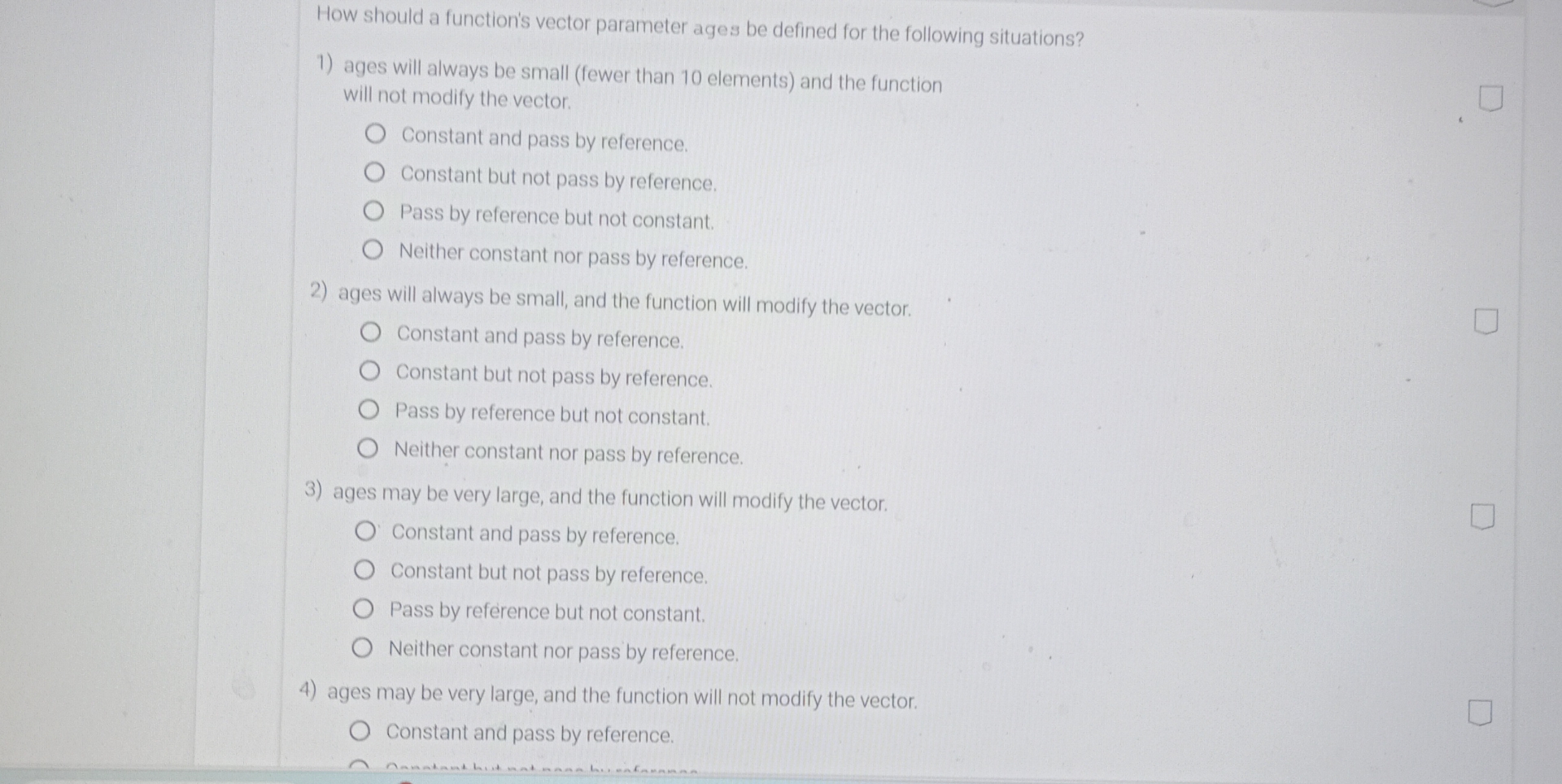
Question: How should a function's vector parameter ages be defined for the following situations? ages will always be small ( fewer than 1 0 elements )
How should a function's vector parameter ages be defined for the following situations?
ages will always be small fewer than elements and the function will not modify the vector.
Constant and pass by reference.
Constant but not pass by reference.
Pass by reference but not constant.
Neither constant nor pass by reference.
ages will always be small, and the function will modify the vector.
Constant and pass by reference.
Constant but not pass by reference.
Pass by reference but not constant.
Neither constant nor pass by reference.
ages may be very large, and the function will modify the vector.
Constant and pass by reference.
Constant but not pass by reference.
Pass by reference but not constant.
Neither constant nor pass by reference.
ages may be very large, and the function will not modify the vector.
Constant and pass by reference.
Step by Step Solution
There are 3 Steps involved in it
1 Expert Approved Answer
Step: 1 Unlock

Question Has Been Solved by an Expert!
Get step-by-step solutions from verified subject matter experts
Step: 2 Unlock
Step: 3 Unlock
 Study Help