







Question: How to answer this question? Paul's utility function is U(c, l) = c(i 20), where c denotes consumption and i leisure. Paul makes 10 per
How to answer this question?
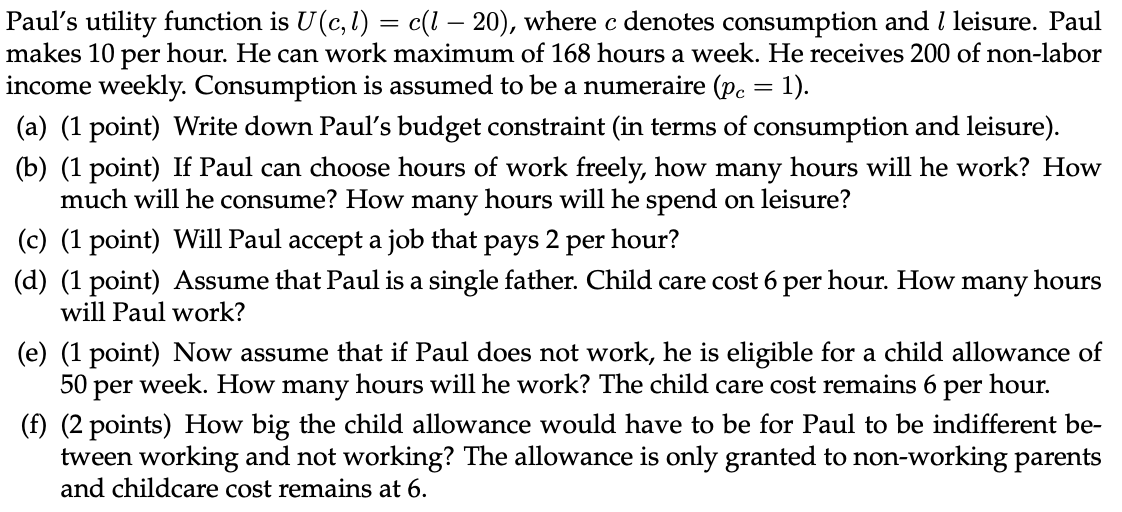
Paul's utility function is U(c, l) = c(i 20), where c denotes consumption and i leisure. Paul makes 10 per hour. He can work maximum of 168 hours a week. He receives 200 of non-labor income weekly. Consumption is assumed to be a numeraire (p6 = 1). (a) (1 point) Write down Paul's budget constraint (in terms of consumption and leisure). (b) (1 point) If Paul can choose hours of work freely, how many hours will he work? How much will he consume? How many hours will he spend on leisure? (c) (1 point) Will Paul accept a job that pays 2 per hour? (d) (1 point) Assume that Paul is a single father. Child care cost 6 per hour. How many hours will Paul work? (e) (1 point) Now assume that if Paul does not work, he is eligible for a child allowance of 50 per week. How many hours will he work? The child care cost remains 6 per hour. (f) (2 points) How big the child allowance would have to be for Paul to be indifferent be- tween working and not working? The allowance is only granted to non-working parents and childcare cost remains at 6
Step by Step Solution
There are 3 Steps involved in it

Get step-by-step solutions from verified subject matter experts
 Study Help