







Question: How to compute a one-sample test. I am having trouble getting the correct answer for question #5(T-TEST) and question #7( p -value for a one-tailed
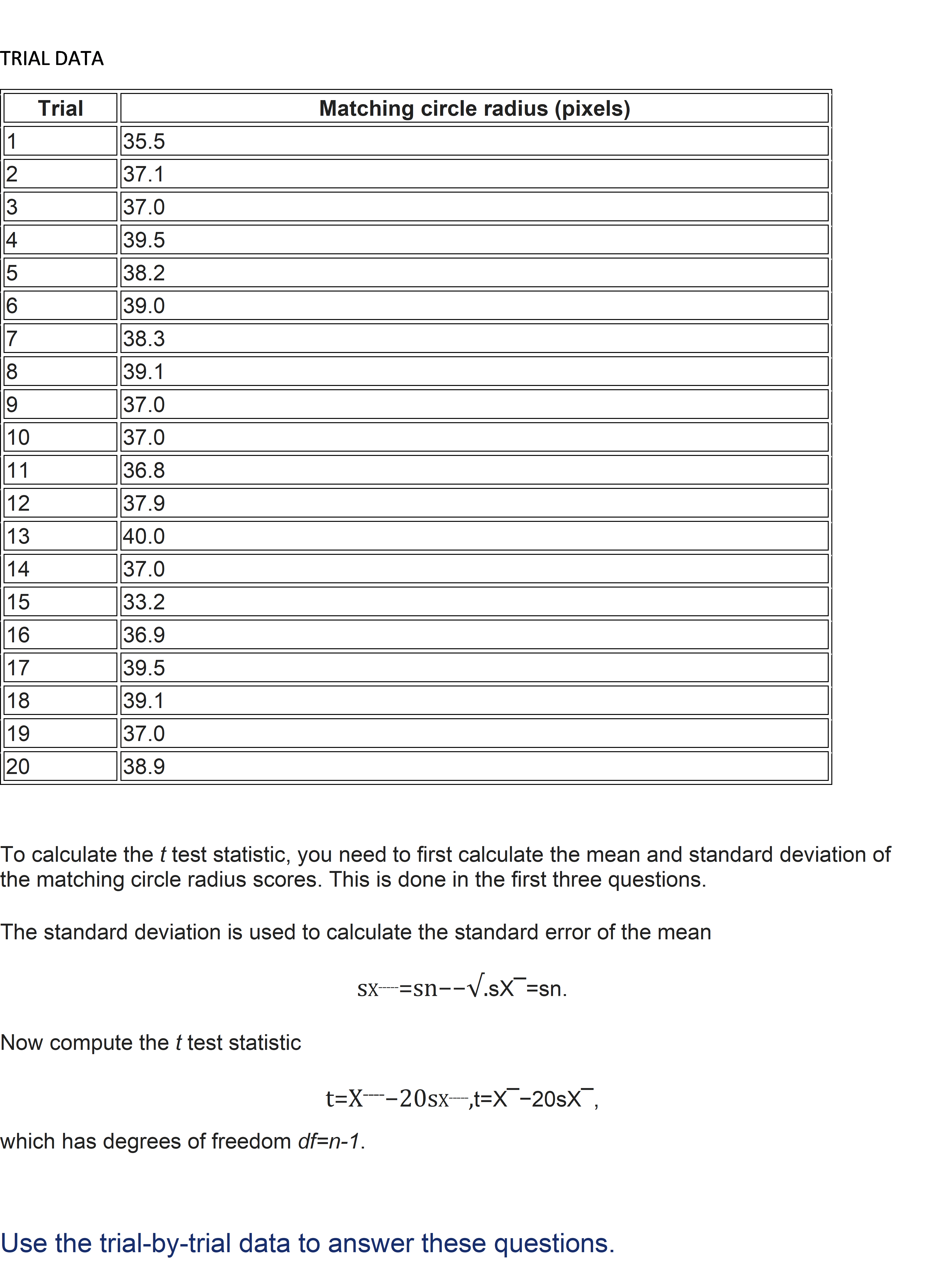
How to compute a one-sample test. I am having trouble getting the correct answer for question #5(T-TEST) and question #7(p-value for a one-tailed test: Please see the data trial.
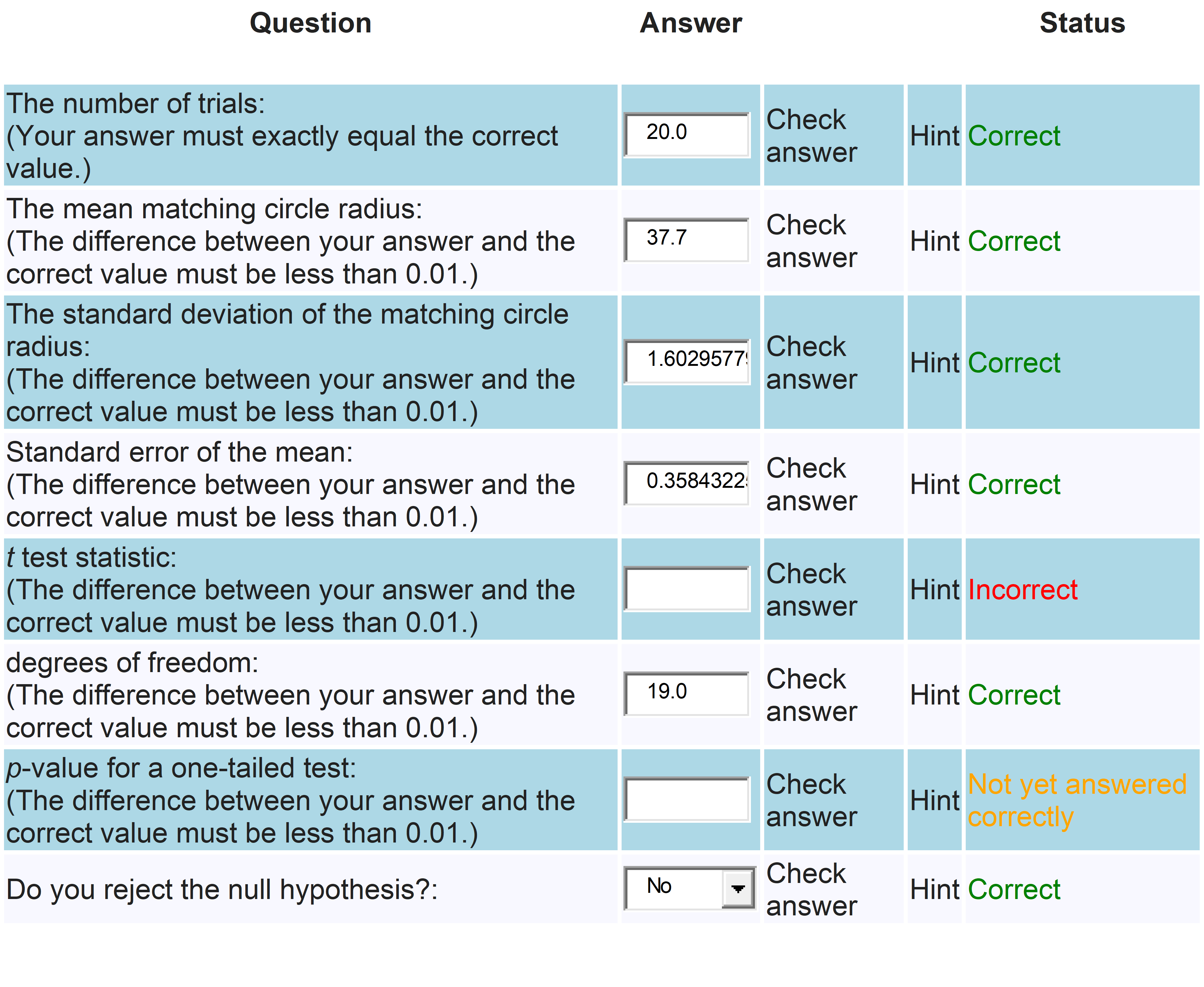
Question Answer Status The number of trials: (Your answer must exactly equal the correct 20.0 Check Hint Correct value.) answer The mean matching circle radius: (The difference between your answer and the 37.7 Check Hint Correct correct value must be less than 0.01.) answer The standard deviation of the matching circle radius: 1.6029577 Check (The difference between your answer and the Hint Correct answer correct value must be less than 0.01.) Standard error of the mean: (The difference between your answer and the 0.3584322 Check Hint Correct correct value must be less than 0.01.) answer t test statistic: (The difference between your answer and the Check Hint Incorrect correct value must be less than 0.01.) answer degrees of freedom: (The difference between your answer and the 19.0 Check Hint Correct correct value must be less than 0.01.) answer p-value for a one-tailed test: (The difference between your answer and the Check Hint Not yet answered correct value must be less than 0.01.) answer correctly Do you reject the null hypothesis?: No Check Hint Correct answerTrial Matching circle radius (pixels) 1 35.5 IN 37.1 37.0 39.5 38.2 16 39.0 38.3 39.1 37.0 10 37.0 11 36.8 12 37.9 13 40.0 14 37.0 15 33.2 16 36.9 17 39.5 18 39.1 19 37.0 20 38.9 To calculate the t test statistic, you need to first calculate the mean and standard deviation of the matching circle radius scores. This is done in the first three questions. The standard deviation is used to calculate the standard error of the mean SX-=sn--V.sX =sn. Now compute the t test statistic t=X--20sx-,t=X" -20sX, which has degrees of freedom df=n-1. Use the trial-by-trial data to answer these questions
Step by Step Solution
There are 3 Steps involved in it

Get step-by-step solutions from verified subject matter experts
 Study Help