







Question: How to do (d) 1. Consider a Random Walk (RW) between neighbouring vertices of the infinite binary free whose structure can be indicated pictorially, at
How to do (d)
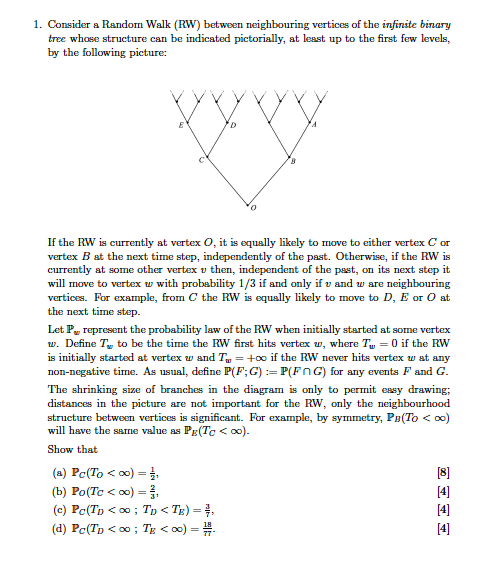
1. Consider a Random Walk (RW) between neighbouring vertices of the infinite binary free whose structure can be indicated pictorially, at least up to the first few levels, by the following picture: If the RW is currently at vertex O, it is equally likely to move to either vertex C or vertex B at the next time step, independently of the past. Otherwise, if the RW is currently at some other vertex v then, independent of the past, on its next step it will move to vertex w with probability 1/3 if and only if v and w are neighbouring vertices. For example, from C the RW is equally likely to move to D, E or O at the next time step. Let P. represent the probability law of the RW when initially started at some vertex w. Define T, to be the time the RW first hits vertex w, where To =0 if the RW is initially started at vertex w and To = too if the RW never hits vertex w at any non-negative time. As usual, define P(F; G) :=P(Fn G) for any events F and G. The shrinking size of branches in the diagram is only to permit easy drawing; distances in the picture are not important for the RW, only the neighbourhood structure between vertices is significant. For example, by symmetry, Po(To
Step by Step Solution
There are 3 Steps involved in it

Get step-by-step solutions from verified subject matter experts
 Study Help