


Question: how to do? Explain with details pls. Thanks. 2) (20') We discussed in class the effect of constriction of the afferent and efferent arterioles on

how to do? Explain with details pls. Thanks.
how to do? Explain with details pls. Thanks. 2)
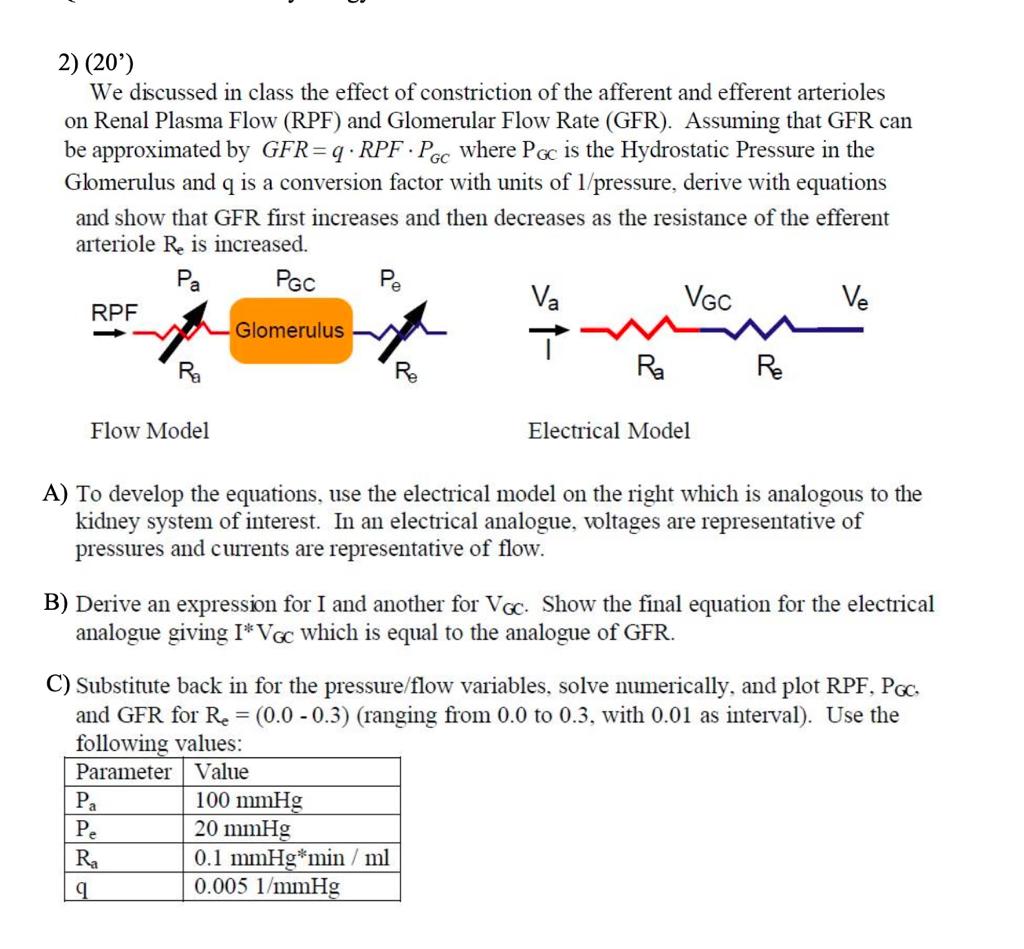
2) (20') We discussed in class the effect of constriction of the afferent and efferent arterioles on Renal Plasma Flow (RPF) and Glomerular Flow Rate (GFR). Assuming that GFR can be approximated by GFR= q . RPF . Poc where Poc is the Hydrostatic Pressure in the Glomerulus and q is a conversion factor with units of 1/pressure, derive with equations and show that GFR first increases and then decreases as the resistance of the efferent arteriole Re is increased. Pa PGC Pe RPF Va VGC Ve Glomerulus Ra Re Ra Re Flow Model Electrical Model A) To develop the equations, use the electrical model on the right which is analogous to the kidney system of interest. In an electrical analogue, voltages are representative of pressures and currents are representative of flow. B) Derive an expression for I and another for VGc. Show the final equation for the electrical analogue giving I* Voc which is equal to the analogue of GFR. C) Substitute back in for the pressure/flow variables, solve numerically, and plot RPF, PGc. and GFR for Re = (0.0 - 0.3) (ranging from 0.0 to 0.3, with 0.01 as interval). Use the following values: Parameter Value Pa 100 mmHg Pe 20 mmHg Ra 0.1 mmHg*min / ml 0.005 1/mmHg

Step by Step Solution

There are 3 Steps involved in it

1 Expert Approved Answer
Step: 1 Unlock blur-text-image

Question Has Been Solved by an Expert!

Get step-by-step solutions from verified subject matter experts

Step: 2 Unlock
Step: 3 Unlock

Students Have Also Explored These Related Law Questions!