







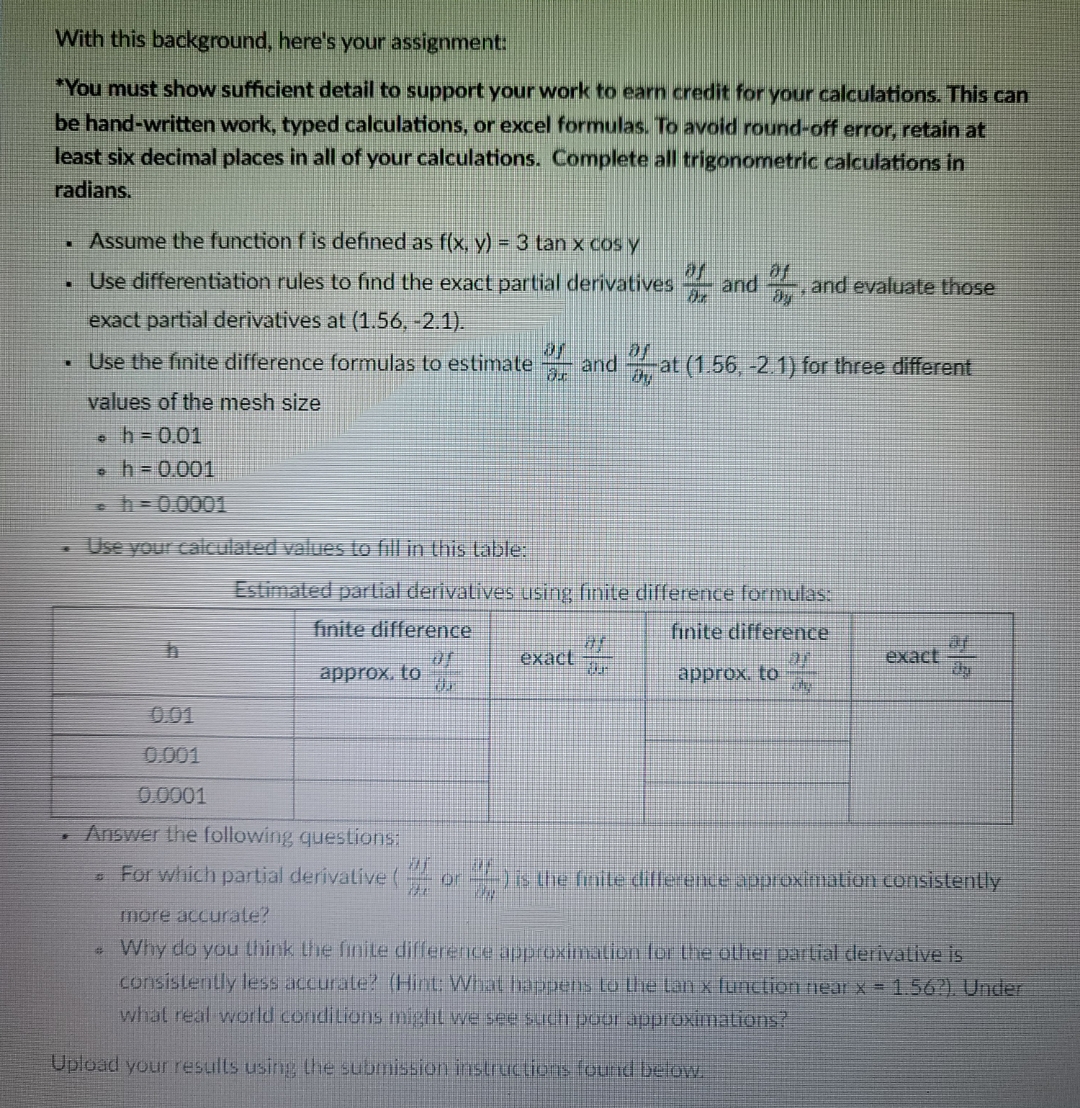
Question: How to estimate partial derivatives using finite difference formula, step bu step? With this background, here's your assignment: You must show sufficient detail to support
How to estimate partial derivatives using finite difference formula, step bu step?
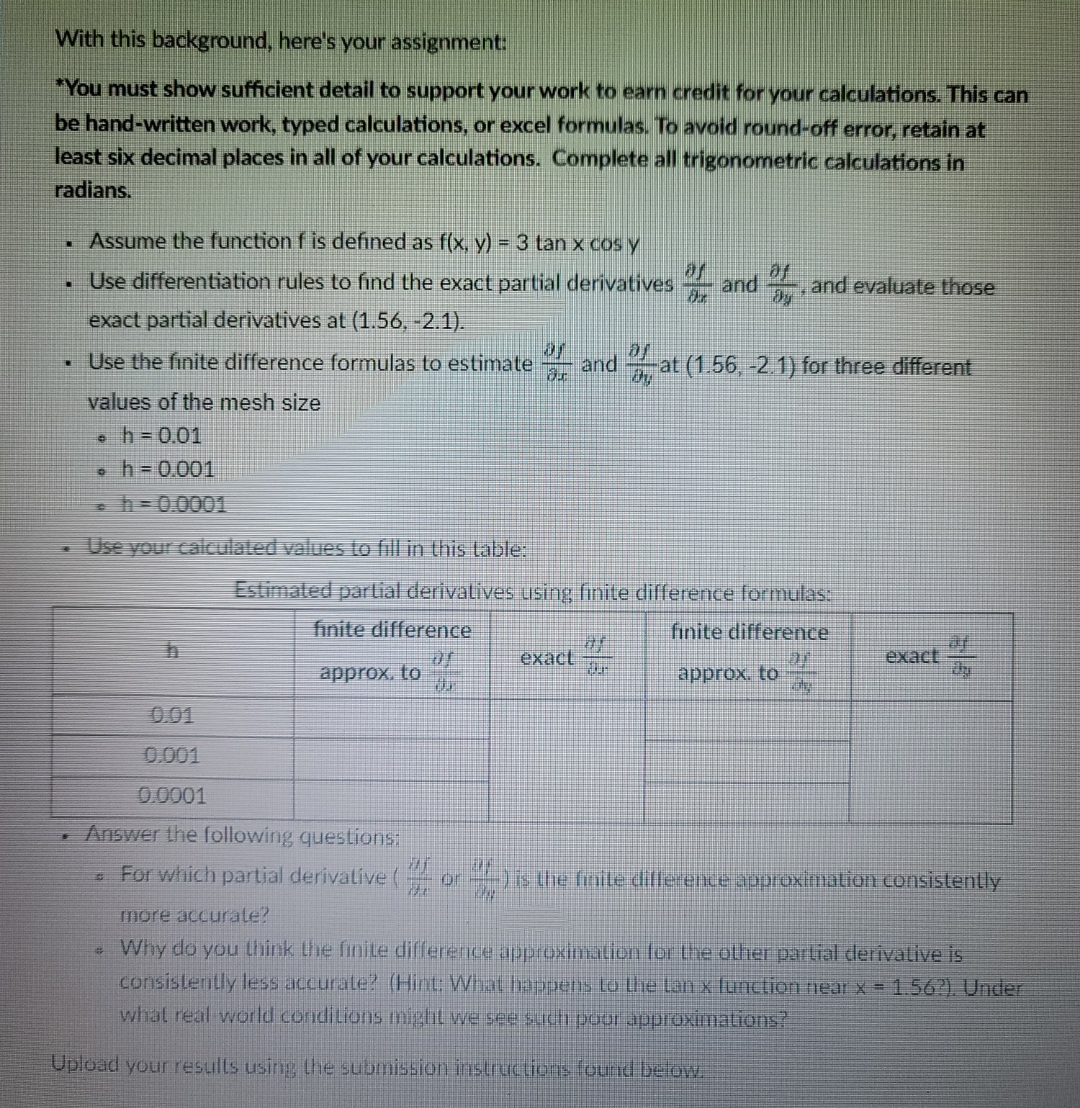
With this background, here's your assignment: "You must show sufficient detail to support your work to earn credit for your calculations. This can be hand-written work, typed calculations, or excel formulas. To avoid round-off error, retain at least six decimal places in all of your calculations. Complete all trigonometric calculations in radians. . Assume the function f is defined as f(x, y) = 3 tan x cos y . Use differentiation rules to find the exact partial derivatives " and , and evaluate those exact partial derivatives at (1.56, -2.1). . Use the finite difference formulas to estimate and a "at (1.56, -2.1) for three different values of the mesh size . h = 0.01 . h = 0.001 . h = 0.0001 . Use your calculated values to fill in this table: Estimated partial derivatives using finite difference formulas: finite difference finite difference exact exact - approx. to approx. to 0.01 0.001 9.0901 Answer the following questions: . For which partial derivative( ( or -)is the finite difference approximation consistently more accurate? Why do you think the finite difference approximation for the other partial derivative is consistently less accurate? (Hint: What happens to the tan x function near x = 1.56?), Under what real world conditions might we see such pour approximations? Upload your results using the submission instructions found below
Step by Step Solution
There are 3 Steps involved in it

Get step-by-step solutions from verified subject matter experts
 Study Help