







Question: How to implement code in java, the bottom-up heapsort must contain all these instructions in the picture, do not use scanner and do not use
How to implement code in java, the bottom-up heapsort must contain all these instructions in the picture, do not use scanner and do not use extending comparable. In general, I MUST use these methods:
Bottom_up_reheap(int m, int i) // this would use these 3 methods below based on the picture given
bottom-up leaf_search(int m, int i)
bottom_up_search(int i, int j)
interchange(int i, int j)
void sort(int[] array) // use the bottom_up_reheap to sort the values by using recursion It does NOT recursively checked in a top-down manner. Everything must be done in a bottom-up manner. Please READ these instructions to do it.
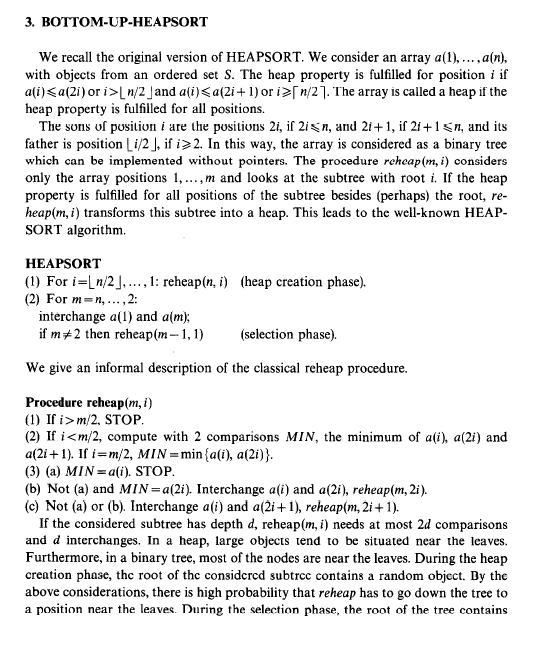
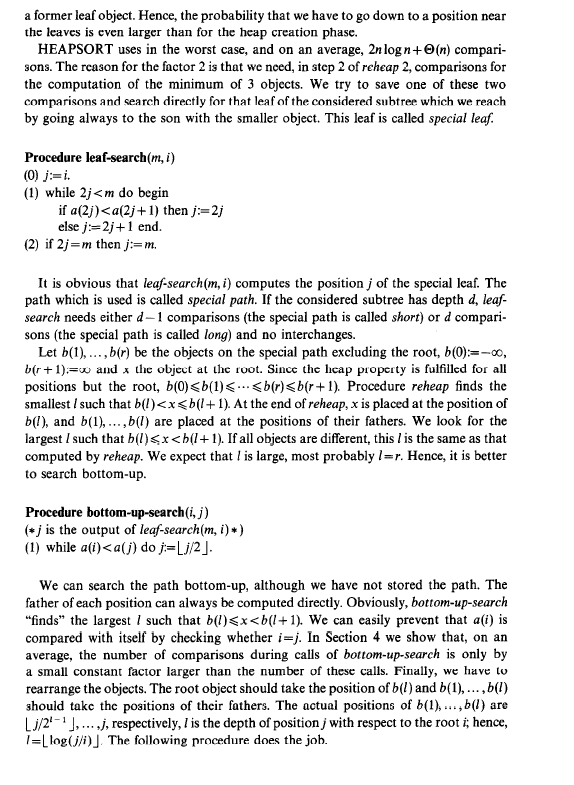
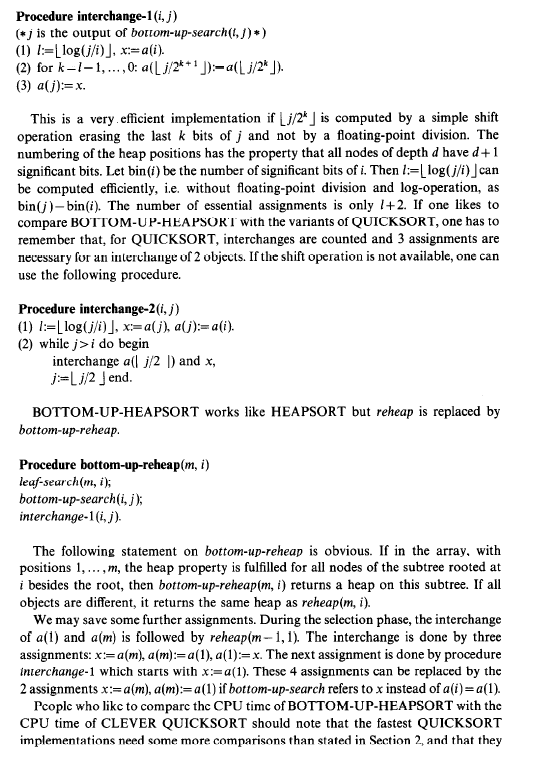

3. BOTTOM-UP-HEAPSORT We recall the original version of HEAPSORT. We consider an array a(1).....a(n), with objects from an ordered set S. The heap property is fulfilled for position i if a(i)4(21) or i >L n/2land a(iKa(2i + 1) or i>??/2]. The array is called a heap if the heap property is fulfilled for all positions. The sons of position i are lhe positions 2i, if 2?n, and 2i+ 1, if 21+?n, and its father is position Li/2 ], if i>2. In this way, the array is considered as a binary tree which can be implemented without pointers. The procedure reheap(m, i) considers only the array positions 1,...,m and looks at the subtree with root i. If the heajp property is fulfilled for all positions of the subtree besides (perhaps) the root, re- heap(m, i) transforms this subtree into a heap. This leads to the well-known HEAP SORT algorithm. HEAPSORT (1) For i-n/2J., : reheap(n, i) (heap creation phase). (2) For m-n, ..., interchange a(1) and alm); if m#2 then reheap(m-1, 1) (selection phase). We give an informal description of the classical reheap procedure. Procedure reheap(m, i) (1) If i>m/2. STOIP (2) If i
Step by Step Solution
There are 3 Steps involved in it

Get step-by-step solutions from verified subject matter experts
 Study Help