







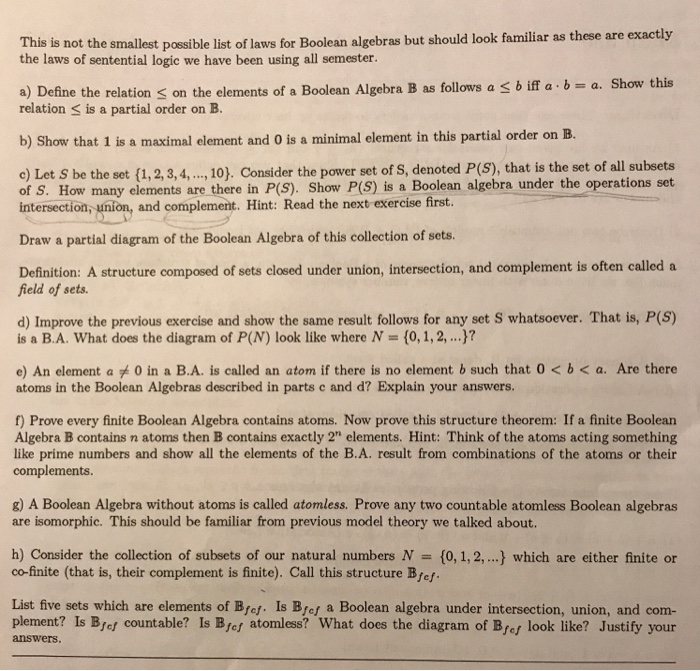
Question: How to solve (d) (e) (f) (g) (h)? 3) Here is a more or less typical set of axioms of a Boolean Algebra, a kind
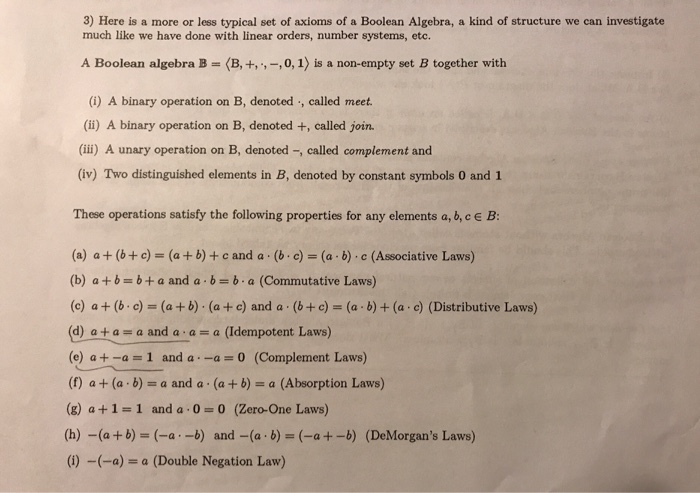
3) Here is a more or less typical set of axioms of a Boolean Algebra, a kind of structure we can investigate much like we have done with linear orders, number systems, etc. A Boolean algebra B (B, 0,1) is a non-empty set B together with A binary operation on B, denoted called meet. (ii) A binary operation on B, denoted called join. (iii) A unary operation on B, denoted called complement and (iv) Two distinguished elements in B, denoted by constant symbols o and 1 These operations satisfy the following properties for any elements a, b, c e B: (a) a (b c) (a b) c and a (b c) (a b) c (Associative Laws) (b) a b b a and a b b. a (Commutative Laws) (d) a a a and a a a (Idempotent Laws) (e) a -a 1 and a -a 0 (Complement Laws) (f a (a b) a and a (a b) a (Absorption Laws) (g) a 1 1 and a .0 0 (Zero-One Laws) (h) (a b) (-a b) and (a b) (-a -b) (DeMorgan's Laws) (i) -(-a) a (Double Negation Law)
Step by Step Solution
There are 3 Steps involved in it

Get step-by-step solutions from verified subject matter experts
 Study Help