







Question: How to solve please show step by step a,b,c,d, and e Several months ago while shopping, I was interviewed to see whether or not I'd
How to solve please show step by step a,b,c,d, and e
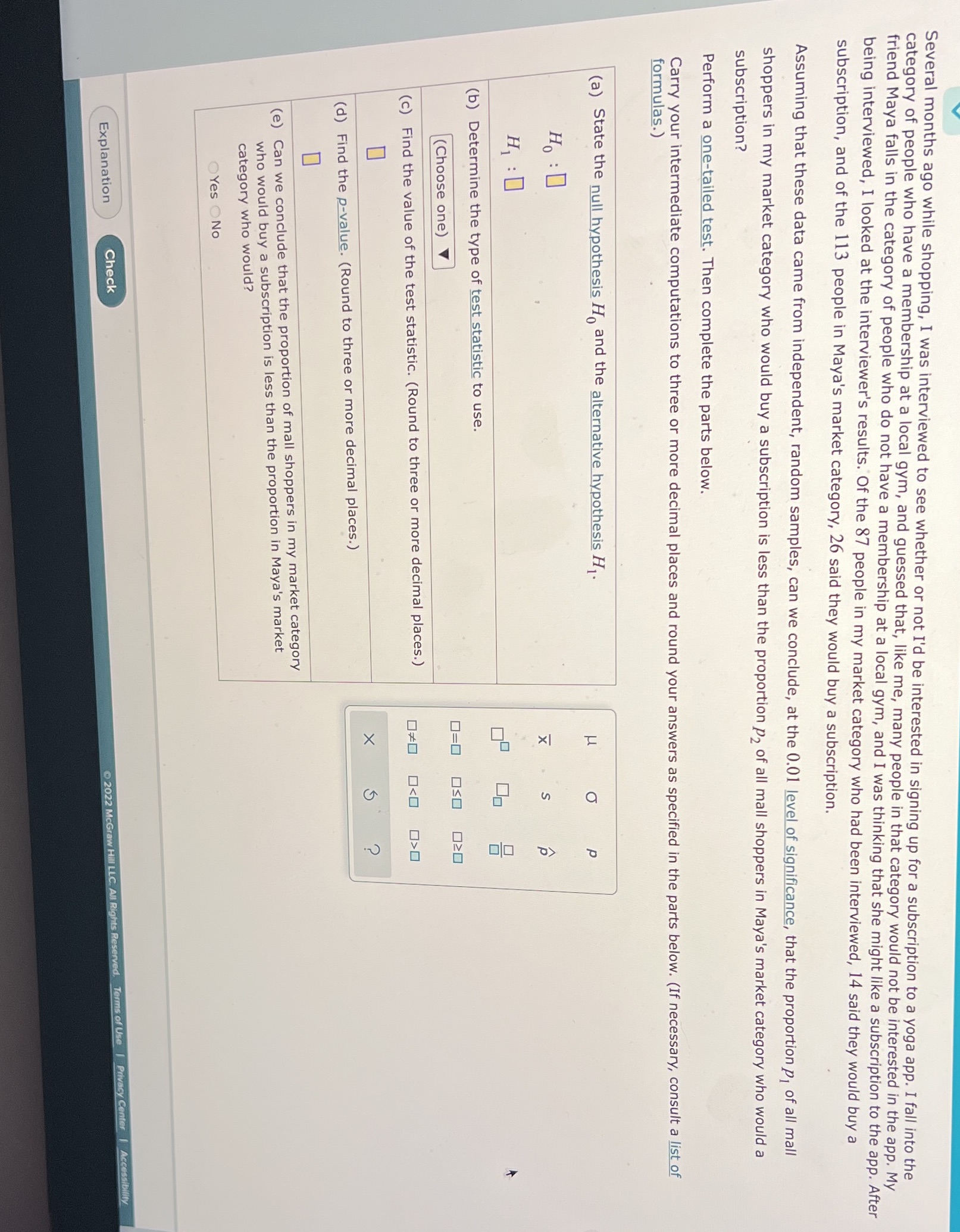
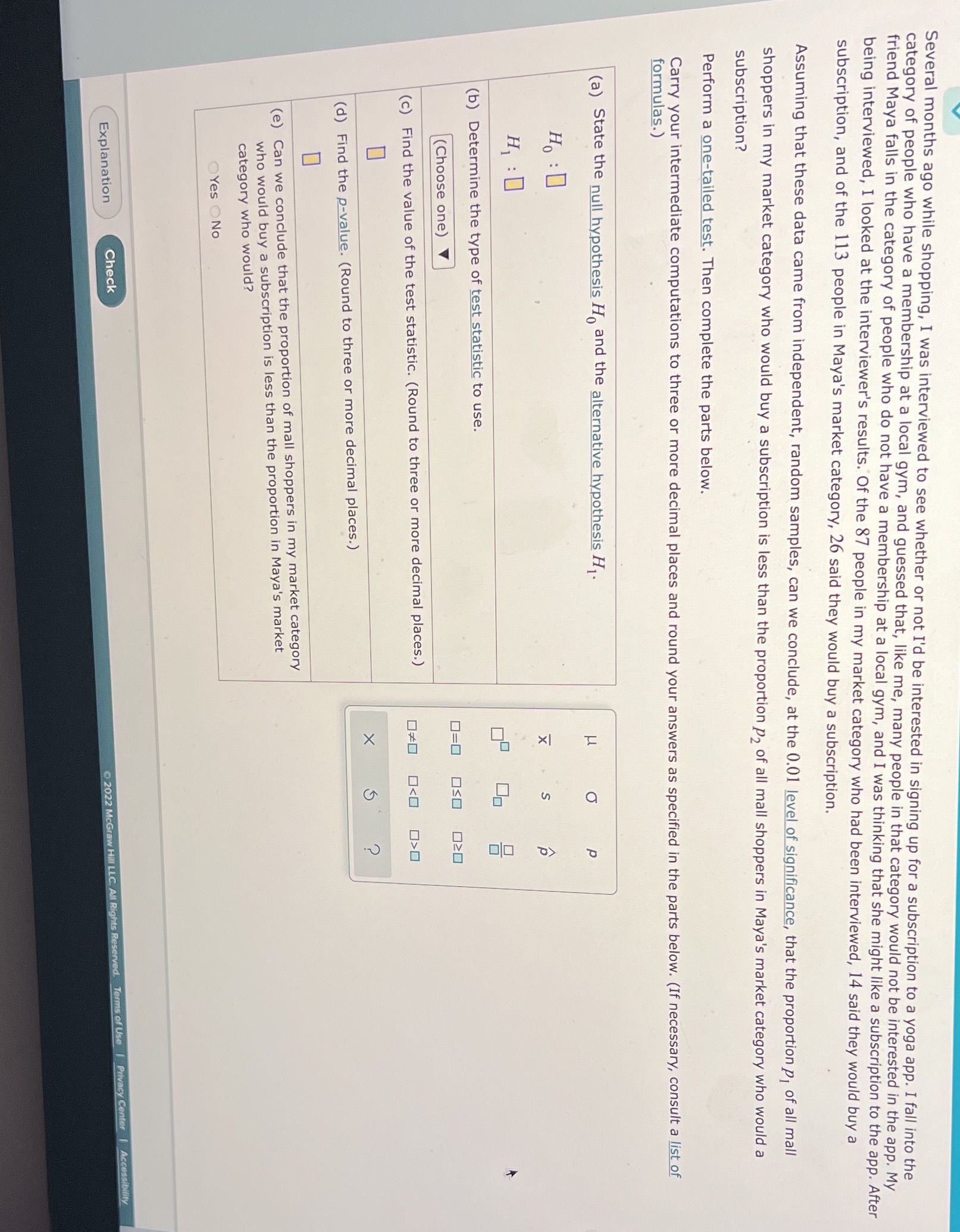
Several months ago while shopping, I was interviewed to see whether or not I'd be interested in signing up for a subscription to a yoga app. I fall into the category of people who have a membership at a local gym, and guessed that, like me, many people in that category would not be interested in the app. My friend Maya falls in the category of people who do not have a membership at a local gym, and I was thinking that she might like a subscription to the app. After being interviewed, I looked at the interviewer's results. Of the 87 people in my market category who had been interviewed, 14 said they would buy a subscription, and of the 113 people in Maya's market category, 26 said they would buy a subscription. Assuming that these data came from independent, random samples, can we conclude, at the 0.01 level of significance, that the proportion p, of all mall shoppers in my market category who would buy a subscription is less than the proportion p, of all mall shoppers in Maya's market category who would a subscription? Perform a one-tailed test. Then complete the parts below. formulas.) Carry your intermediate computations to three or more decimal places and round your answers as specified in the parts below. (If necessary, consult a list of (a) State the null hypothesis Ho and the alternative hypothesis H. Ho : 0 IX H 1 :0 b) Determine the type of test statistic to use. (Choose one) V 020 (c) Find the value of the test statistic. (Round to three or more decimal places.) 070 0
Step by Step Solution
There are 3 Steps involved in it

Get step-by-step solutions from verified subject matter experts
 Study Help