







Question: How to solve Problem 3 by using R language? 3. Perform model selection (using forward, backward, exhaustive search) to choose the best polynomial model from
How to solve Problem 3 by using R language?
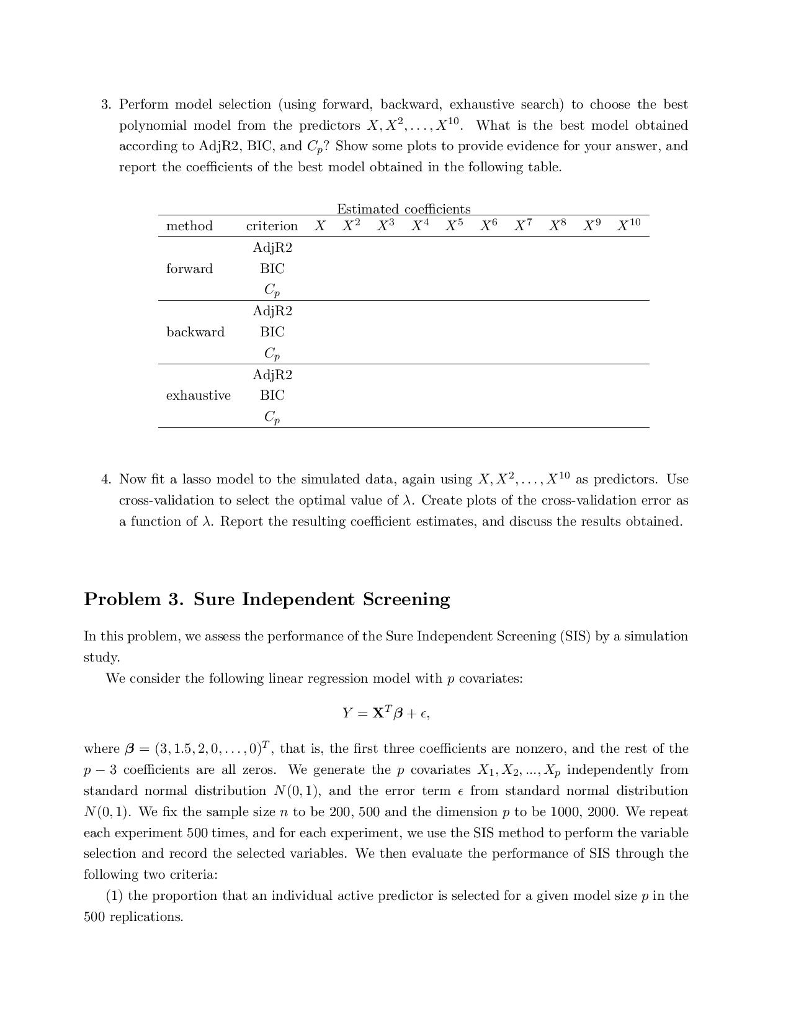
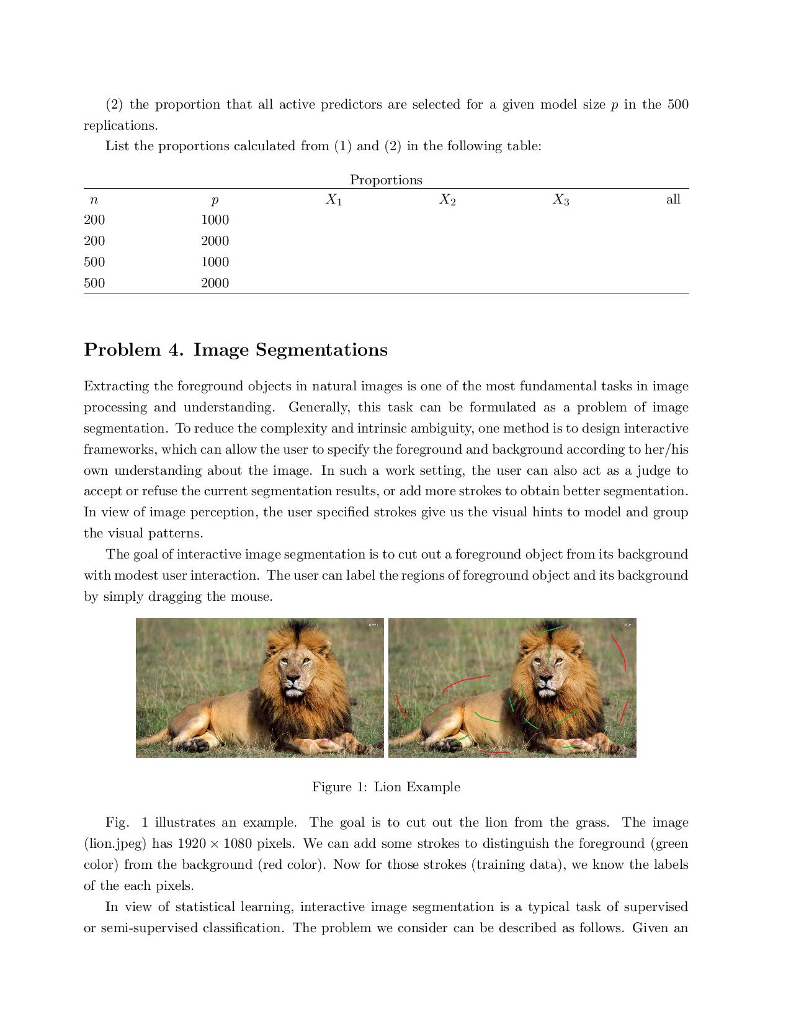
3. Perform model selection (using forward, backward, exhaustive search) to choose the best polynomial model from the predictors X,X What is the best model obtained according to AdjR2, BIC, and Cp? Show some plots to provide evidence for your answer, an report the coefficients of the best model obtained in the following table Estimated coeficients criterion X X2 X3 X4 X5 X6 X7 X8 X9 X10 method AdjR2 forwa BIC Adj R2 backward BIC AdjR2 exhaustive BIC 4. Now fit a lasso model to the simulated data, again using A, X2, X10 as predictors. Use cross-validation to select the optimal value of A. Create plots of the cross-validation error as a function of A. Report the resulting coefficient estimates, and discuss the results obtained Problem 3. Sure Independent Screening In this problem, we assess the performance of the Sure Independent Screening (SIS) by a simulation study We consider the following linear regression model with p covariates: E where B (3, 2.0 0) that is, the first three coefficients are nonzero, and the rest of the p 3 coeffi are all zeros. We generate the p covariates X1, X2, Xp independently from cients standard normal distribution N(0,1), and the error term from standard normal distribution N(0,1). We fix the sample size n to be 200, 500 and the dimen sion p to be 1000, 2000. We repeat each experiment 500 times, and for each experiment, we use the SIS method to perform the variable selection and record the selected variables. We then evaluate the performance of SIS through the following two criteria: (1) the proportion that a dividual active predictor is selected for a given model size p in the 500 replications 3. Perform model selection (using forward, backward, exhaustive search) to choose the best polynomial model from the predictors X,X What is the best model obtained according to AdjR2, BIC, and Cp? Show some plots to provide evidence for your answer, an report the coefficients of the best model obtained in the following table Estimated coeficients criterion X X2 X3 X4 X5 X6 X7 X8 X9 X10 method AdjR2 forwa BIC Adj R2 backward BIC AdjR2 exhaustive BIC 4. Now fit a lasso model to the simulated data, again using A, X2, X10 as predictors. Use cross-validation to select the optimal value of A. Create plots of the cross-validation error as a function of A. Report the resulting coefficient estimates, and discuss the results obtained Problem 3. Sure Independent Screening In this problem, we assess the performance of the Sure Independent Screening (SIS) by a simulation study We consider the following linear regression model with p covariates: E where B (3, 2.0 0) that is, the first three coefficients are nonzero, and the rest of the p 3 coeffi are all zeros. We generate the p covariates X1, X2, Xp independently from cients standard normal distribution N(0,1), and the error term from standard normal distribution N(0,1). We fix the sample size n to be 200, 500 and the dimen sion p to be 1000, 2000. We repeat each experiment 500 times, and for each experiment, we use the SIS method to perform the variable selection and record the selected variables. We then evaluate the performance of SIS through the following two criteria: (1) the proportion that a dividual active predictor is selected for a given model size p in the 500 replications
Step by Step Solution
There are 3 Steps involved in it

Get step-by-step solutions from verified subject matter experts
 Study Help