







Question: How to solve this case study? When Amancio Ortega, a Spanish former bathrobe maker, opened his first Zara clothing store, his business model was simple:
How to solve this case study?
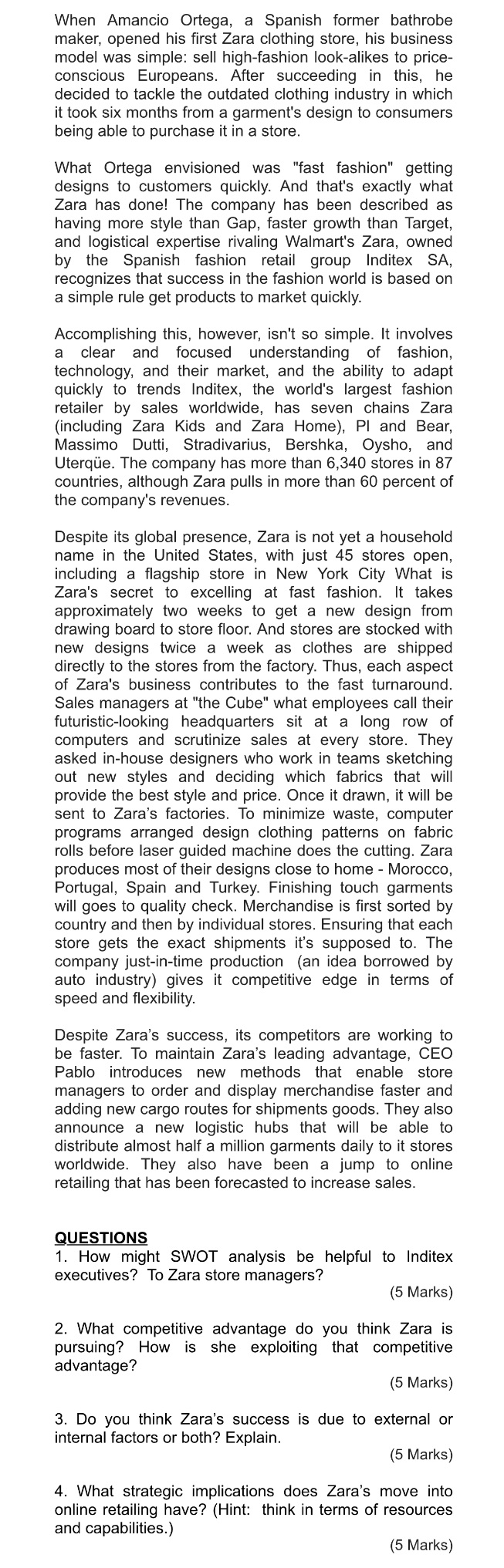
When Amancio Ortega, a Spanish former bathrobe maker, opened his first Zara clothing store, his business model was simple: sell high-fashion lookalikes to price- conscious Europeans. After succeeding in this. he decided to tackle the outdated clothing industry in which it took six months from a garment's design to consumers being able to purchase it in a store. What Ortega envisioned was "fast fashion" getting designs to customers quickly. And that's exactly what Zara has done! The company has been described as having more style than Gap, faster growth than Target, and logistical expertise rivaling Walmart's Zara, owned by the Spanish fashion retail group Inditex SA, recognizes that success in the fashion world is based on a simple rule get products to market quickly. Accomplishing this. however. isn't so simple. It involves a clear and focused understanding of fashion, technology, and their market. and the ability to adapt quickly to trends tnditex. the world's largest fashion retailer by sales worldwide. has seven chains Zara (including Zara Kids and Zara Home), PI and Bear. Massimo Dutti. Stradivarius, Bershka. Oysho, and Uterqtie. The company has more than 6,340 stores in 87 countries. although Zara pulls in more than 60 percent of the company's revenues. Despite its global presence, Zara is not yet a household name in the United States, with just 45 stores open, including a agship store in New York City What is Zara's secret to excelling at fast fashion. It takes approximately two weeks to get a new design from drawing board to store floor. And stores are stocked with new designs twice a week as clothes are shipped directly to the stores from the factory. Thus. each aspect of Zara's business contributes to the fast turnaround. Sales managers at "the Cube" what employees call their futuristic-looking headquarters sit at a long row of computers and scrutinize sales at every store. They asked in-house designers who work in teams sketching out new styles and deciding which fabrics that will provide the best style and price. Once it drawn, it will be sent to Zara's factories. To minimize waste. computer programs arranged design clothing patterns on fabric rolls before laser guided machine does the cutting. Zara produces most of their designs close to home - Morocco. Portugal. Spain and Turkey. Finishing touch garments will goes to quatity check. Merchandise is rst sorted by country and then by individual stores. Ensuring that each store gets the exact shipments it's supposed to. The company just-in-time production (an idea borrowed by auto industry) gives it competitive edge in terms of speed and exibility. Despite Zara's success, its competitors are working to be faster. To maintain Zara's leading advantage. CEO Pablo introduces new methods that enable store managers to order and display merchandise faster and adding new cargo routes for shipments goods. They also announce a new logistic hubs that will be able to distribute almost half a million garments daily to it stores worldwide. They also have been a jump to online retailing that has been forecasted to increase sales. QUESTIONS 1. How might SWOT analysis be helpful to lnditex executives? To Zara store managers? (5 Marks) 2. What competitive advantage do you think Zara is pursuing? How is she exploiting that competitive advantage? (5 Marks) 3. Do you think Zara's success is due to external or internal factors or both? Explain. (5 Marks) 4. What strategic implications does Zara's move into online retailing have? (Hint: think in terms of resources and capabilities.)
Step by Step Solution
There are 3 Steps involved in it

Get step-by-step solutions from verified subject matter experts
 Study Help