







Question: How to solve this question Curves are usually specified in terms of a single equation. For example the equation of a circle of radius 1
How to solve this question
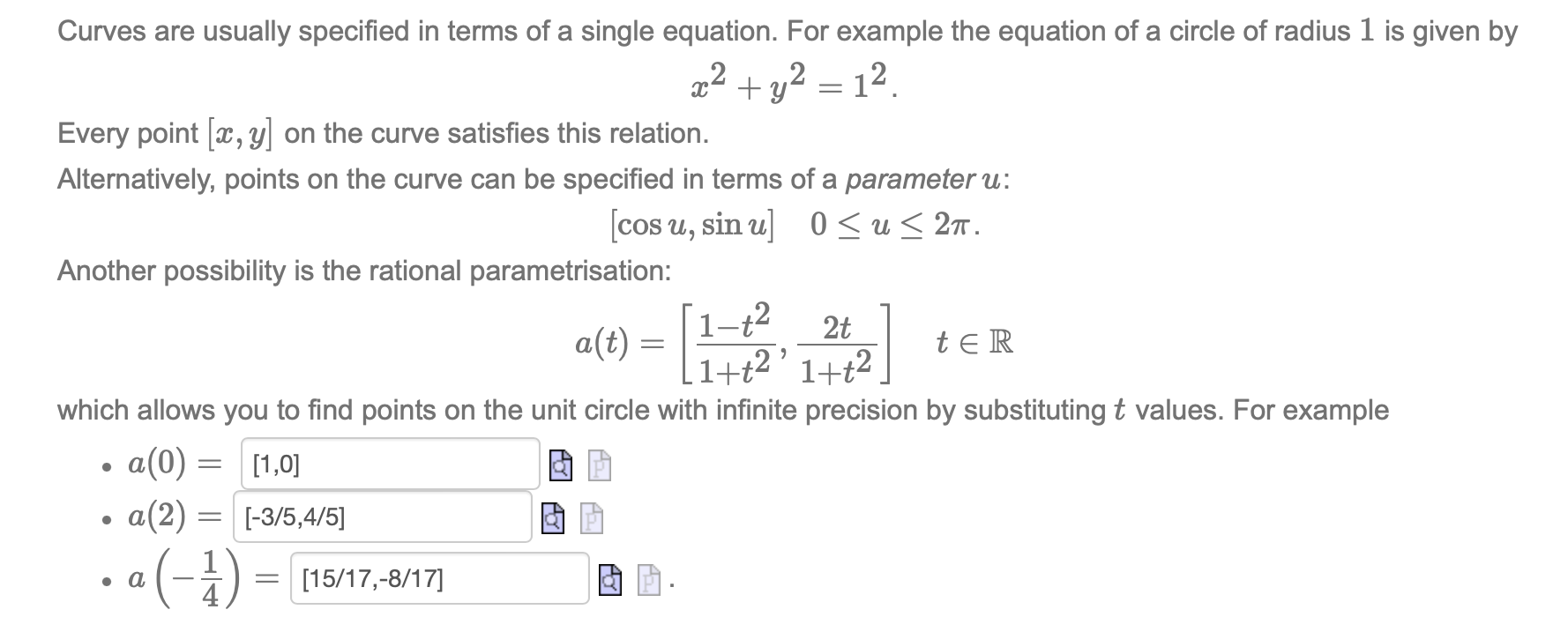
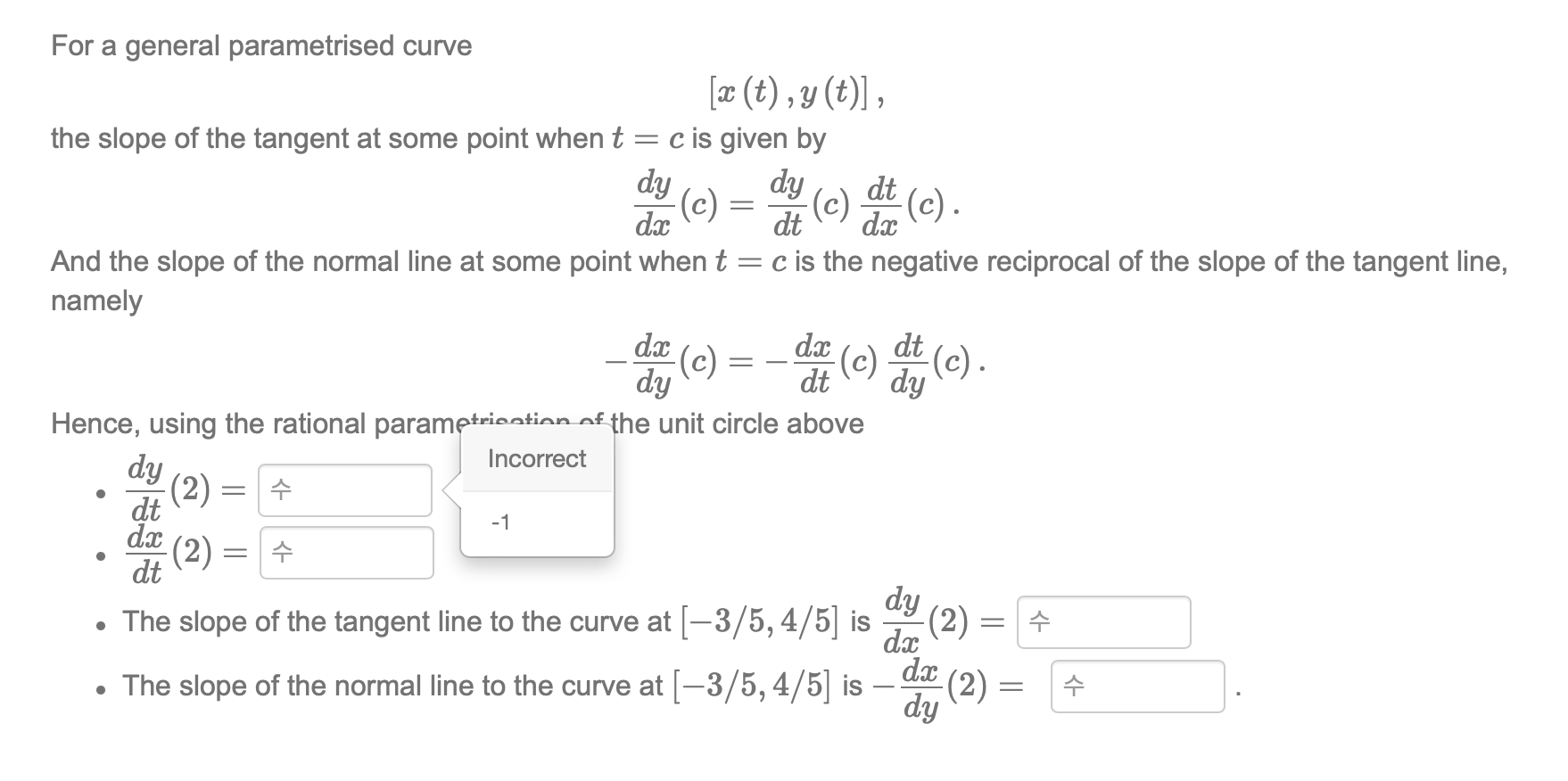
Curves are usually specified in terms of a single equation. For example the equation of a circle of radius 1 is given by x2 +y2 = 12. Every point [x, y] on the curve satisfies this relation. Alternatively, points on the curve can be specified in terms of a parameter u: [cos u, sinu] O Su - 27. Another possibility is the rational parametrication: a(t) = 1 - + 2 2t tER Litt2 1+ +2 which allows you to find points on the unit circle with infinite precision by substituting t values. For example . a (0) = [1,0] P a(2) = [-3/5,4/5] . a (- 1 = [15/17,-8/17]For a general parametrised curve in: (t) ,y (t)] , the slope of the tangent at some point when t = c is given by dy dy dt $02) = Wk) %(C)- And the slope of the normal line at some point when t = c is the negative reciprocal of the slope of the tangent line, namely ';;(c) = 'f,(c) j;(c). Hence. using the rational param ' he unit circle above . . dy _ A . The slope of the tangent line to the curve at [3/5, 4/5] Is @(2) . _ . _ a} _ A o The slope of the normal line to the curve at [ 3/5, 4/5] IS dy (2)
Step by Step Solution
There are 3 Steps involved in it

Get step-by-step solutions from verified subject matter experts
 Study Help