







Question: How to write function that satisfy this sequence? Take into account that if only two of the three sequences yield same answer, then it is
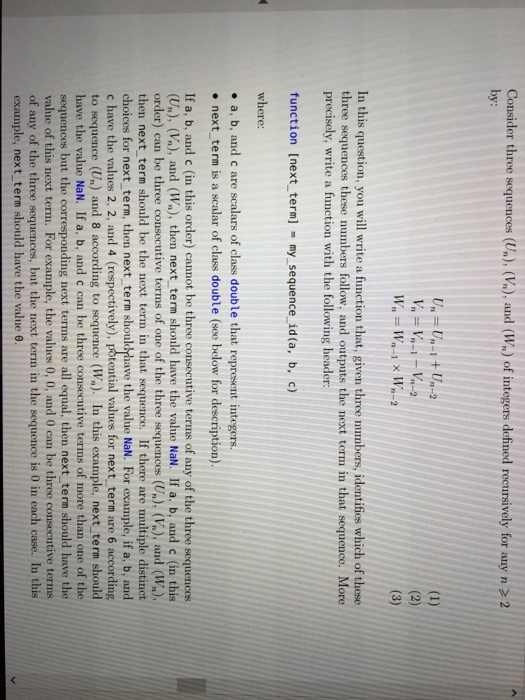
Consider three sequences (Un), (Vn), and (W,) of integers defined recursively for any n 2 n-1 t U (1) (2) W. n-1 X will write a function that, given three numbers, identifies which of these In this question, you three sequences these numbers follow, and outputs the next term in that sequence. More precisely, write a function with the following header: function Inext term] my sequence id (a, b, c) where: a, b, and c are scalars of class double that represent integers next term is a scalar of class double (see below for description) If a, b, and d c (in this order) cannot be three consecutive terms of any of the three sequences (Un), (Vn), and (Wn), then next term should have the value NaN. If a, b, and c (in this order) can be three consecutive terms of one of the three sequences (Un), (Vn), and (Wn), then next term should be the next term in that sequence. If there are multiple distinct choices for next term, then next term shoul have the value NaN. For example, if a b, and c have the values 2, 2, and 4 (respectively), tential values for next term are 6 according to sequence (Un) and 8 according to sequence (Wa). In this example, next term should have the value NaN. If a, b, and c can be three consecutive terms of more than one of the sequences but the corresponding next terms are all equal, then next term should have the value of this next term. For example, the values 0, 0, and 0 can be three consecutive terms of any of the three sequences, but the next term in the sequence is 0 in each case. In this example, next term should have the value 0
Step by Step Solution
There are 3 Steps involved in it

Get step-by-step solutions from verified subject matter experts
 Study Help