







Question: How will the organisational capabilities translate to core competencies that give Cisco a sustainable competitive advantage in their industry? 300 words STRATEGIC ACQUISITIONS AND ACCELERATED
How will the organisational capabilities translate to core competencies that give Cisco a sustainable competitive advantage in their industry? 300 words
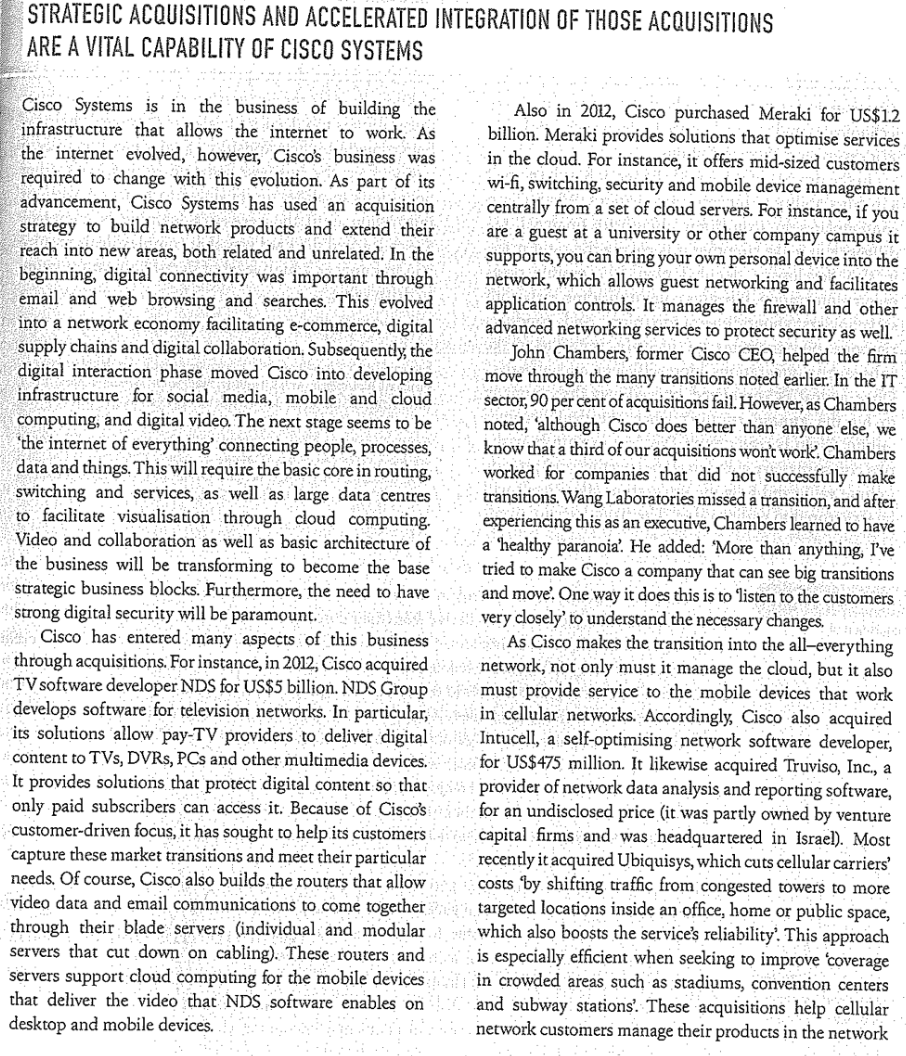
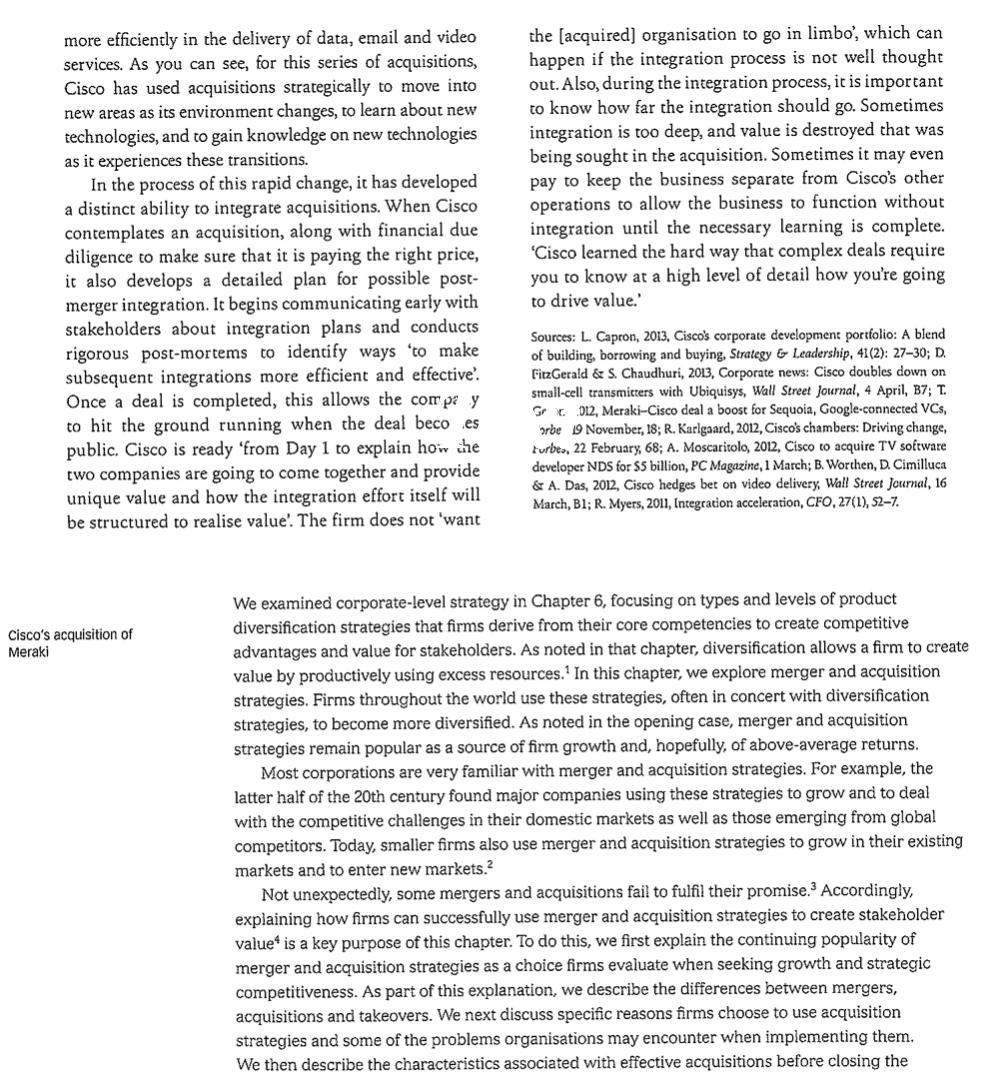
STRATEGIC ACQUISITIONS AND ACCELERATED INTEGRATION OF THOSE ACQUISITIONS ARE A VITAL CAPABILITY OF CISCO SYSTEMS Cisco Systems is in the business of building the Also in 2012, Cisco purchased Meraki for US$1.2 infrastructure that allows the internet to work. As billion. Meraki provides solutions that optimise services the internet evolved, however, Cisco's business was in the cloud. For instance, it offers mid-sized customers required to change with this evolution. As part of its wi-fi, switching, security and mobile device management advancement, Cisco Systems has used an acquisition centrally from a set of cloud servers. For instance, if you strategy to build network products and extend their are a guest at a university or other company campus it reach into new areas, both related and unrelated. In the supports, you can bring your own personal device into the beginning, digital connectivity was important through network, which allows guest networking and facilitates email and web browsing and searches. This evolved application controls. It manages the firewall and other into a network economy facilitating e-commerce, digital advanced networking services to protect security as well. supply chains and digital collaboration. Subsequently, the John Chambers, former Cisco CEO, helped the firm digital interaction phase moved Cisco into developing move through the many transitions noted earlier. In the IT infrastructure for social media, mobile and cloud sector, 90 per cent of acquisitions fail. However, as Chambers computing, and digital video. The next stage seems to be noted, although Cisco does better than anyone else, we 'the internet of everything connecting people, processes, know that a third of our acquisitions won't work. Chambers data and things. This will require the basic core in routing, worked for companies that did not successfully make switching and services, as well as large data centres transitions. Wang Laboratories missed a transition, and after to facilitate visualisation through cloud computing. experiencing this as an executive, Chambers learned to have Video and collaboration as well as basic architecture of a 'healthy paranoia? He added: 'More than anything, I've the business will be transforming to become the base tried to make Cisco a company that can see big transitions strategic business blocks. Furthermore, the need to have and move. One way it does this is to listen to the customers strong digital security will be paramount. very closely to understand the necessary changes. Cisco has entered many aspects of this business As Cisco makes the transition into the all-everything through acquisitions. For instance, in 2012, Cisco acquired network, not only must it manage the cloud, but it also TV software developer NDS for US$5 billion. NDS Group must provide service to the mobile devices that work develops software for television networks. In particular, in cellular networks. Accordingly, Cisco also acquired its solutions allow pay-TV providers to deliver digital Intucell, a self-optimising network software developer, content to TVs, DVRs, PCs and other multimedia devices. for US$475 million. It likewise acquired Truviso, Inc., a It provides solutions that protect digital content so that provider of network data analysis and reporting software, only paid subscribers can access it. Because of Cisco's for an undisclosed price (it was partly owned by venture customer-driven focus, it has sought to help its customers capital firms and was headquartered in Israel). Most capture these market transitions and meet their particular recently it acquired Ubiquisys, which cuts cellular carriers needs. Of course, Cisco also builds the routers that allow costs by shifting traffic from congested towers to more video dara and email communications to come together targeted locations inside an office, home or public space, through their blade servers (individual and modular which also boosts the services reliability. This approach servers that cut down on cabling). These routers and is especially efficient when seeking to improve coverage servers support cloud computing for the mobile devices in crowded areas such as stadiums, convention centers that deliver the video that NDS software enables on and subway stations. These acquisitions help cellular desktop and mobile devices. network customers manage their products in the network more efficiently in the delivery of data, email and video services. As you can see, for this series of acquisitions, Cisco has used acquisitions strategically to move into new areas as its environment changes, to learn about new technologies, and to gain knowledge on new technologies as it experiences these transitions. In the process of this rapid change, it has developed a distinct ability to integrate acquisitions. When Cisco contemplates an acquisition, along with financial due diligence to make sure that it is paying the right price, it also develops a detailed plan for possible post- merger integration. It begins communicating early with stakeholders about integration plans and conducts rigorous post-mortems to identify ways to make subsequent integrations more efficient and effective' Once a deal is completed, this allows the compa y to hit the ground running when the deal becoes public. Cisco is ready 'from Day 1 to explain how the two companies are going to come together and provide unique value and how the integration effort itself will be structured to realise value! The firm does not 'want the (acquired) organisation to go in limbo', which can happen if the integration process is not well thought out. Also, during the integration process, it is important to know how far the integration should go. Sometimes integration is too deep, and value is destroyed that was being sought in the acquisition. Sometimes it may even pay to keep the business separate from Cisco's other operations to allow the business to function without integration until the necessary learning is complete. "Cisco learned the hard way that complex deals require you to know at a high level of detail how you're going to drive value.' Sources: L. Capron, 2013, Cisco's corporate development portfolio: A blend of building, borrowing and buying, Strategy & Leadership, 41(2): 27-30; D. FitzGerald & S. Chaudhuri, 2013, Corporate news: Cisco doubles down on small-cell transmitters with Ubiquisys, Wall Street Journal, 4 April, B7; T. GP .012, Meraki-Cisco deal a boost for Sequoia, Google-connected VCs, orbe 19 November, 18; R. Karlgaard, 2012, Cisco's chambers: Driving change, turbta, 22 February, 68; A. Moscaritolo, 2012, Cisco to acquire TV software developer NDS for S5 billion, PC Magazine, 1 March; B. Worchen, D. Cimilluca & A. Das, 2012, Cisco hedges bet on video delivery, Wall Street Journal, 16 March, B1; R. Myers, 2011, Integration acceleration, CFO, 27(1), 52-7. Cisco's acquisition of Meraki We examined corporate-level strategy in Chapter 6, focusing on types and levels of product diversification strategies that firms derive from their core competencies to create competitive advantages and value for stakeholders. As noted in that chapter, diversification allows a firm to create value by productively using excess resources. In this chapter, we explore merger and acquisition strategies. Firms throughout the world use these strategies, often in concert with diversification strategies, to become more diversified. As noted in the opening case, merger and acquisition strategies remain popular as a source of firm growth and, hopefully, of above-average returns. Most corporations are very familiar with merger and acquisition strategies. For example, the latter half of the 20th century found major companies using these strategies to grow and to deal with the competitive challenges in their domestic markets as well as those emerging from global competitors. Today, smaller firms also use merger and acquisition strategies to grow in their existing markets and to enter new markets.? Not unexpectedly, some mergers and acquisitions fail to fulfil their promise. Accordingly, explaining how firms can successfully use merger and acquisition strategies to create stakeholder value is a key purpose of this chapter. To do this, we first explain the continuing popularity of merger and acquisition strategies as a choice firms evaluate when seeking growth and strategic competitiveness. As part of this explanation, we describe the differences between mergers, acquisitions and takeovers. We next discuss specific reasons firms choose to use acquisition strategies and some of the problems organisations may encounter when implementing them. We then describe the characteristics associated with effective acquisitions before closing theStep by Step Solution
There are 3 Steps involved in it
1 Expert Approved Answer
Step: 1 Unlock

Question Has Been Solved by an Expert!
Get step-by-step solutions from verified subject matter experts
Step: 2 Unlock
Step: 3 Unlock
 Study Help