



Question: How would one solve the following problem? For practice. Problem 2. Price Discrimination Consider a monopolist in three different situations. (a) (b) (C) First-degree price
How would one solve the following problem? For practice.
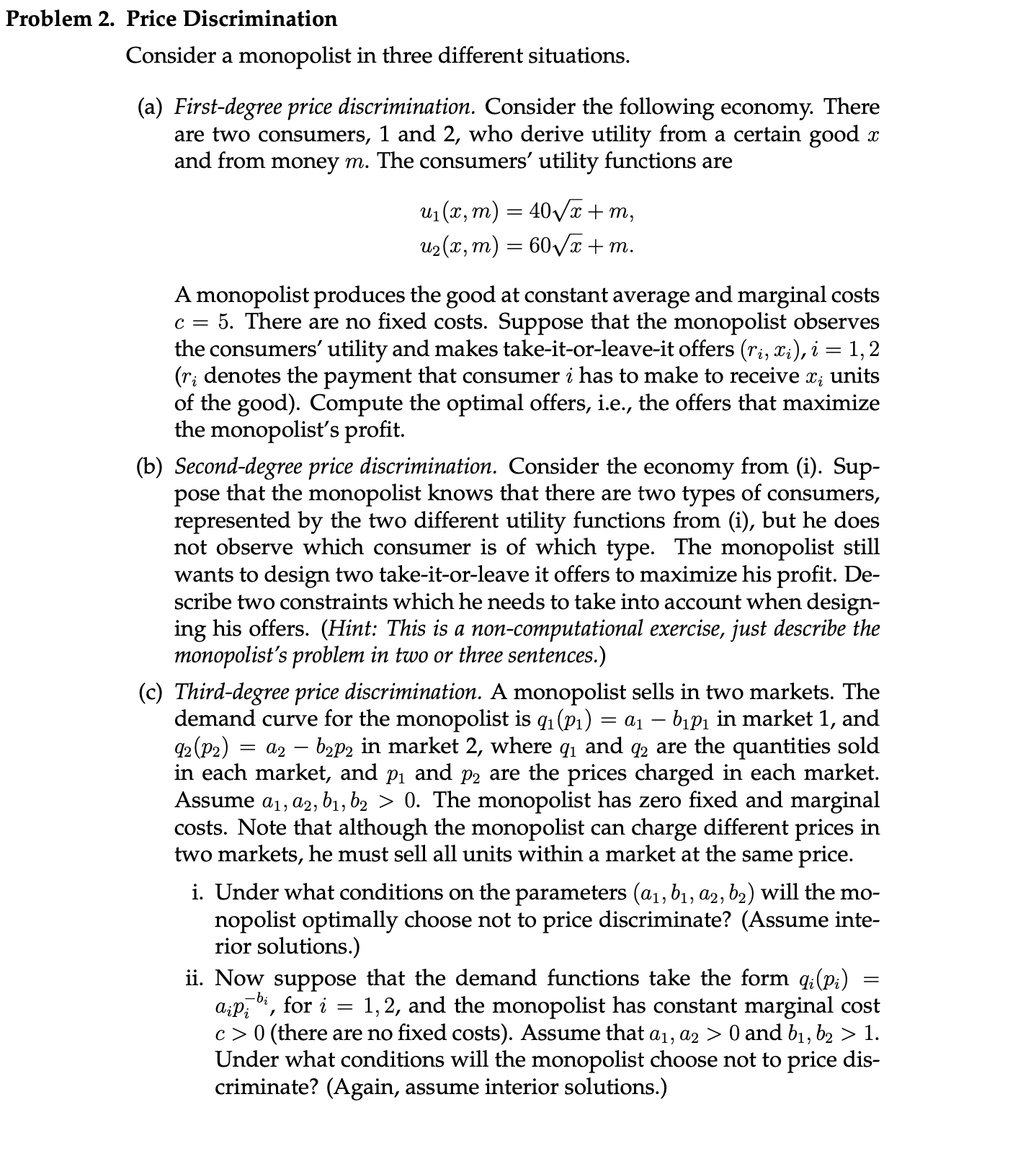
Problem 2. Price Discrimination Consider a monopolist in three different situations. (a) (b) (C) First-degree price discrimination. Consider the following economy. There are two consumers, 1 and 2, who derive utility from a certain good r and from money m. The consumers' utility functions are u1(:c, m) = 40%;? + m, \"2(55, m) = 50; + m. A monopolist produces the good at constant average and marginal costs 0 = 5. There are no xed costs. Suppose that the monopolist observes the consumers' utility and makes take-it-or-leave-it offers (73-, at), i = 1, 2 (n- denotes the payment that consumer i has to make to receive :5.- units of the good). Compute the optimal offers, i.e., the offers that maximize the monopolist's prot. Seconddegree price discrimination. Consider the economy from (1). Sup- pose that the monopolist knows that there are two types of consumers, represented by the two different utility functions from (i), but he does not observe which consumer is of which type. The monopolist still wants to design two take-it-or-leave it offers to maximize his prot. De- scribe two constraints which he needs to take into account when design- ing his offers. (Hint: This is a noncomputational exercise, just describe the monopolist's problem in two or three sentences.) Third-degree price discrimination. A monopolist sells in two markets. The demand curve for the monopolist is q1(p1) = a1 b1 p1 in market 1, and (12(132) = a2 bgpg in market 2, where ql and qg are the quantities sold in each market, and p1 and 192 are the prices charged in each market. Assume a1, 0.2,?)1, :52 > O. The monopolist has zero xed and marginal costs. Note that although the monopolist can charge different prices in two markets, he must sell all units within a market at the same price. i. Under what conditions on the parameters (a1, b1, a2, b2) will the mo- nopolist optimally choose not to price discriminate? (Assume inte- rior solutions.) ii. Now suppose that the demand functions take the form qi(p,-) = ail-pf\
Step by Step Solution
There are 3 Steps involved in it

Get step-by-step solutions from verified subject matter experts