







Question: How would you complete this problem ? This is all the information provided. Question 1. Optimization Models [15 Points] A company provides 4 types of
How would you complete this problem ? This is all the information provided.
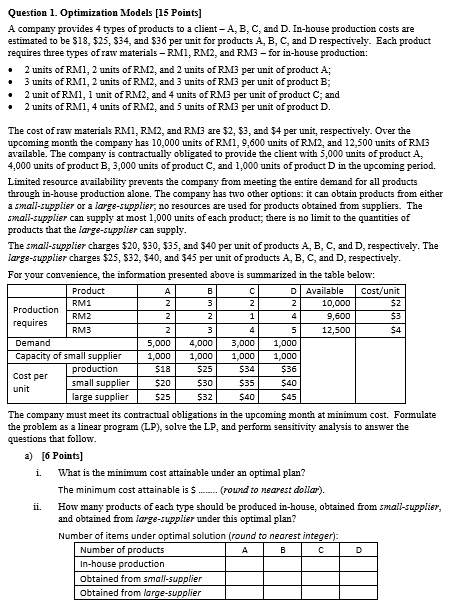
Question 1. Optimization Models [15 Points] A company provides 4 types of products to a client - A,B,C, and D. In-house production costs are estimated to be $18, 525, 534, and $36 per unit for products A, B, C, and Drespectively. Each product requires three types of raw materials - RMI, RM2, and RM3 - for in-house production: 2 units of RMI, 2 units of RM2, and 2 units of RM3 per unit of product A; 3 units of RMI, 2 units of RM2, and 3 units of RM3 per unit of product B; 2 unit of RMI, 1 unit of RM2, and 4 units of RM3 per unit of product C; and 2 units of RM1,4 units of RM2, and 5 units of RM3 per unit of product D. A 2 1 4 3 4 The cost of raw materials RMI, RM2, and RM3 are 52, 53, and 54 per unit, respectively. Over the upcoming month the company has 10,000 units of RM1,9,600 units of RM2, and 12,500 units of RM3 available. The company is contractually obligated to provide the client with 5,000 units of product A, 4,000 units of product B, 3,000 units of product C, and 1,000 units of product D in the upcoming period. Limited resource availability prevents the company from meeting the entire demand for all products through in-house production alone. The company has two other options: it can obtain products from either a small-supplier or a large-supplier, no resources are used for products obtained from suppliers. The small-supplier can supply at most 1,000 units of each product; there is no limit to the quantities of products that the large-supplier can supply. The small-supplier charges $20, $30, $35, and $40 per unit of products A, B, C, and D, respectively. The large-supplier charges 525, 532, 540, and $45 per unit of products A, B, C, and D, respectively. For your convenience, the information presented above is summarized in the table below: Product B C D Available Cost/unit RM1 3 2 2 10,000 SZ Production RMZ Z 2 9,600 $3 requires RM3 2 5 12,500 $4 Demand 5,000 4,000 3,000 1,000 Capacity of small supplier 1,000 1,000 1,000 1,000 production $18 $25 $34 $36 Cost per small supplier unit $20 $30 $35 $40 large supplier $25 $32 $40 $45 The company must meet its contractual obligations in the upcoming month at minimum cost. Formulate the problem as a linear program (LP), solve the LP, and perform sensitivity analysis to answer the questions that follow. a) [6 Points) i. What is the minimum cost attainable under an optimal plan? The minimum cost attainable is ... (round to nearest dollar). ii. How many products of each type should be produced in-house, obtained from small-supplier, and obtained from large-supplier under this optimal plan? Number of items under optimal solution (round to nearest integer): Number of products C D In-house production Obtained from small-supplier Obtained from large-supplier B Question 1. Optimization Models [15 Points] A company provides 4 types of products to a client - A,B,C, and D. In-house production costs are estimated to be $18, 525, 534, and $36 per unit for products A, B, C, and Drespectively. Each product requires three types of raw materials - RMI, RM2, and RM3 - for in-house production: 2 units of RMI, 2 units of RM2, and 2 units of RM3 per unit of product A; 3 units of RMI, 2 units of RM2, and 3 units of RM3 per unit of product B; 2 unit of RMI, 1 unit of RM2, and 4 units of RM3 per unit of product C; and 2 units of RM1,4 units of RM2, and 5 units of RM3 per unit of product D. A 2 1 4 3 4 The cost of raw materials RMI, RM2, and RM3 are 52, 53, and 54 per unit, respectively. Over the upcoming month the company has 10,000 units of RM1,9,600 units of RM2, and 12,500 units of RM3 available. The company is contractually obligated to provide the client with 5,000 units of product A, 4,000 units of product B, 3,000 units of product C, and 1,000 units of product D in the upcoming period. Limited resource availability prevents the company from meeting the entire demand for all products through in-house production alone. The company has two other options: it can obtain products from either a small-supplier or a large-supplier, no resources are used for products obtained from suppliers. The small-supplier can supply at most 1,000 units of each product; there is no limit to the quantities of products that the large-supplier can supply. The small-supplier charges $20, $30, $35, and $40 per unit of products A, B, C, and D, respectively. The large-supplier charges 525, 532, 540, and $45 per unit of products A, B, C, and D, respectively. For your convenience, the information presented above is summarized in the table below: Product B C D Available Cost/unit RM1 3 2 2 10,000 SZ Production RMZ Z 2 9,600 $3 requires RM3 2 5 12,500 $4 Demand 5,000 4,000 3,000 1,000 Capacity of small supplier 1,000 1,000 1,000 1,000 production $18 $25 $34 $36 Cost per small supplier unit $20 $30 $35 $40 large supplier $25 $32 $40 $45 The company must meet its contractual obligations in the upcoming month at minimum cost. Formulate the problem as a linear program (LP), solve the LP, and perform sensitivity analysis to answer the questions that follow. a) [6 Points) i. What is the minimum cost attainable under an optimal plan? The minimum cost attainable is ... (round to nearest dollar). ii. How many products of each type should be produced in-house, obtained from small-supplier, and obtained from large-supplier under this optimal plan? Number of items under optimal solution (round to nearest integer): Number of products C D In-house production Obtained from small-supplier Obtained from large-supplier BStep by Step Solution
There are 3 Steps involved in it
1 Expert Approved Answer
Step: 1 Unlock

Question Has Been Solved by an Expert!
Get step-by-step solutions from verified subject matter experts
Step: 2 Unlock
Step: 3 Unlock
 Study Help