







Question: How would you explain the following code to a non-technical person? from math import factorial row_number = int(input('Enter board size: ')) k = row_number -
How would you explain the following code to a non-technical person?
from math import factorial
row_number = int(input('Enter board size: '))
k = row_number - 1
res = []
for n in range(k+1):
for r in range(0,n+1,1):
val = int(factorial(n) / (factorial(n - r) * factorial(r)))
res.append(val)
while len(res)
if len(res)
res.append(0)
res_str = ' '.join([str(r) for r in res])
print(res_str)
res.clear()
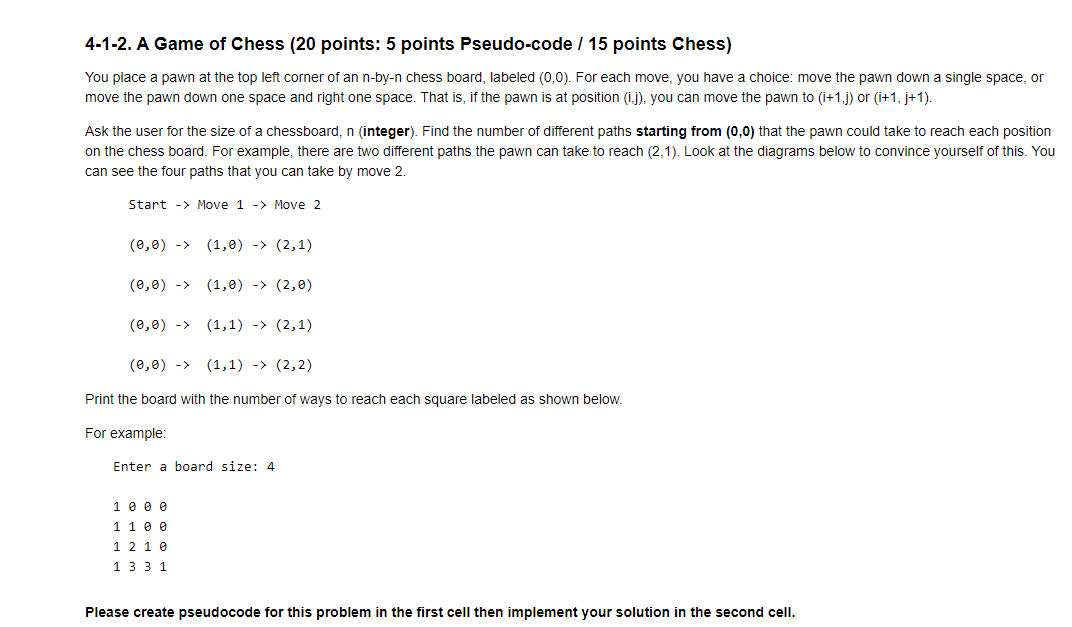
4-1-2. A Game of Chess (20 points: 5 points Pseudo-code / 15 points Chess) You place a pawn at the top left corner of an n-by-n chess board, labeled (0,0). For each move, you have a choice: move the pawn down a single space, or move the pawn down one space and right one space. That is, if the pawn is at position (i)), you can move the pawn to (i+1.j) or (i+1, 3+1). Ask the user for the size of a chessboard, n (integer). Find the number of different paths starting from (0,0) that the pawn could take to reach each position on the chess board. For example, there are two different paths the pawn can take to reach (2,1). Look at the diagrams below to convince yourself of this. You can see the four paths that you can take by move 2. Start -> Move 1 -> Move 2 (0,0) -> (1,0) -> (2,1) (0,0) -> (1,0) -> (2,0) (0,0) -> (1,1) -> (2,1) (0,0) -> (1,1) -> (2,2) Print the board with the number of ways to reach each square labeled as shown below. For example: Enter a board size: 4 1 000 1 1 0 0 1 2 1 0 1 3 3 1 Please create pseudocode for this problem in the first cell then implement your solution in the second cell
Step by Step Solution
There are 3 Steps involved in it

Get step-by-step solutions from verified subject matter experts
 Study Help