



Question: How would you summarize this article? Then add your own thoughts under the summary? Mackus et al. hangover cure. Using the same test. these variables
How would you summarize this article? Then add your own thoughts under the summary?
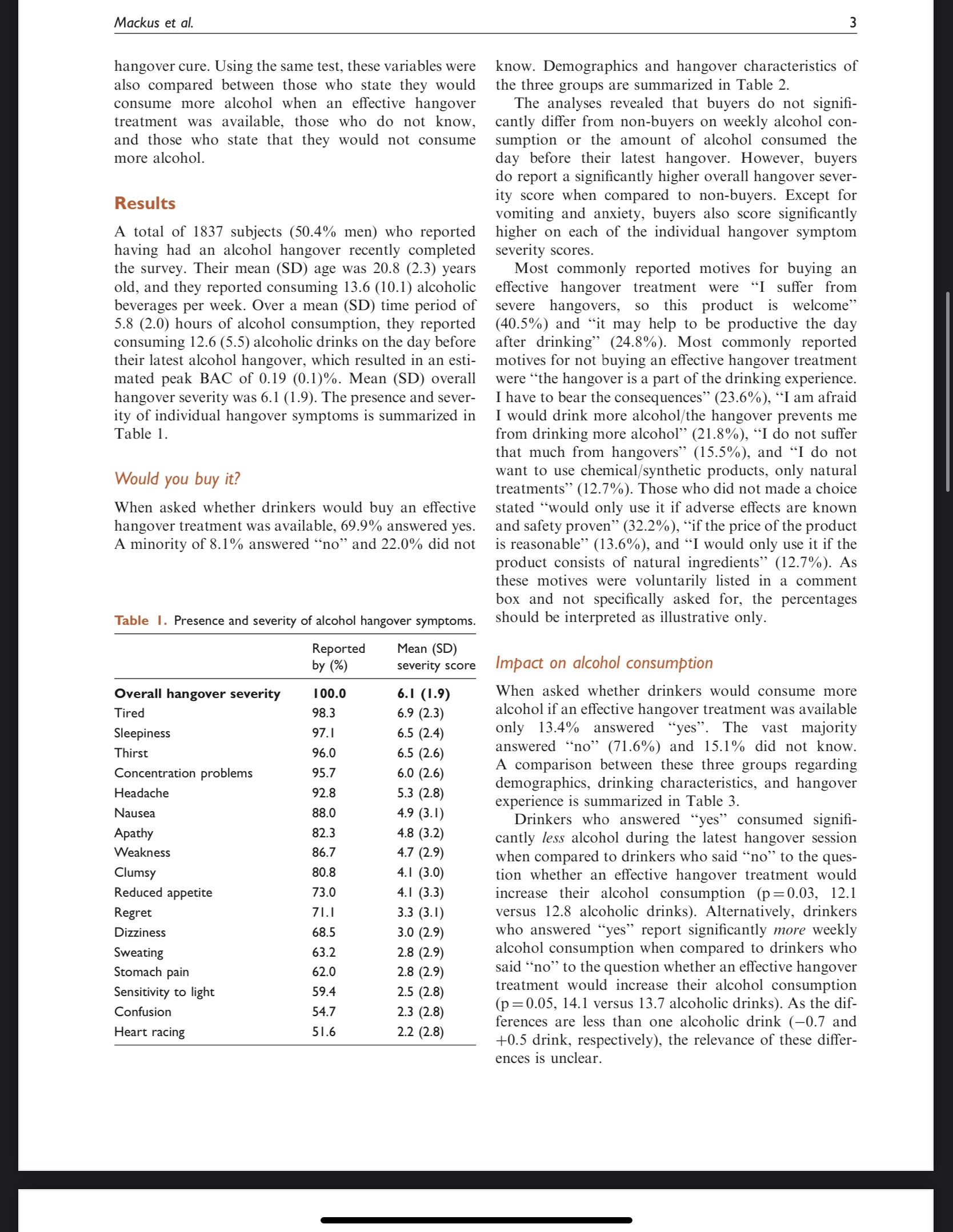
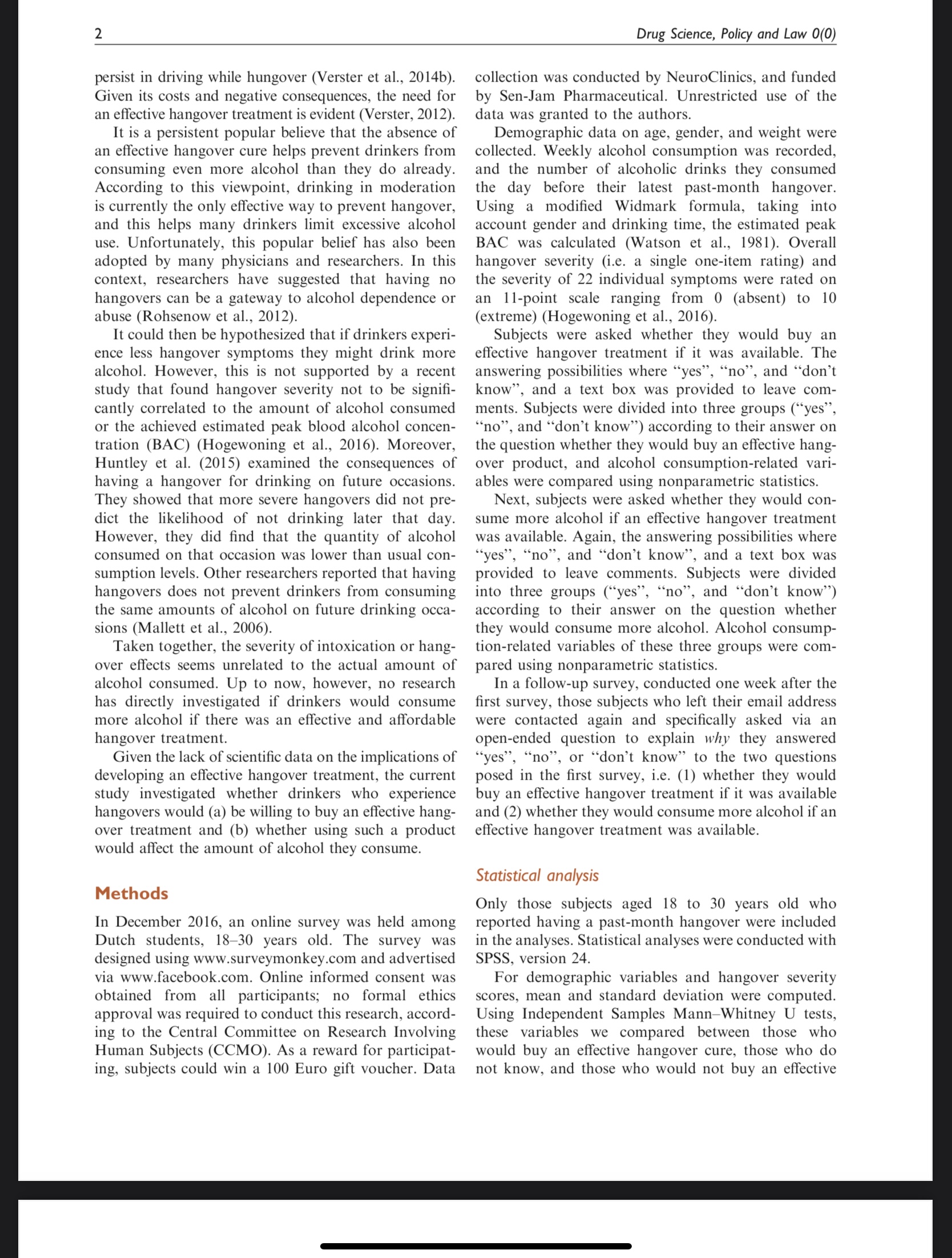
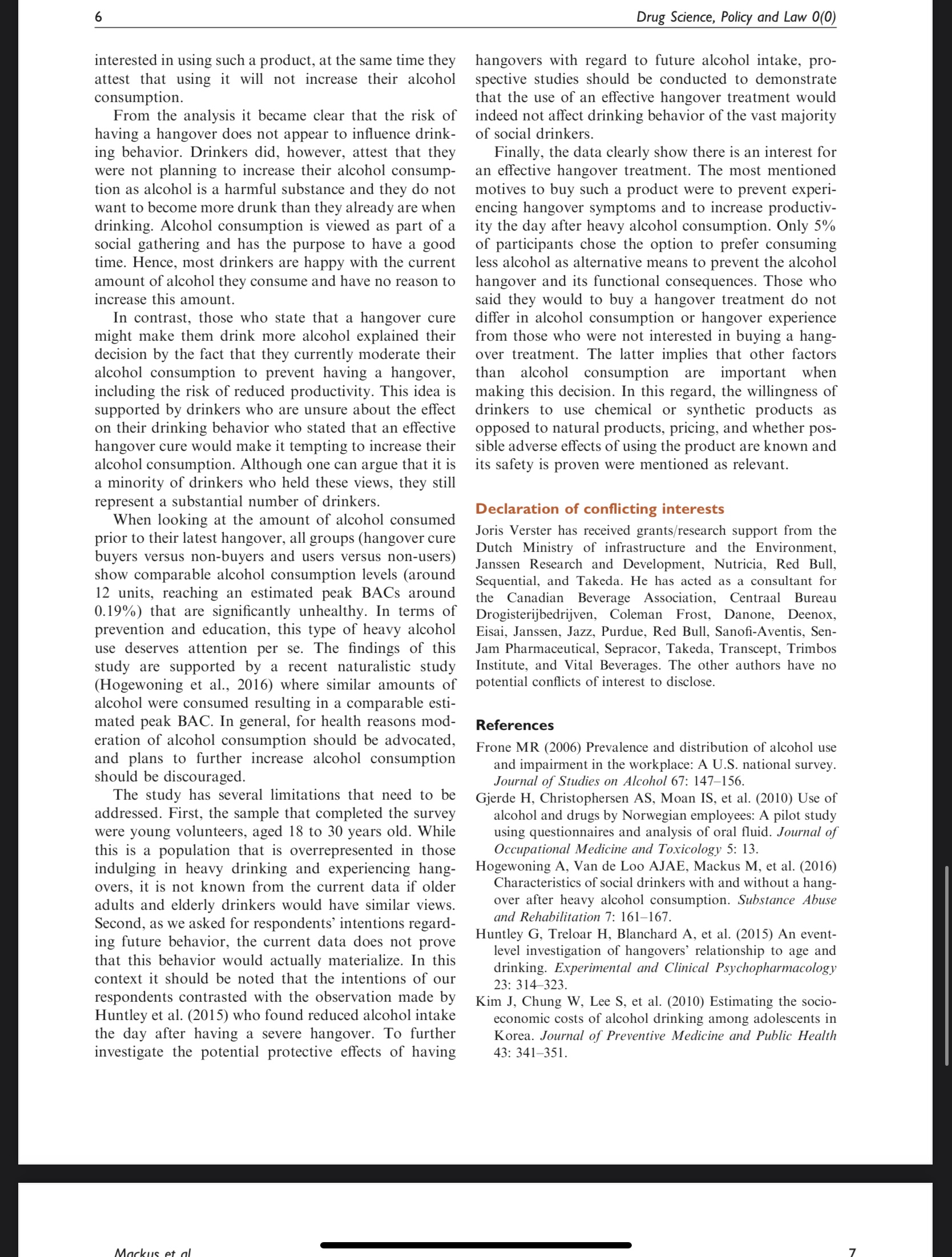
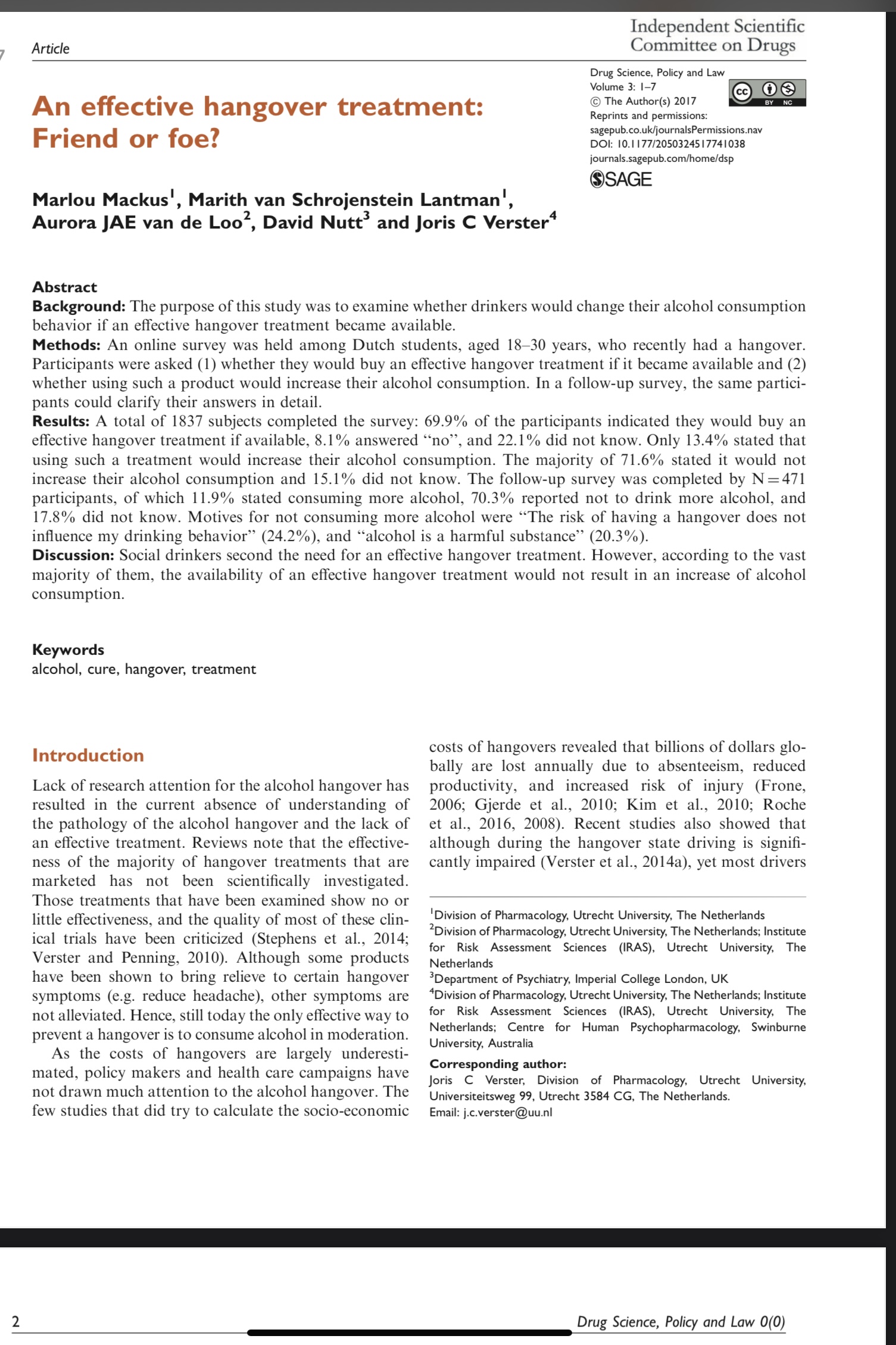
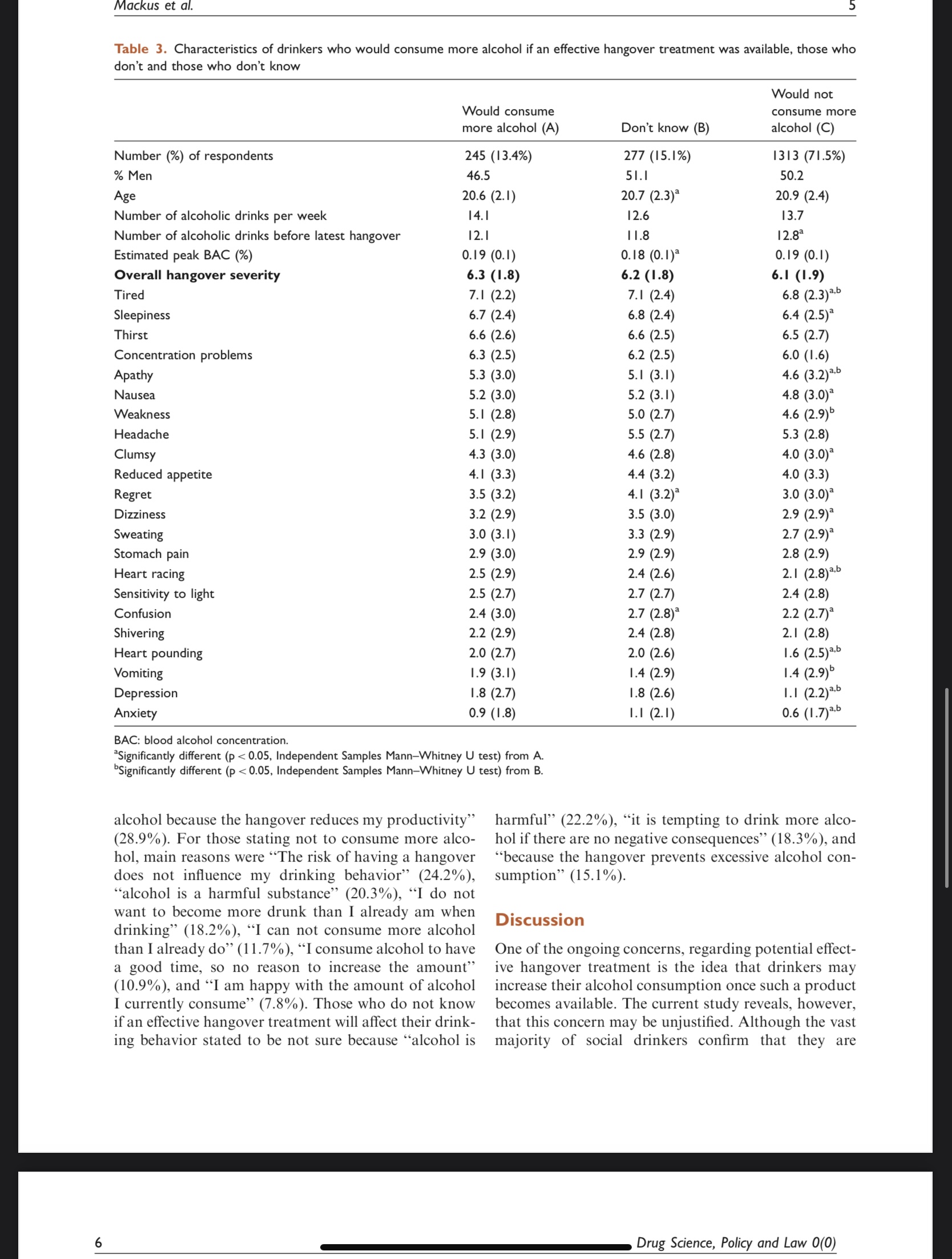
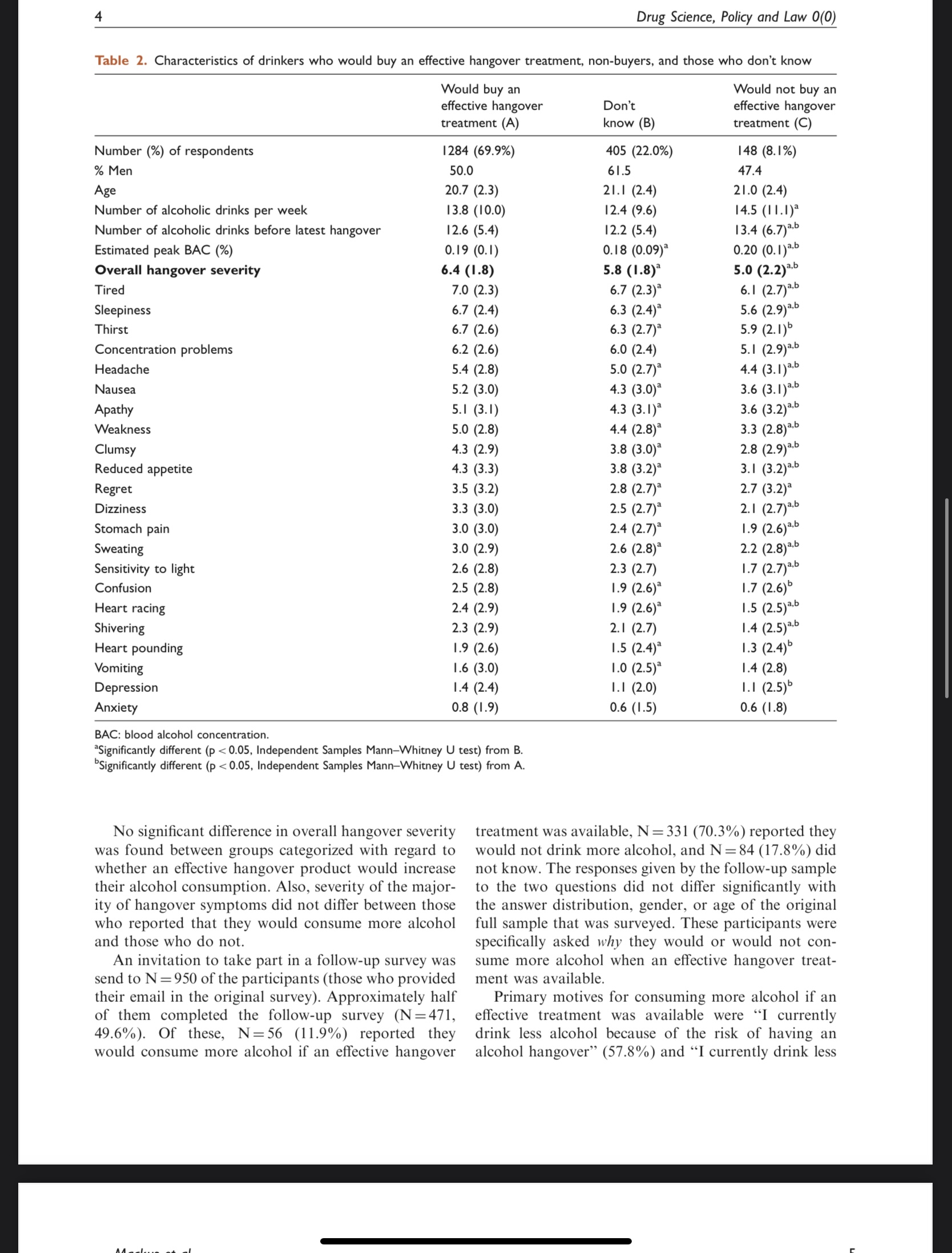
Mackus et al. hangover cure. Using the same test. these variables were also compared between those who state they would consume more alcohol when an effective hangover treatment was available. those who do not know. and those who state that they would not consume more alcohol. Results A total of 1837 subjects (50.4% men) who reported having had an alcohol hangover recently completed the survey. Their mean (SD) age was 20.8 (2.3) years old. and they reported consuming 13.6 (10.1) alcoholic beverages per week. Over a mean (SD) time period of 5.8 (2.0) hours of alcohol consumption. they reported consuming 12.6 (5.5) alcoholic drinks on the day before their latest alcohol hangover. which resulted in an esti- mated peak BAC of 0.19 (0.1)%. Mean (SD) overall hangover severity was 6.1 (1.9). The presence and sever ity of individual hangover symptoms is summarized in Table 1. Would you buy it? When asked whether drinkers would buy an effective hangover treatment was available. 69.9% answered yes. A minority of8. 1% answered "no" and 22.0% did not Table I. Presence and severity of alcohol hangover symptoms. Reported Mean (SD) by (%) severity score Overall hangover severity \"30.0 6.I (L9) Tired 98.3 6.9 (2.3) Sleepiness 97.1 6.5 (2.4) Thirst 96.0 6.5 (2.6) Concentration problems 95.7 6.0 (2.6) Headache 92.8 5.3 (2.8) Nausea 88.0 4.9 (3.|) Apathy 82.3 4.8 (3.2) Weakness 86.7 4.7 (2.9) Clumsy 80.8 4.I (3.0) Reduced appetite 73.0 4.| (3.3) Regret 71.! 3.3 (3.1) Dizziness 68.5 3.0 (2.9) Sweating 63.2 2.8 (2.9) Stomach pain 62.0 2.8 (2.9) Sensitivity to light 59.4 2.5 (2.8) Confusion 54.7 2.3 (2.8) Heart racing 5|.6 2.2 (2.8) know. Demographics and hangover characteristics of the three groups are summarized in Table 2. The analyses revealed that buyers do not signi- cantly differ from nonbuyers on weekly alcohol con sumption or the amount of alcohol consumed the day before their latest hangover. However. buyers do report a signicantly higher overall hangover sever- ity score when compared to nonbuyers. Except for vomiting and anxiety. buyers also score signicantly higher on each of the individual hangover symptom severity scores. Most commonly reported motives for buying an effective hangover treatment were \"1 suffer from severe hangovers. so this product is welcome" (40.5%) and \"it may help to be productive the day after drinking" (24.8%). Most commonly reported motives for not buying an effective hangover treatment were \"the hangover is a part of the drinking experience. I have to bear the consequences\" (23.6%). \"1 am afraid I would drink more alcohol.-'the hangover prevents me from drinking more alcohol\" (21.8%). "I do not suffer that much from hangovers" (15.5%). and \"1 do not want to use cheniicalyilsynthetic products. only natural treatments\" (12.7%). Those who did not made a choice stated "would only use it if adverse effects are known and safety proven\" (32.2%). \"ifthe price ofthe product is reasonable\" (13.6%). and \"1 would only use it if the product consists of natural ingredients" (12.7%). As these motives were voluntarily listed in a comment box and not specically asked for. the percentages should be interpreted as illustrative only. impact on alcohol consumption When asked whether drinkers would consume more alcohol if an effective hangover treatment was available only 13.4% answered \"yes". The vast majority answered "no\" (71.6%) and 15.1% did not know. A comparison between these three groups regarding demographics. drinking characteristics. and hangover experience is summarized in Table 3. Drinkers who answered "yes" consumed signi cantly less alcohol during the latest hangover session when compared to drinkers who said \"no" to the ques- tion whether an effective hangover treatment would increase their alcohol consumption (p=0.03._ 12.1 versus 12.8 alcoholic drinks). Alternatively. drinkers who answered \"yes" report signicantly more weekly alcohol consumption when compared to drinkers who said "no\" to the question whether an effective hangover treatment would increase their alcohol consumption (p : 0.05. 14.1 versus 13.7 alcoholic drinks). As the dif- ferences are less than one alcoholic drink (70.7 and +0.5 drink. respectively). the relevance of these differ- ences is unclear. persist in driving while hungover (Verster et al.. 2014b). Given its costs and negative consequences. the need for an effective hangover treatment is evident (Verster. 2012). It is a persistent popular believe that th ' absence of an effective hangover cure helps prevent drinkers from consuming even mor' alcohol than they do already. According to this viewpoint. drinking in moderation is currently the only effective way to prevent hangover. and this helps many drinkers limit excessive alcohol tlse. Unfortunately. this popular belief has also been adopted by many physicians and researchers. In this context. res'archers have suggested that having no hangovers can be a gateway to alcohol dependence or abuse (Rohsenow et al.. 2012). It could then be hypothesized that ifdrinkers experi- ence less hangover symptoms they might drink more alcohol. However. this is not supported by a recent study that found hangover severity not to be signifi 'antly correlated to the amount of alcohol consumed or the achieved estimated peak blood alcohol concen- tration (BAC) (Hogewoning et al.. 2016). Moreover. Huntley et al. (2015) examined the consequences of having a hangover for drinking on future occasions. They showed that more severe hangovers did not pre- dict the likelihood of not drinking later that day. However. they did find that the quantity of alcohol consumed on that occasion was lower than usual con- sumption levels. Other res 'archcrs reported that having hangovers does not Prevent drinkers from consuming the same amounts of alcohol on future drinking occa- sions (Mallett et al.. 2006). Taken together. the severity of intoxication or hang- over elfects seems unrelated to the actual amount of alcohol consumed. Up to now. however. no research has directly investigated if drinkers would consume more alcohol if there was an ellective and alfordable hangover treatment. Given the lack ofscientilic data on the implications of developing an effective hangover treatment. the current study investigated whether drinkers who experience hangovers would (a) be willing to buy an effective hang- over treatment and (b) whether using such a product would affect the amount of alcohol they consume. Methods In December 2016. an online survey was held among Dutch students. 1830 years old. The survey was designed using www.surveymonkey.com and advertised via www.facebook.com. Online informed consent was obtained from all participants: no formal ethics approval was required to conduct this research. accord- ing to the Central Committee on Research Involving Human Subjects (CCMO). As a reward for participat- ing. subjects could win a 100 Euro gift voucher. Data Drug Science, Policy and Law 0(0) collection was condtlcted by NeuroClinics. and funded by SenJam Pharmaceutical. Unrestricted use of the data was granted to the authors. Demographic data on age. gender. and weight were collected. Weekly alcohol consumption was recorded. and the number of alcoholic drinks they consumed the day before their latest pastmonth hangover. Using a modied Widmark formula. taking into account gender and drinking time. the estimated peak BAC was calculated (Watson et al.. 1981). Overall hangover severity (i.e. a single oneitem rating) and the severity of 22 individual symptoms were rated on an llpoint scale ranging from 0 (absent) to 10 (extreme) (Hogewoning et al.. 2016). Subjects were asked whether they would buy an effective hangover treatment if it was available. The answering possibilities where \"yes". \"no". and \"don't know". and a text box was provided to leave com ments. Subjects were divided into three groups (\"yes". \"no". and \"don't know") according to their answer on the question whether they would buy an elfective hang- over product. and alcohol consumptionrelated vari ables were compared using nonparametric statistics. Next. subjects were asked whether they would con- sume more alcohol if an effective hangover treatment was available. Again. the answering possibilities where \"yes". \"no". and \"don't know". and a text box was provided to leave comments. Subjects were divided into three groups ("'yes". \"no". and \"don't know") according to their answer on the question whether they would consume more alcohol. Alcohol consump- tion-related variables of these three groups were com- pared using nonparametric statistics. In a follow-up survey. conducted one week after the first survey. those subjects who left their email address were contacted again and specically asked via an open-ended question to explain why they answered \"yes". \"no". or \"don't know" to the two questions posed in the first survey. i.e. (1) whether they would buy an elfective hangover treatment if it was available and (2) whether they would consume more alcohol ifan effective hangover treatment was available. Statistical analysis Only those subjects aged 18 to 30 years old who reported having a past-month hangover were included in th ' analyses. Statistical analyses were conducted with SPSS. version 24. For demographic variables and hangover severity scores. mean and standard deviation were computed. Using Independent Samples Maanhitney U tests. these variables we compared between those who would btly an elfective hangover cure. those who do not know. and those who would not buy an effective Drug Science, Policy and Law 0(0) interested in using such a product, at the same time they hangovers with regard to future alcohol intake, pro- attest that using it will not increase their alcohol spective studies should be conducted to demonstrate consumption. that the use of an effective hangover treatment would From the analysis it became clear that the risk of indeed not affect drinking behavior of the vast majority having a hangover does not appear to influence drink- of social drinkers. ing behavior. Drinkers did, however, attest that they Finally, the data clearly show there is an interest for were not planning to increase their alcohol consump an effective hangover treatment. The most mentioned tion as alcohol is a harmful substance and they do not motives to buy such a product were to prevent experi- want to become more drunk than they already are when encing hangover symptoms and to increase productive drinking. Alcohol consumption is viewed as part of a ity the day after heavy alcohol consumption. Only 5% social gathering and has the purpose to have a good of participants chose the option to prefer consuming time. Hence, most drinkers are happy with the current less alcohol as alternative means to prevent the alcohol amount of alcohol they consume and have no reason to hangover and its functional consequences. Those who increase this amount. said they would to buy a hangover treatment do not In contrast, those who state that a hangover cure differ in alcohol consumption or hangover experience might make them drink more alcohol explained their from those who were not interested in buying a hang- decision by the fact that they currently moderate their over treatment. The latter implies that other factors alcohol consumption to prevent having a hangover, than alcohol consumption are important when including the risk of reduced productivity. This idea is making this decision. In this regard, the willingness of supported by drinkers who are unsure about the effect drinkers to use chemical or synthetic products as on their drinking behavior who stated that an effective opposed to natural products, pricing, and whether pos- hangover cure would make it tempting to increase their sible adverse effects of using the product are known and alcohol consumption. Although one can argue that it is its safety is proven were mentioned as relevant. a minority of drinkers who held these views, they still represent a substantial number of drinkers. When looking at the amount of alcohol consumed Declaration of conflicting interests prior to their latest hangover, all groups (hangover cure Joris Verster has received grants/research support from the buyers versus non-buyers and users versus non-users) Dutch Ministry of infrastructure and the Environment, show comparable alcohol consumption levels (around Janssen Research and Development, Nutricia, Red Bull, Sequential, and Takeda. He has acted as a consultant for 12 units, reaching an estimated peak BACs around the Canadian Beverage Association, Centraal Bureau 0.19%) that are significantly unhealthy. In terms of Drogisterijbedrijven, Coleman Frost, Danone, Deenox, prevention and education, this type of heavy alcohol Eisai, Janssen, Jazz, Purdue, Red Bull, Sanofi-Aventis, Sen- use deserves attention per se. The findings of this Jam Pharmaceutical, Sepracor, Takeda, Transcept, Trimbos study are supported by a recent naturalistic study Institute, and Vital Beverages. The other authors have no (Hogewoning et al., 2016) where similar amounts of potential conflicts of interest to disclose. alcohol were consumed resulting in a comparable esti- mated peak BAC. In general, for health reasons mod- References eration of alcohol consumption should be advocated, Frone MR (2006) Prevalence and distribution of alcohol use and plans to further increase alcohol consumption and impairment in the workplace: A U.S. national survey. should be discouraged Journal of Studies on Alcohol 67: 147-156. The study has several limitations that need to be Gjerde H, Christophersen AS, Moan IS, et al. (2010) Use of addressed. First, the sample that completed the survey alcohol and drugs by Norwegian employees: A pilot study were young volunteers, aged 18 to 30 years old. While ising questionnaires and analysis of oral fluid. Journal of this is a population that is overrepresented in those Occupational Medicine and Toxicology 5: 13. indulging in heavy drinking and experiencing hang- Hogewoning A, Van de Loo AJAE, Mackus M, et al. (2016) overs, it is not known from the current data if older Characteristics of social drinkers with and without a hang- adults and elderly drinkers would have similar views. over after heavy alcohol consumption. Substance Abuse Second, as we asked for respondents' intentions regard- and Rehabilitation 7: 161-167. ing future behavior, the current data does not prove Huntley G, Treloar H, Blanchard A, et al. (2015) An event- that this behavior would actually materialize. In this level investigation of hangovers' relationship to age and drinking. Experimental and Clinical Psychopharmacology context it should be noted that the intentions of our 23: 314-323. respondents contrasted with the observation made by Kim J, Chung W, Lee S, et al. (2010) Estimating the socio- Huntley et al. (2015) who found reduced alcohol intake economic costs of alcohol drinking among adolescents in the day after having a severe hangover. To further Korea. Journal of Preventive Medicine and Public Health investigate the potential protective effects of having 43: 341-351.Independent Scientific Article Committee on Drugs Drug Science, Policy and Law Volume 3: 1-7 CC An effective hangover treatment: The Author(s) 2017 Reprints and permissions: Friend or foe? sagepub.co.uk/journalsPermissions.nav DOI: 10.1 177/20503245 17741038 journals.sagepub.com/home/dsp OSAGE Marlou Mackus , Marith van Schrojenstein Lantman', Aurora JAE van de Loo, David Nutt' and Joris C Verster* Abstract Background: The purpose of this study was to examine whether drinkers would change their alcohol consumption behavior if an effective hangover treatment became available. Methods: An online survey was held among Dutch students, aged 18-30 years, who recently had a hangover. Participants were asked (1) whether they would buy an effective hangover treatment if it became available and (2) whether using such a product would increase their alcohol consumption. In a follow-up survey, the same partici- pants could clarify their answers in detail. Results: A total of 1837 subjects completed the survey: 69.9% of the participants indicated they would buy an effective hangover treatment if available, 8.1% answered "no", and 22.1% did not know. Only 13.4% stated that using such a treatment would increase their alcohol consumption. The majority of 71.6% stated it would not increase their alcohol consumption and 15.1% did not know. The follow-up survey was completed by N=471 participants, of which 11.9% stated consuming more alcohol, 70.3% reported not to drink more alcohol, and 17.8% did not know. Motives for not consuming more alcohol were "The risk of having a hangover does not influence my drinking behavior" (24.2%), and "alcohol is a harmful substance" (20.3%). Discussion: Social drinkers second the need for an effective hangover treatment. However, according to the vast majority of them, the availability of an effective hangover treatment would not result in an increase of alcohol consumption. Keywords alcohol, cure, hangover, treatment Introduction costs of hangovers revealed that billions of dollars glo- bally are lost annually due to absenteeism, reduced Lack of research attention for the alcohol hangover has productivity, and increased risk of injury (Frone, resulted in the current absence of understanding of 2006; Gjerde et al., 2010; Kim et al., 2010; Roche the pathology of the alcohol hangover and the lack of et al., 2016, 2008). Recent studies also showed that an effective treatment. Reviews note that the effective- although during the hangover state driving is signifi- ness of the majority of hangover treatments that are cantly impaired (Verster et al., 2014a), yet most drivers marketed has not been scientifically investigated. Those treatments that have been examined show no or little effectiveness, and the quality of most of these clin- 'Division of Pharmacology, Utrecht University, The Netherlands ical trials have been criticized (Stephens et al., 2014; 2 Division of Pharmacology, Utrecht University, The Netherlands; Institute for Risk Assessment Sciences (IRAS), Utrecht University, The Verster and Penning, 2010). Although some products Netherlands have been shown to bring relieve to certain hangover Department of Psychiatry, Imperial College London, UK symptoms (e.g. reduce headache), other symptoms are *Division of Pharmacology, Utrecht University, The Netherlands; Institute not alleviated. Hence, still today the only effective way to for Risk Assessment Sciences (IRAS), Utrecht University, The prevent a hangover is to consume alcohol in moderation. Netherlands; Centre for Human Psychopharmacology, Swinburne As the costs of hangovers are largely underesti- University, Australia mated, policy makers and health care campaigns have Corresponding author: Joris C Verster, Division of Pharmacology, Utrecht University, not drawn much attention to the alcohol hangover. The Universiteitsweg 99, Utrecht 3584 CG, The Netherlands. few studies that did try to calculate the socio-economic Email: j.c.verster@uu.nl Drug Science, Policy and Law O(0)Mackus et al. Table 3. Characteristics of drinkers who would consume more alcohol if an effective hangover treatment was available. those who don't and those who don't know Would not Would consume consume more more alcohol (A) Don't know (B) alcohol (C) Number (%) of respondents 245 (I3.4%) 277 (15.1%) I313 (71.5%) % Men 46.5 51.1 50.2 Age 20.6 (2.1) 20.7 (2.3)3 20.9 (2.4) Number of alcoholic drinks per week |4.l l2.6 l3.7 Number of alcoholic drinks before latest hangover |2.| | |.8 |2.8a Estimated peak BAC (%) 0.]9 (0.1) 0. 18 (0.1)\" 0.19 (0.1) Overall hangover severity 6.3 (1.8) 6.2 (LB) 6 6(11.9) Tired 7.! (2.2) 7.1 (2.4) (.2 3):b Sleepiness 6.7 (2.4) 6.8 (2.4) 4(2.5 Thirst 6.6 (2.6) 6.6 (2.5) 5.(2 7) Concentration problems 6.3 (2.5) 6.2 (2.5) DU 6.) Apathy 5.3 (3.0) 5| (3. I) .6.(3 2)ab Nausea 5.2 (3.0) 5.2 (3. I) 8(3. 0)3 Weakness 5.| (2.8) 5.0 (2. 7) 6(.2 9)b Headache 5.1 (2.9) 5. 5 (2. 7) 3(2. 8) Clumsy 4.3 (3.0) 62.( 8) (.3 0)3 Reduced appetite 4.! (3.3) 4.4 (3. 2) 0(.3 3) Regret 3.5 (3.2) 4.1 (3. 2) .0(3. 0)3 Dizziness 3.2 (2.9) 3.5 (3.0) 9(.2 9) Sweating 3.0 (FM) 3.3 (2.9) .7(.2 9) Stomach pain 2.9 (3.0) 2.9 (2.9) 8(.2 9) Heart racing 2.5 (2.9) 2.4 (2.6) I.(2 8)ah Sensitivity to light 2.5 (2.7) 2.7 (2.7) 4(2.8 Confusion 2.4 (3.0) 2.7 (2.8)3 2(.2 7) Shivering 2.2 (2.9) 2.4 (2.8) |.(2 8) Heart pounding 2.0 (2.7) 2.0 (2.6) .(.2 5) 3" Vomiting 1.9 (3.1) 1.4 (2.9) 4(.2 9)b Depression 1.8 (2.7) I.8 (2.6) |(.2 2)3 h Anxiety 0.9 (1.8) H (2.1) 6(I 7.)\"'b BAC: blood alcohol concentration. aSignicantly different (p
Step by Step Solution
There are 3 Steps involved in it

Get step-by-step solutions from verified subject matter experts