



Question: However many you can answer would be helpful! Thank you! Nestle, the world's largest consumer packaged food company, rocked the food space in 2018 by
However many you can answer would be helpful! Thank you! 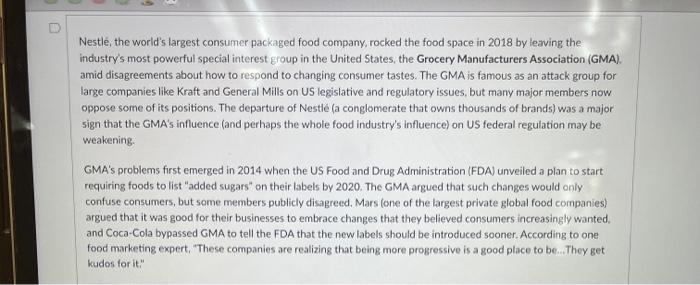
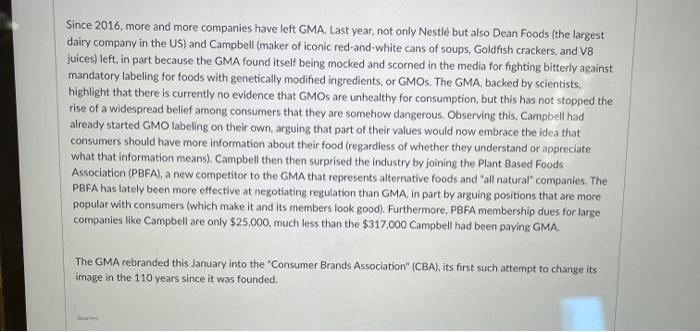
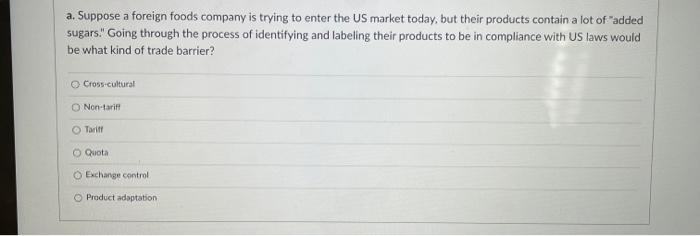
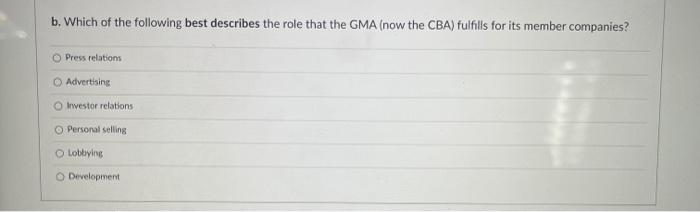
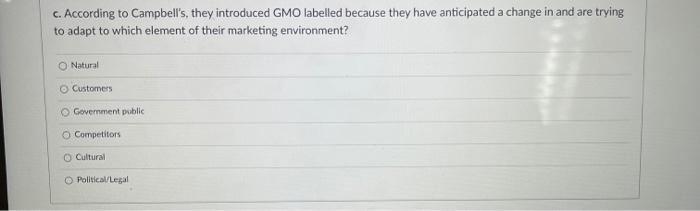
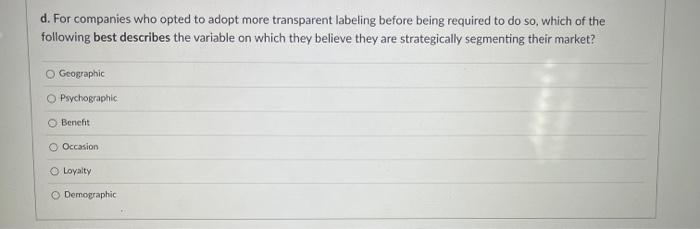
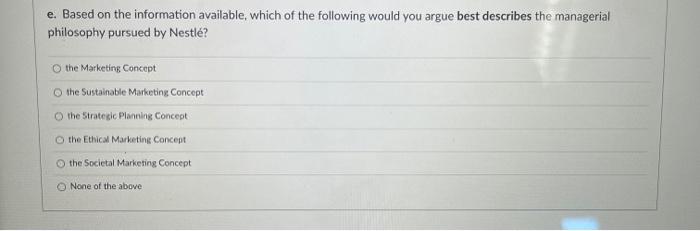
Nestle, the world's largest consumer packaged food company, rocked the food space in 2018 by leaving the industry's most powerful special interest group in the United States, the Grocery Manufacturers Association (GMA). amid disagreements about how to respond to changing consumer tastes. The GMA is famous as an attack group for large companies like Kraft and General Mills on US legislative and regulatory issues, but many major members now oppose some of its positions. The departure of Nestl (a conglomerate that owns thousands of brands) was a major sign that the GMA's influence (and perhaps the whole food industry's influence) on US federal regulation may be weakening GMA's problems first emerged in 2014 when the US Food and Drug Administration (FDA) unveiled a plan to start requiring foods to list "added sugars" on their labels by 2020. The GMA argued that such changes would only confuse consumers, but some members publicly disagreed. Mars (one of the largest private global food companies) argued that it was good for their businesses to embrace changes that they believed consumers increasingly wanted and Coca-Cola bypassed GMA to tell the FDA that the new labels should be introduced sooner. According to one food marketing expert, "These companies are realizing that being more progressive is a good place to be. They get kudos for it." Since 2016, more and more companies have left GMA. Last year, not only Nestl but also Dean Foods (the largest dairy company in the US and Campbell (maker of iconic red-and-white cans of soups, Goldfish crackers and V8 juices) left in part because the GMA found itself being mocked and scored in the media for fighting bitterly against mandatory labeling for foods with genetically modified ingredients, or GMOs. The GMA backed by scientists, highlight that there is currently no evidence that GMOs are unhealthy for consumption, but this has not stopped the rise of a widespread belief among consumers that they are somehow dangerous. Observing this, Campbell had already started GMO labeling on their own, arguing that part of their values would now embrace the idea that consumers should have more information about their food (regardless of whether they understand or appreciate what that information means). Campbell then then surprised the industry by joining the Plant Based Foods Association (PBFA), a new competitor to the GMA that represents alternative foods and fall natural companies. The PBFA has lately been more effective at negotiating regulation than GMA. In part by arguing positions that are more popular with consumers (which make it and its members look good). Furthermore, PBFA membership dues for large companies like Campbell are only $25,000, much less than the $317,000 Campbell had been paying GMA. The GMA rebranded this January into the Consumer Brands Association (CBA), its first such attempt to change its image in the 110 years since it was founded, a. Suppose a foreign foods company is trying to enter the US market today, but their products contain a lot of added sugars."Going through the process of identifying and labeling their products to be in compliance with US laws would be what kind of trade barrier? Cross-cultural Non tarif Tari O Quota Exchange control Product adaptation b. Which of the following best describes the role that the GMA (now the CBA) fulfills for its member companies? Press relations Advertising Investor relations Personal selling Lobbying Development c. According to Campbell's, they introduced GMO labelled because they have anticipated a change in and are trying to adapt to which element of their marketing environment? Natural Customers Government public Competitors Cultural Political/Legal d. For companies who opted to adopt more transparent labeling before being required to do so, which of the following best describes the variable on which they believe they are strategically segmenting their market? Geographic Psychographic Benefit Occasion Loyalty Demographic e. Based on the information available, which of the following would you argue best describes the managerial philosophy pursued by Nestl? the Marketing Concept the Sustainable Marketing Concept the Strategic Planning Concept O the Ethical Marketing Concept the Societal Marketing Concept None of the above Step by Step Solution
There are 3 Steps involved in it
1 Expert Approved Answer
Step: 1 Unlock

Question Has Been Solved by an Expert!
Get step-by-step solutions from verified subject matter experts
Step: 2 Unlock
Step: 3 Unlock