







Question: (https: //en.wikipedia.org/wiki/Drake_equation), the number of such civilizations, N, is equal to the product of a number of terms. For this assignment, we will use the
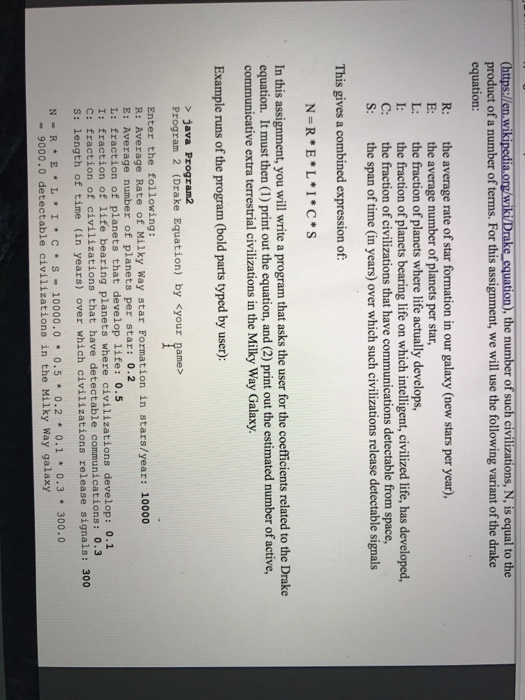
(https: //en.wikipedia.org/wiki/Drake_equation), the number of such civilizations, N, is equal to the product of a number of terms. For this assignment, we will use the following variant of the drake equation: R: the average rate of star formation in our galaxy (new stars per year), E: the average number of planets per star, L: the fraction of planets where life actually develops, I: the fraction of planets bearing life on which intelligent, civilized life, has developed C: the fraction of civilizations that have communications detectable from space, S: the span of time (in years) over which such civilizations release detectable signals This gives a combined expression of: N = R * E * L * I * C * S In this assignment, you will write a program that asks the user for the coefficients related to the Drake equation. It must then (1) print out the equation, and (2) print out the estimated number of active, communicative extra terrestrial civilizations in the Milky Way Galaxy. Example runs of the program (bold parts typed by user): > java Program 2 Program 2 (Drake Equation) by Enter the following: R: Average Rate of Milky Way star Formation in stars/year: 10000 E: Average number of planets per star: 0.2 L: fraction of planets that develop life: 0.5 I: fraction of life bearing planets where civilizations develop: 0.1 C: fraction of civilizations that have detectable communications: 0.3 s: length of time (in years) over which civilizations release signals: 300 N = R * E * L * I * C * S = 10000.0 * 0.5 * 0.2 * 0.1 * 0.3 * 300.0 = 9000.0 detectable civilizations in the Milky Way galaxy
Step by Step Solution
There are 3 Steps involved in it

Get step-by-step solutions from verified subject matter experts
 Study Help