







Question: https://drive.google.com/file/d/1dwLqIZW0V34hg5BK-ekpG2BMxAi-p-Bh/view If you cannot see the question below, please refer to Question 4 of the file above (accessible via Google Drive download): Note: It is
https://drive.google.com/file/d/1dwLqIZW0V34hg5BK-ekpG2BMxAi-p-Bh/view
If you cannot see the question below, please refer to Question 4 of the file above (accessible via Google Drive download):
Note: It is just a problem of discrete probability and ergodicity in Markov chain.
==="Latex" format of question including all the equations:=====
Exercise 4: Let (X_n)^\infty_{n=1} be a sequence of A's and B's formed as follows. The first two letters, X_1 and X_2, are chosen independently and at random, with Pr(A) = Pr(B) = 1/2. For n \geq 2, letter X_{n+1} is selected in a way that depends on previously selected letters.
(1). Suppose X_{n+1}, for n \geq 2, is selected conditionally on X_n with
\[Pr(X_{n+1} =A|X_n =A)=1/2\]
\[Pr(X_{n+1} =A|X_n =B)=1/4\]
Find the proportion of A's and B's in an infinitely long sequence
(X_n).
(2). Suppose we instead select X_{n+1}, for n \geq 2, conditionally on the preceding two letters with \[Pr(X_{n+1} = A|X_n = A,X_{n-1} = A) = Pr(X_{n+1} = A|X_n = B,X_{n-1} = A) = 1/2\] \[Pr(X_{n+1} = A|X_n = A,X_{n-1} = B) = Pr(X_{n+1} = A|X_n = B,X_{n-1} = B) = 1/4\] Is (X_{2n-1})^\infty _{n=1} a Markov chain? Explain.
(3). In the setting from (b), find the proportion of A's and B's in an infinitely long sequence.
========
===Snapshot of question:===
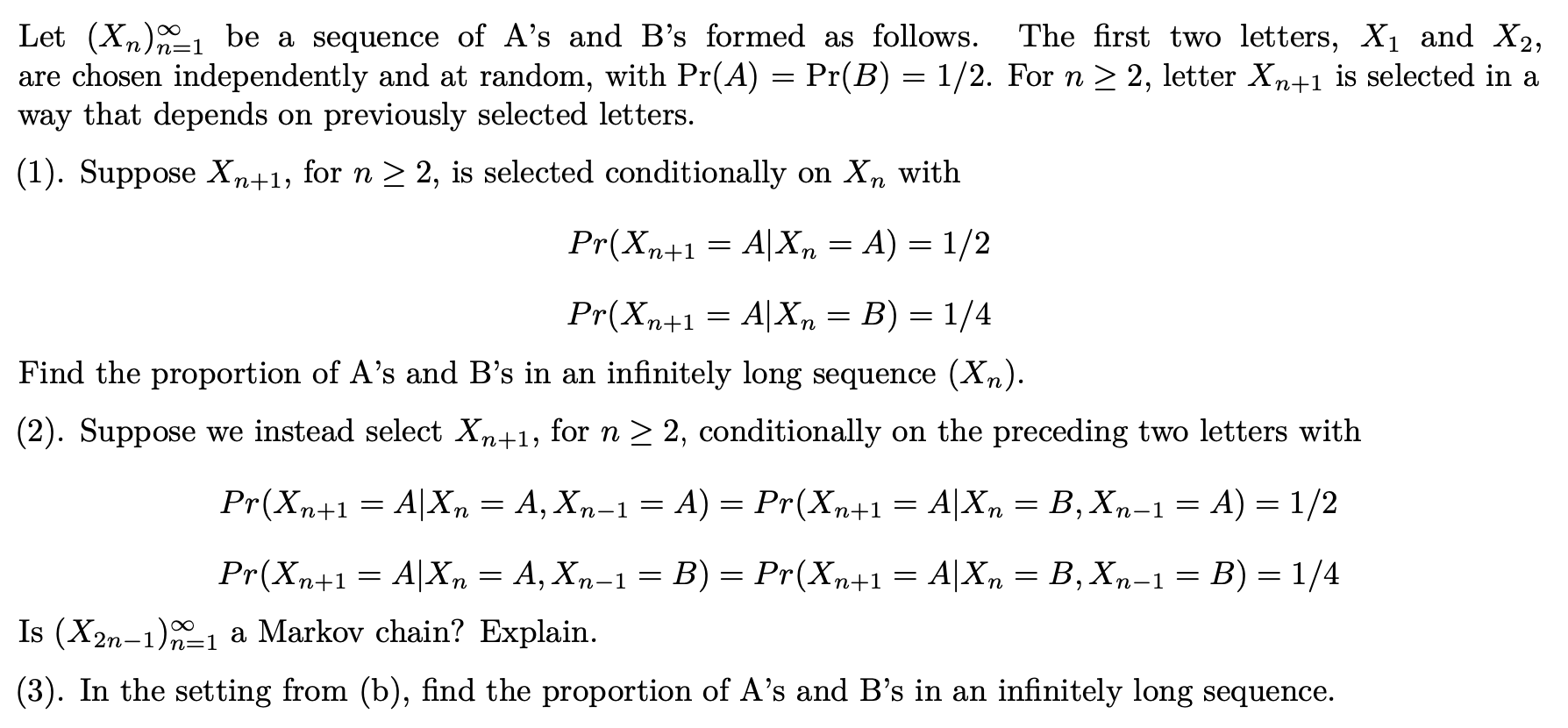
Let (Xn) . m=1 be a sequence of A's and B's formed as follows. The first two letters, X1 and X2, are chosen independently and at random, with Pr(A) = Pr(B) = 1/2. For n 2 2, letter Xn+1 is selected in a way that depends on previously selected letters. (1). Suppose Xn+1, for n 2 2, is selected conditionally on Xn with Pr(Xn+1 = A[Xn = A) =1/2 Pr(Xn+1 = AXn = B) = 1/4 Find the proportion of A's and B's in an infinitely long sequence (Xn). (2). Suppose we instead select Xn+1, for n 2 2, conditionally on the preceding two letters with Pr(Xn+1 = AXn = A, Xn-1 = A) = Pr(Xn+1 = A[Xn = B, Xn-1 = A) = 1/2 Pr(Xn+1 = AXn = A, Xn-1 = B) = Pr(Xn+1 = A[Xn = B, Xn-1 = B) = 1/4 Is (X2n-1)2 1 a Markov chain? Explain. (3). In the setting from (b), find the proportion of A's and B's in an infinitely long sequence
Step by Step Solution
There are 3 Steps involved in it

Get step-by-step solutions from verified subject matter experts
 Study Help