







Question: https://hbsp.harvard.edu/inspiring-minds/why-student-success-depends-on-continuous-feedback the following is the required: The main idea of the article Summarize the central idea of an article, also called the main idea, is
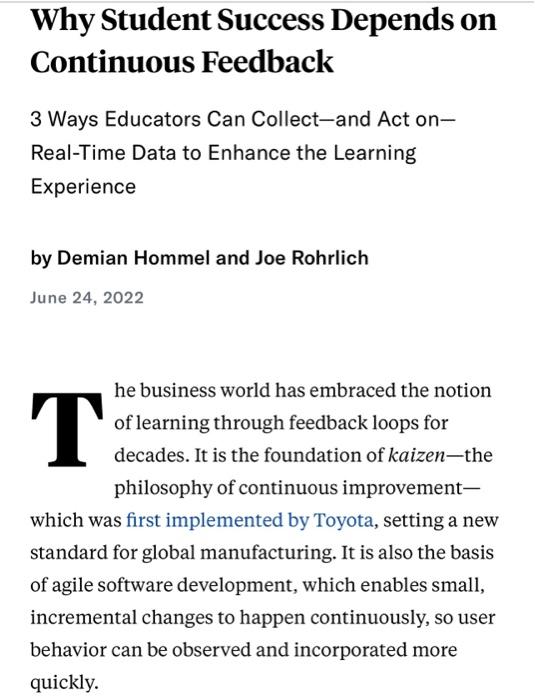
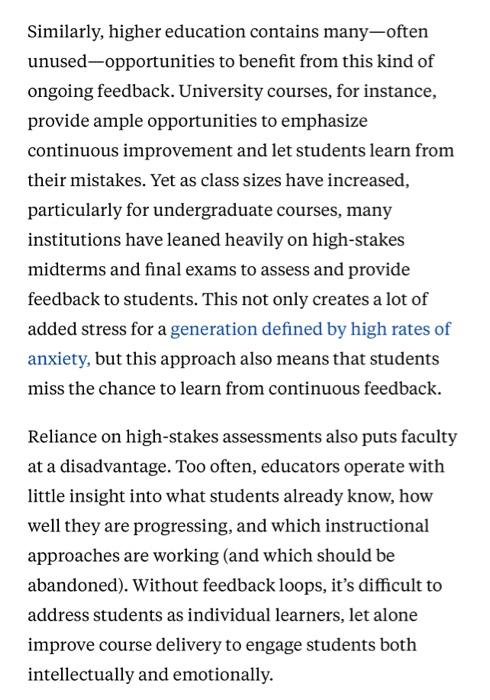
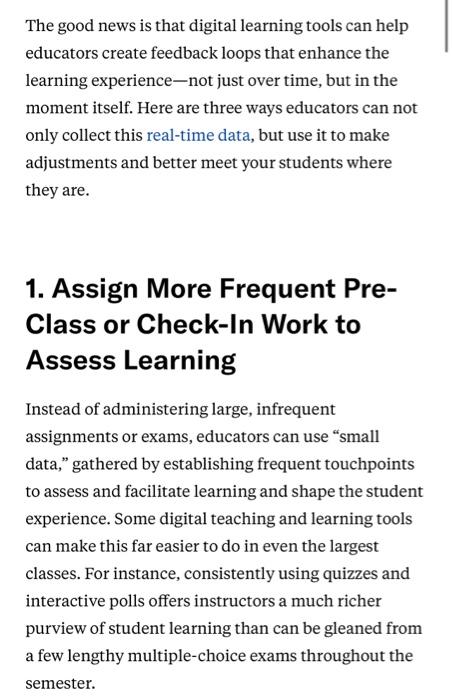
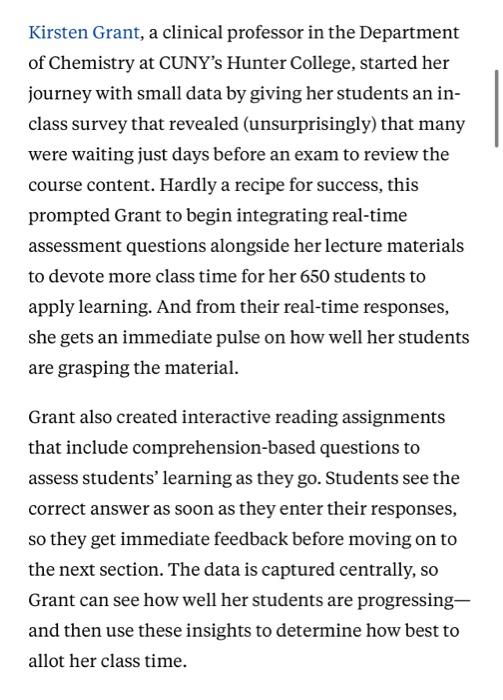
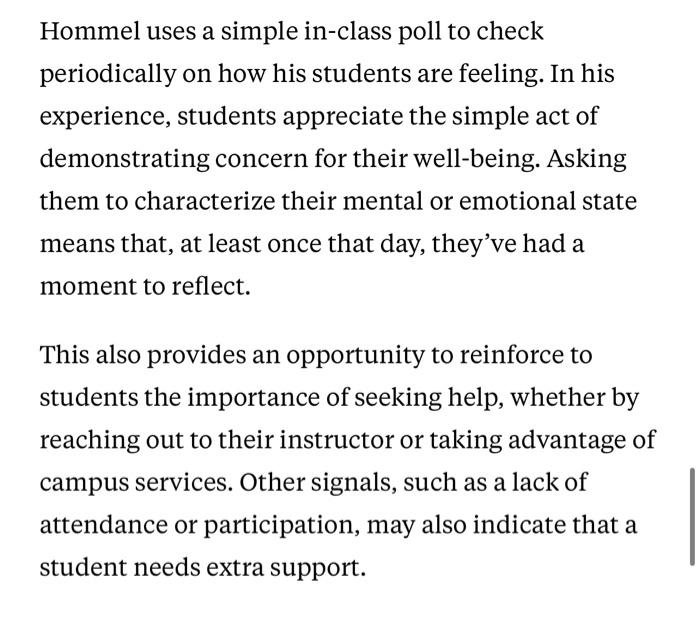
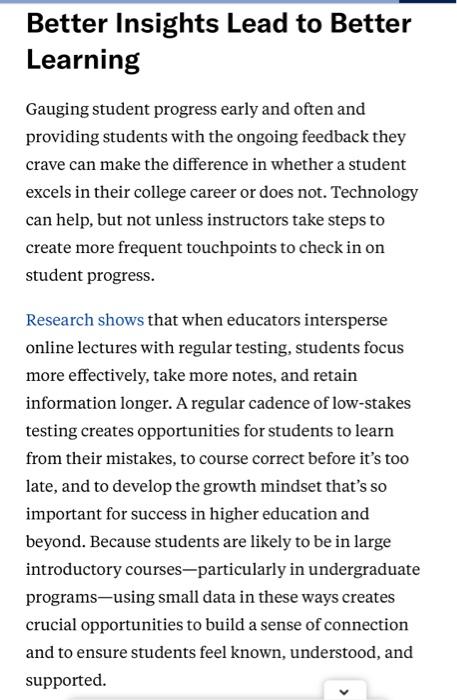
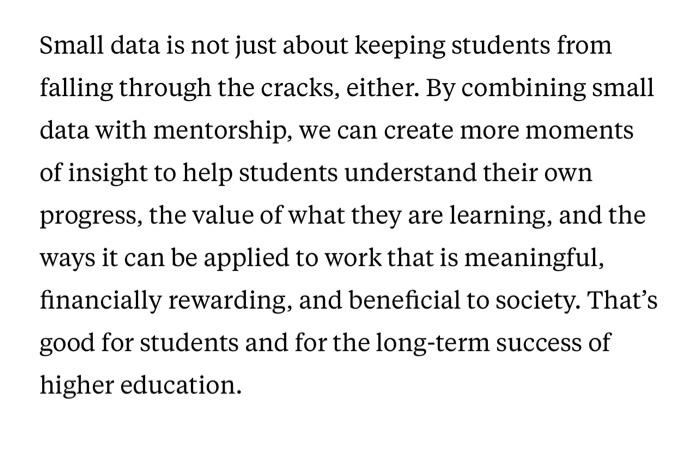
he business world has embraced the notion of learning through feedback loops for decades. It is the foundation of kaizen - the philosophy of continuous improvementwhich was first implemented by Toyota, setting a new standard for global manufacturing. It is also the basis of agile software development, which enables small, incremental changes to happen continuously, so user behavior can be observed and incorporated more quickly. Similarly, higher education contains many-often unused-opportunities to benefit from this kind of ongoing feedback. University courses, for instance, provide ample opportunities to emphasize continuous improvement and let students learn from their mistakes. Yet as class sizes have increased, particularly for undergraduate courses, many institutions have leaned heavily on high-stakes midterms and final exams to assess and provide feedback to students. This not only creates a lot of added stress for a generation defined by high rates of anxiety, but this approach also means that students miss the chance to learn from continuous feedback. Reliance on high-stakes assessments also puts faculty at a disadvantage. Too often, educators operate with little insight into what students already know, how well they are progressing, and which instructional approaches are working (and which should be abandoned). Without feedback loops, it's difficult to address students as individual learners, let alone improve course delivery to engage students both intellectually and emotionally. The good news is that digital learning tools can help educators create feedback loops that enhance the learning experience-not just over time, but in the moment itself. Here are three ways educators can not only collect this real-time data, but use it to make adjustments and better meet your students where they are. 1. Assign More Frequent PreClass or Check-In Work to Assess Learning Instead of administering large, infrequent assignments or exams, educators can use "small data," gathered by establishing frequent touchpoints to assess and facilitate learning and shape the student experience. Some digital teaching and learning tools can make this far easier to do in even the largest classes. For instance, consistently using quizzes and interactive polls offers instructors a much richer purview of student learning than can be gleaned from a few lengthy multiple-choice exams throughout the semester. Kirsten Grant, a clinical professor in the Department of Chemistry at CUNY's Hunter College, started her journey with small data by giving her students an inclass survey that revealed (unsurprisingly) that many were waiting just days before an exam to review the course content. Hardly a recipe for success, this prompted Grant to begin integrating real-time assessment questions alongside her lecture materials to devote more class time for her 650 students to apply learning. And from their real-time responses, she gets an immediate pulse on how well her students are grasping the material. Grant also created interactive reading assignments that include comprehension-based questions to assess students' learning as they go. Students see the correct answer as soon as they enter their responses, so they get immediate feedback before moving on to the next section. The data is captured centrally, so Grant can see how well her students are progressingand then use these insights to determine how best to allot her class time. 2. Ask Students Who They Are, Then Explore and Celebrate Their Differences Data collection doesn't have to apply just to assessments and grading; to make learning more relevant and meaningful, it can also help you understand who your students are. To ensure students see their own passions and life experiences reflected in the learning process, Demian Hommel, coauthor of this article, begins each term with a survey to capture his students' academic goals, interests, and a range of demographic information. Armed with these insights, he's able to reflect his students' unique viewpoints; as he engages them using interactive polls and discussions on various topics, he's also able to see the changes that may emerge as a result of the course content. For example, he may ask, Do students have favorable or unfavorable views about immigration? How do students from rural backgrounds differ compared to those from large urban centers? Overlaying student responses to various questions creates a sense of discovery, both individually and for the class as a whole, and allows students to appreciate differences in individual perspectives. As you might imagine, this is a great way to spur discussion. Responses can be used to frame areas of confusion or debate. In these instances, student feedback becomes a tool for teaching rather than a mechanism for determining if something is right or wrong. Feedback from student surveys also offers insights to better cater the learning experience. When it comes to undergraduate courses, most topics are relatively static. But by using a survey at the start of the semester, Hommel varies the examples he uses to bring learning to life based on student interests. Quick in-class polls can also be used to give students more autonomy over the assignments they take on. Would individuals prefer to do a video response on a topic or create a micro-lecture? Providing options gets students more invested in the outcome they're working toward by playing to their strengths, with the added benefit of keeping things interesting for the instructor. 3. Use In-Class Polls to Monitor Student Well-Being A nationwide survey by The Generation Lab and Axios reported that, since the start of the pandemic, 53 percent of students report having suffered from depression and 72 percent from anxiety. One in three have considered dropping out. Getting insight into student sentiment can help educators identify early signs of struggle and more easily scale mentorship and support. Hommel uses a simple in-class poll to check periodically on how his students are feeling. In his experience, students appreciate the simple act of demonstrating concern for their well-being. Asking them to characterize their mental or emotional state means that, at least once that day, they've had a moment to reflect. This also provides an opportunity to reinforce to students the importance of seeking help, whether by reaching out to their instructor or taking advantage of campus services. Other signals, such as a lack of attendance or participation, may also indicate that a student needs extra support. Better Insights Lead to Better Learning Gauging student progress early and often and providing students with the ongoing feedback they crave can make the difference in whether a student excels in their college career or does not. Technology can help, but not unless instructors take steps to create more frequent touchpoints to check in on student progress. Research shows that when educators intersperse online lectures with regular testing, students focus more effectively, take more notes, and retain information longer. A regular cadence of low-stakes testing creates opportunities for students to learn from their mistakes, to course correct before it's too late, and to develop the growth mindset that's so important for success in higher education and beyond. Because students are likely to be in large introductory courses-particularly in undergraduate programs-using small data in these ways creates crucial opportunities to build a sense of connection and to ensure students feel known, understood, and supported. Small data is not just about keeping students from falling through the cracks, either. By combining small data with mentorship, we can create more moments of insight to help students understand their own progress, the value of what they are learning, and the ways it can be applied to work that is meaningful, financially rewarding, and beneficial to society. That's good for students and for the long-term success of higher education
Step by Step Solution
There are 3 Steps involved in it

Get step-by-step solutions from verified subject matter experts
 Study Help