







Question: https://phet.colorado.edu/en/simulations/circuit-construction- kit-dc-virtual-lab this is the simulation link Part 2: Parallel Circuits 1. Build a circuit with two resistors R1 and R2 connected in parallel as
https://phet.colorado.edu/en/simulations/circuit-construction- kit-dc-virtual-lab
this is the simulation link
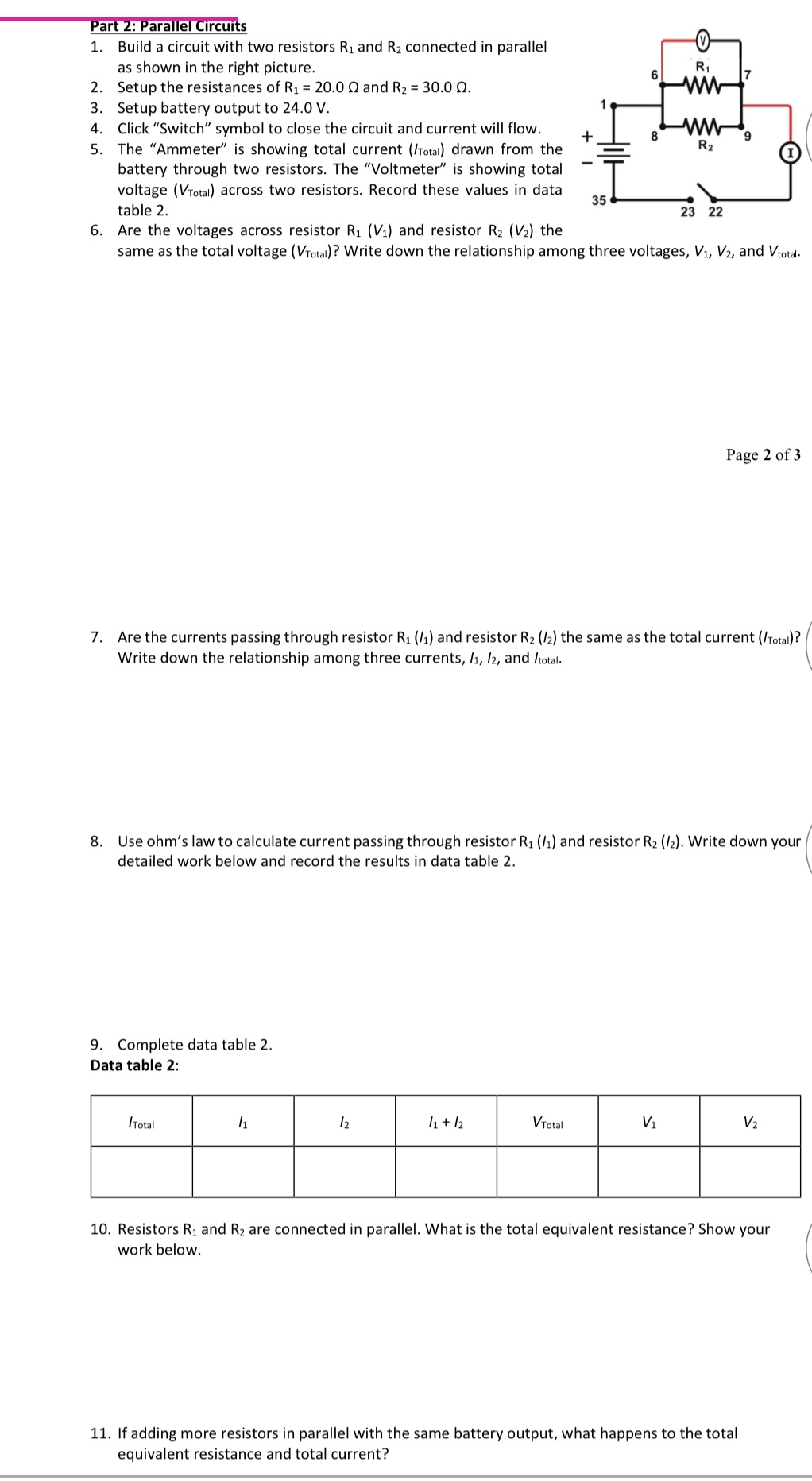
Part 2: Parallel Circuits 1. Build a circuit with two resistors R1 and R2 connected in parallel as shown in the right picture. R1 2. Setup the resistances of R1 = 20.0 0 and R2 = 30.0 0. WW 3. Setup battery output to 24.0 V. 4. Click "Switch" symbol to close the circuit and current will flow. WW 5 . The "Ammeter" is showing total current (/Total) drawn from the R2 battery through two resistors. The "Voltmeter" is showing total voltage (VTotal) across two resistors. Record these values in data 35 table 2. 23 22 6. Are the voltages across resistor R1 (V1) and resistor R2 (V2) the same as the total voltage (VTotal)? Write down the relationship among three voltages, V1, V2, and Vtotal. Page 2 of 3 7. Are the currents passing through resistor R1 (/1) and resistor R2 (/2) the same as the total current (/Total)? Write down the relationship among three currents, /1, /2, and /total. 8. Use ohm's law to calculate current passing through resistor R1 (/1) and resistor R2 (/2). Write down your detailed work below and record the results in data table 2. 9. Complete data table 2. Data table 2: /Total 12 1+/2 VTotal V1 V2 10. Resistors R1 and R2 are connected in parallel. What is the total equivalent resistance? Show your work below. 11. If adding more resistors in parallel with the same battery output, what happens to the total equivalent resistance and total current
Step by Step Solution
There are 3 Steps involved in it

Get step-by-step solutions from verified subject matter experts
 Study Help