







Question: https://phet.colorado.edu/sims/html/collision-lab/latest/collision-lab_en.html PhET Collision Lab In this lab activity we will explore the law of conservation of momentum by looking at different Collision scenarios Click on
https://phet.colorado.edu/sims/html/collision-lab/latest/collision-lab_en.html
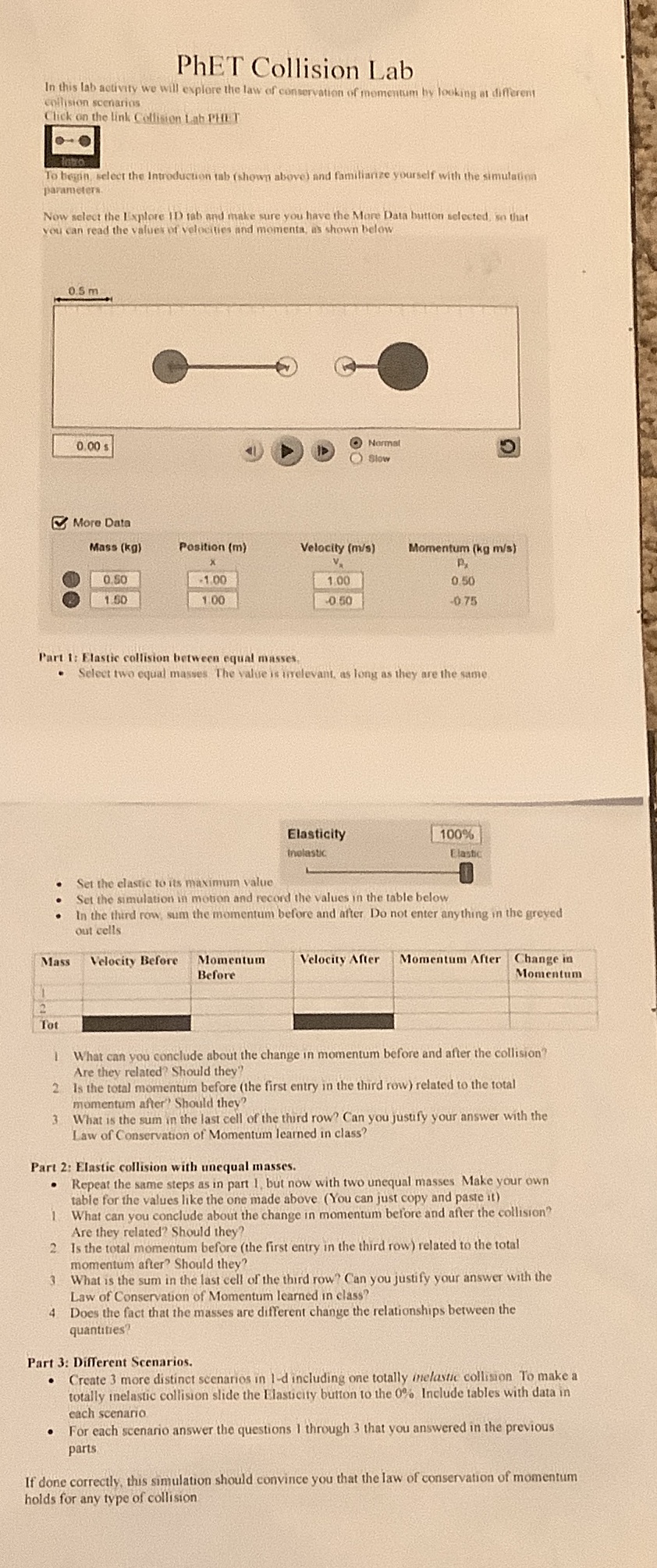
PhET Collision Lab In this lab activity we will explore the law of conservation of momentum by looking at different Collision scenarios Click on the link Collision Lah PHET To begin, select the Introduction tab (shown above) and familiarize yourself with the simulation parameters. Now select the Explore ID tab and make sure you have the Mare Data button selected, so that you can read the values of velocities and momenta, as shown below 0.5 m 0.00 s Normal G Slow More Data Mass (kg) Position (m) Velocity (m/s) Momentum (kg m/s) 0.50 -1.00 1:00 0.50 1:50 1:00 -0.50 075 Part 1: Elastic collision between equal masses, Select two equal masses The value is arelevant, as long as they are the same Elasticity 100% Inclastic Elastic Set the elastic to its maximum value Set the simulation in motion and record the values in the table below . In the third row, sum the momentum before and after Do not enter anything in the greyed out cells Mass Velocity Before Momentum Velocity After Momentum After |Change in Before Momentum 2 Tot What can you conclude about the change in momentum before and after the collision? Are they related? Should they" 2 Is the total momentum before (the first entry in the third row) related to the total momentum after" Should they? What is the sum in the last cell of the third row? Can you justify your answer with the Law of Conservation of Momentum learned in class? Part 2: Elastic collision with unequal masses. Repeat the same steps as in part 1, but now with two unequal masses Make your own table for the values like the one made above (You can just copy and paste it) What can you conclude about the change in momentum before and after the collision" Are they related? Should they? 2 Is the total momentum before (the first entry in the third row) related to the total momentum after? Should they? What is the sum in the last cell of the third row? Can you justify your answer with the Law of Conservation of Momentum learned in class? 4 Does the fact that the masses are different change the relationships between the quantities? Part 3: Different Scenarios. Create 3 more distinct scenarios in 1-d including one totally inelastic collision To make a totally inelastic collision slide the Elasticity button to the 0% Include tables with data in each scenario For each scenario answer the questions 1 through 3 that you answered in the previous parts If done correctly, this simulation should convince you that the law of conservation of momentum holds for any type of collision
Step by Step Solution
There are 3 Steps involved in it

Get step-by-step solutions from verified subject matter experts
 Study Help