



Question: https://phet.colorado.edu/sims/html/gravity-and-orbits/latest/gravity-and-orbits_en.html. Method. 1. Practice with the model option of the simulation to understand how it works. After this, use the to scale model practice measuring
https://phet.colorado.edu/sims/html/gravity-and-orbits/latest/gravity-and-orbits_en.html.
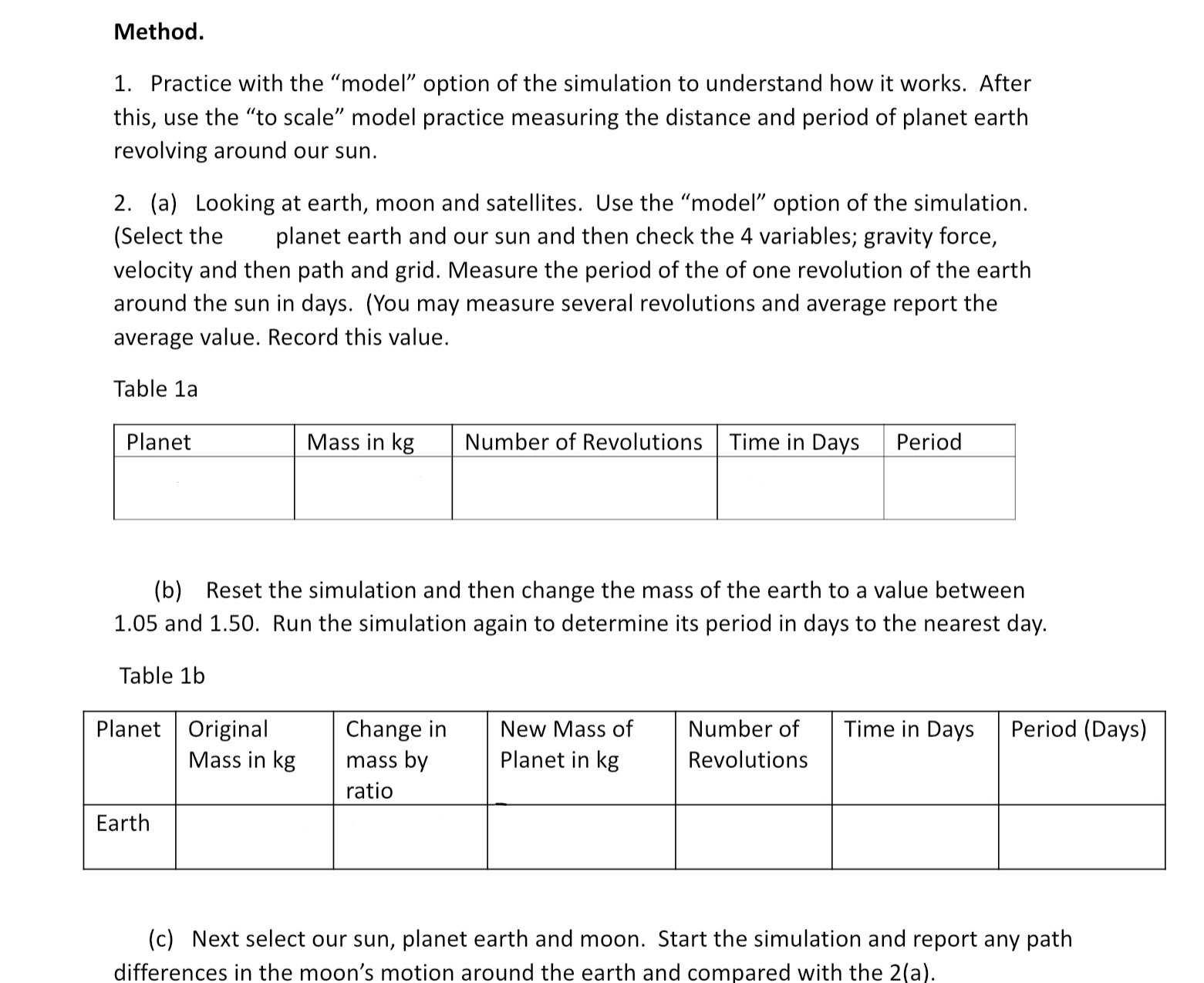
Method. 1. Practice with the \"model\" option of the simulation to understand how it works. After this, use the \"to scale" model practice measuring the distance and period of planet earth revolving around our sun. 2. (a) Looking at earth, moon and satellites. Use the "model\" option of the simulation. (Select the planet earth and our sun and then check the 4 variables; gravity force, velocity and then path and grid. Measure the period of the of one revolution of the earth around the sun in days. (You may measure several revolutions and average report the average value. Record this value. Table 1a Numberof Revolutions (b) Reset the simulation and then change the mass of the earth to a value between 1.05 and 1.50. Run the simulation again to determine its period in days to the nearest clay. Table 1b Original Change in New Mass of Number of Time in Days Period (Days) Mass in kg mass by Planet in kg Revolutions ratio ------- (c) Next select our sun, planet earth and moon. Start the simulation and report any path differences in the moon's motion around the earth and compared with the 2(a)
Step by Step Solution
There are 3 Steps involved in it

Get step-by-step solutions from verified subject matter experts