







Question: https://tutorial.math.lamar.edu/Classes/CalcI/DefnOfDerivative.aspx (Link for Q1) 1. In this page from the online notes :5 , Example 1 uses the limit denition of the derivative to calculate
https://tutorial.math.lamar.edu/Classes/CalcI/DefnOfDerivative.aspx (Link for Q1)
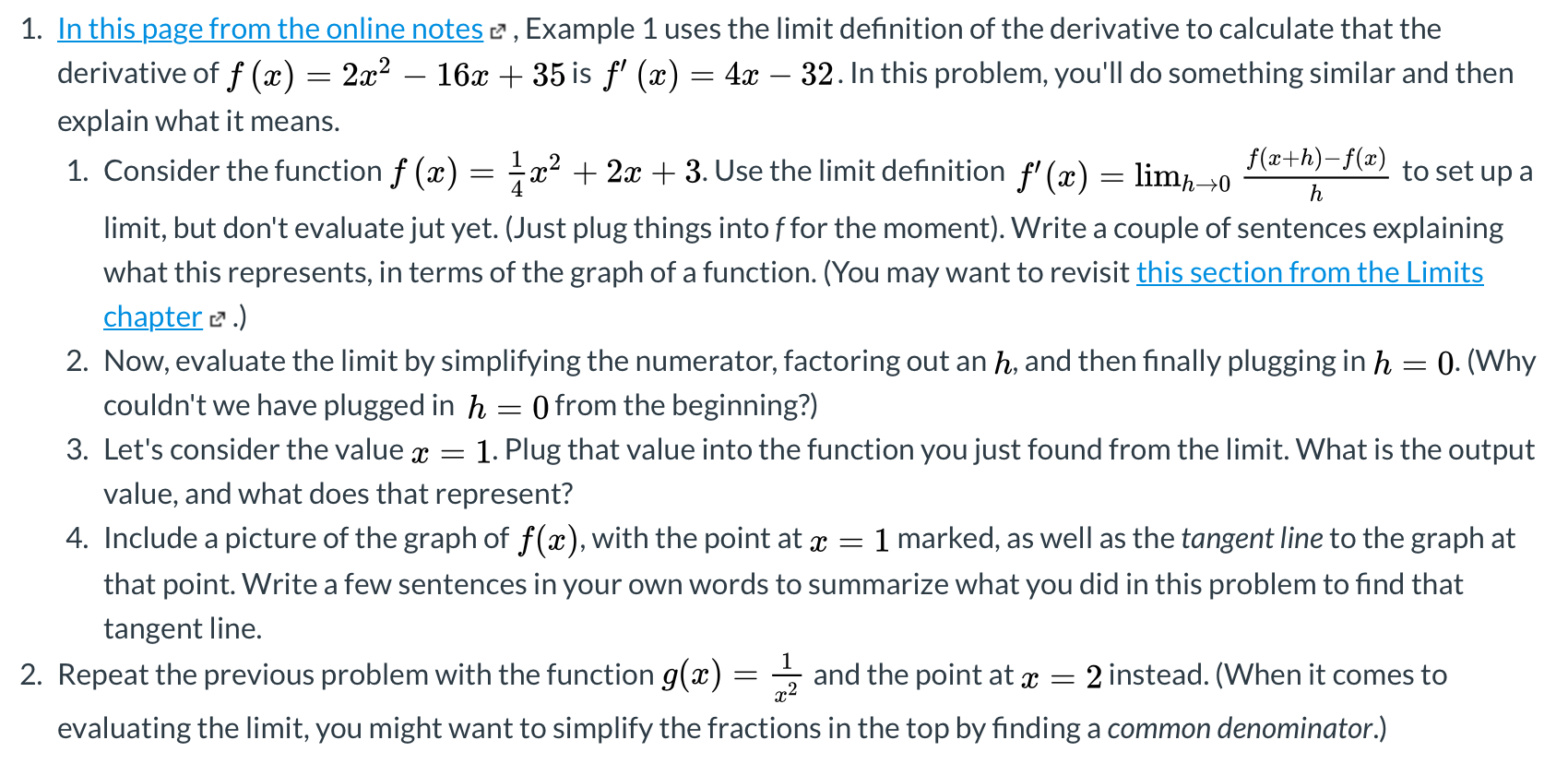
1. In this page from the online notes :5 , Example 1 uses the limit denition of the derivative to calculate that the derivative of f (3:) = 2x2 163: + 35 is f' (.71) = 4m 32. In this problem, you'll do something similar and then explain what it means. 1. Consider the function f(a:) = if + 2:1: + 3.Use thelimit denition f'(g;) = limeD w limit, but don't evaluate jut yet. (Just plug things into ffor the moment). Write a couple of sentences explaining what this represents, in terms of the graph of a function. (You may want to revisit this section from the Limits to set upa ch_apt_er a -) 2. Now, evaluate the limit by simplifying the numerator, factoring out an h, and then nally plugging in h, = 0. (Why couldn't we have plugged in h : 0 from the beginning?) 3. Let's consider the value at = 1. Plug that value into the function you just found from the limit. What is the output value, and what does that represent? 4. Include a picture of the graph of f($), with the point at a: : 1 marked, as well as the tangent line to the graph at that point. Write a few sentences in your own words to summarize what you did in this problem to nd that tangent line. 2. Repeat the previous problem with the function g(a:) 2 mi? and the point at m = 2 instead. (When it comes to evaluating the limit, you might want to simplify the fractions in the top by nding a common denominator.)
Step by Step Solution
There are 3 Steps involved in it

Get step-by-step solutions from verified subject matter experts
 Study Help