







Question: https://www.chegg.com/homework-help/Corporate-Finance-7th-edition-chapter-2-problem-1MC-solution-9781337909747 The mini case in Chapter 2 has no solution, can you give a complete solution? Jenny Cochran, a graduate of the University of Tennessee
https://www.chegg.com/homework-help/Corporate-Finance-7th-edition-chapter-2-problem-1MC-solution-9781337909747
The mini case in Chapter 2 has no solution, can you give a complete solution?
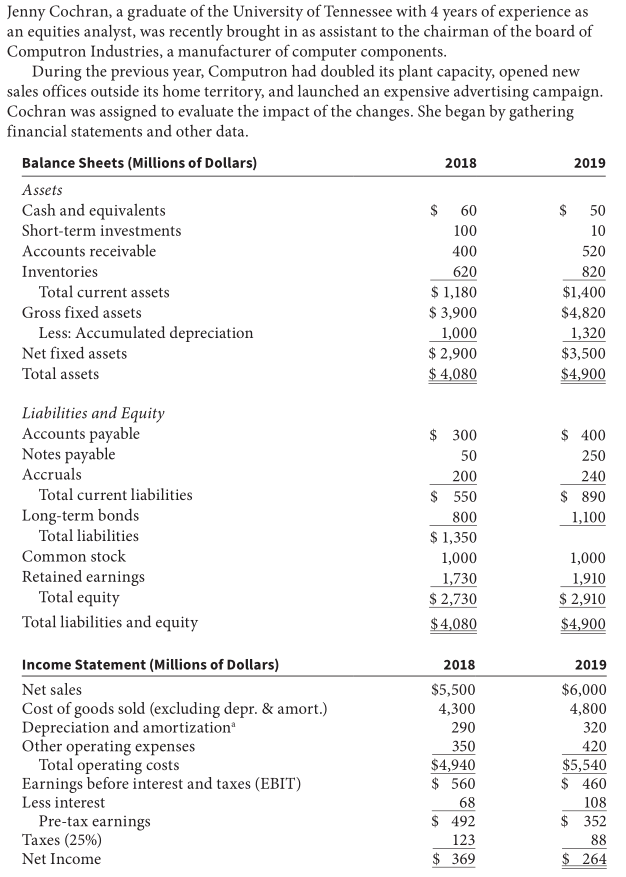
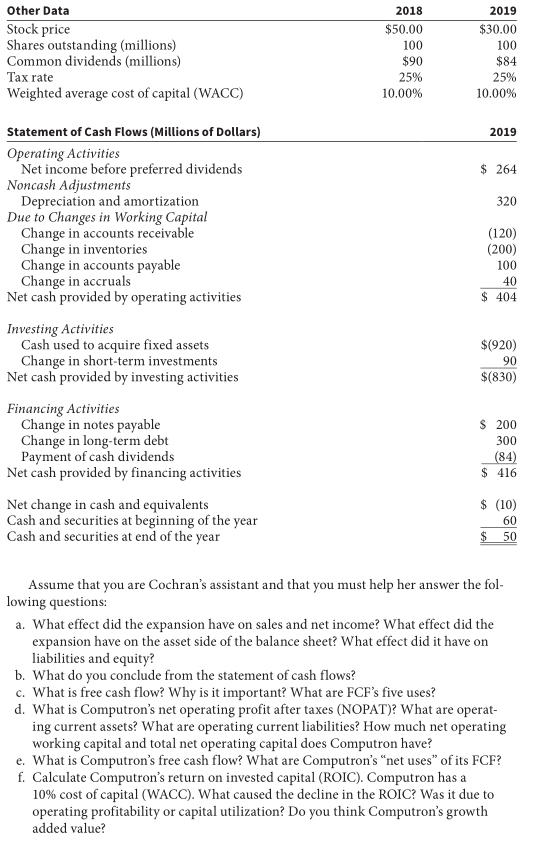
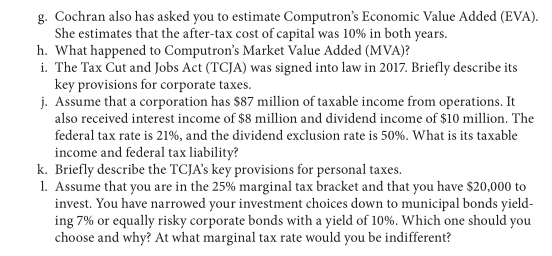
Jenny Cochran, a graduate of the University of Tennessee with 4 years of experience as an equities analyst, was recently brought in as assistant to the chairman of the board of Computron Industries, a manufacturer of computer components. During the previous year, Computron had doubled its plant capacity, opened new sales offices outside its home territory, and launched an expensive advertising campaign. Cochran was assigned to evaluate the impact of the changes. She began by gathering financial statements and other data. Balance Sheets (Millions of Dollars) 2018 2019 Assets Cash and equivalents $ 60 $ 50 Short-term investments 100 10 Accounts receivable 400 520 Inventories 620 820 Total current assets $ 1,180 $1,400 Gross fixed assets $3,900 $4,820 Less: Accumulated depreciation 1,000 1,320 Net fixed assets $ 2,900 $3,500 Total assets $ 4,080 $4,900 $ 300 50 200 $ 550 Liabilities and Equity Accounts payable Notes payable Accruals Total current liabilities Long-term bonds Total liabilities Common stock Retained earnings Total equity Total liabilities and equity $ 400 250 240 $ 890 1,100 800 $ 1,350 1,000 1,730 $ 2,730 $4,080 1,000 1,910 $ 2,910 $4,900 2018 Income Statement (Millions of Dollars) Net sales Cost of goods sold (excluding depr. & amort.) Depreciation and amortization Other operating expenses Total operating costs Earnings before interest and taxes (EBIT) Less interest Pre-tax earnings Taxes (25%) Net Income $5,500 4,300 290 350 $4,940 $ 560 68 $ 492 123 $ 369 2019 $6,000 4,800 320 420 $5,540 $ 460 108 $ 352 88 $ 264 Other Data Stock price Shares outstanding (millions) Common dividends (millions) Tax rate Weighted average cost of capital (WACC) 2018 $50.00 100 $90 25% 10.00% 2019 $30.00 100 $84 25% 10.00% 2019 $ 264 320 (120) (200) 100 40 $ 404 Statement of Cash Flows (Millions of Dollars) Operating Activities Net income before preferred dividends Noncash Adjustments Depreciation and amortization Due to Changes in Working Capital Change in accounts receivable Change in inventories Change in accounts payable Change in accruals Net cash provided by operating activities Investing Activities Cash used to acquire fixed assets Change in short-term investments Net cash provided by investing activities Financing Activities Change in notes payable Change in long-term debt Payment of cash dividends Net cash provided by financing activities Net change in cash and equivalents Cash and securities at beginning of the year Cash and securities at end of the year $(920) 90 $(830) $ 200 300 (84) $ 416 $ (10) 60 $ 50 Assume that you are Cochran's assistant and that you must help her answer the fol- lowing questions: a. What effect did the expansion have on sales and net income? What effect did the expansion have on the asset side of the balance sheet? What effect did it have on liabilities and equity? b. What do you conclude from the statement of cash flows? c. What is free cash flow? Why is it important? What are FCF's five uses? d. What is Computron's net operating profit after taxes (NOPAT)? What are operat- ing current assets? What are operating current liabilities? How much net operating working capital and total net operating capital does Computron have? e. What is Computron's free cash flow? What are Computron's net uses of its FCF? f. Calculate Computron's return on invested capital (ROIC). Computron has a 10% cost of capital (WACC). What caused the decline in the ROIC? Was it due to operating profitability or capital utilization? Do you think Computron's growth added value? g. Cochran also has asked you to estimate Computron's Economic Value Added (EVA). She estimates that the after-tax cost of capital was 10% in both years. h. What happened to Computron's Market Value Added (MVA)? i. The Tax Cut and Jobs Act (TCJA) was signed into law in 2017. Briefly describe its key provisions for corporate taxes. j. Assume that a corporation has $87 million of taxable income from operations. It also received interest income of $8 million and dividend income of $10 million. The federal tax rate is 21%, and the dividend exclusion rate is 50%. What is its taxable income and federal tax liability? k. Briefly describe the TCJA's key provisions for personal taxes. 1. Assume that you are in the 25% marginal tax bracket and that you have $20,000 to invest. You have narrowed your investment choices down to municipal bonds yield- ing 7% or equally risky corporate bonds with a yield of 10%. Which one should you choose and why? At what marginal tax rate would you be indifferent? Jenny Cochran, a graduate of the University of Tennessee with 4 years of experience as an equities analyst, was recently brought in as assistant to the chairman of the board of Computron Industries, a manufacturer of computer components. During the previous year, Computron had doubled its plant capacity, opened new sales offices outside its home territory, and launched an expensive advertising campaign. Cochran was assigned to evaluate the impact of the changes. She began by gathering financial statements and other data. Balance Sheets (Millions of Dollars) 2018 2019 Assets Cash and equivalents $ 60 $ 50 Short-term investments 100 10 Accounts receivable 400 520 Inventories 620 820 Total current assets $ 1,180 $1,400 Gross fixed assets $3,900 $4,820 Less: Accumulated depreciation 1,000 1,320 Net fixed assets $ 2,900 $3,500 Total assets $ 4,080 $4,900 $ 300 50 200 $ 550 Liabilities and Equity Accounts payable Notes payable Accruals Total current liabilities Long-term bonds Total liabilities Common stock Retained earnings Total equity Total liabilities and equity $ 400 250 240 $ 890 1,100 800 $ 1,350 1,000 1,730 $ 2,730 $4,080 1,000 1,910 $ 2,910 $4,900 2018 Income Statement (Millions of Dollars) Net sales Cost of goods sold (excluding depr. & amort.) Depreciation and amortization Other operating expenses Total operating costs Earnings before interest and taxes (EBIT) Less interest Pre-tax earnings Taxes (25%) Net Income $5,500 4,300 290 350 $4,940 $ 560 68 $ 492 123 $ 369 2019 $6,000 4,800 320 420 $5,540 $ 460 108 $ 352 88 $ 264 Other Data Stock price Shares outstanding (millions) Common dividends (millions) Tax rate Weighted average cost of capital (WACC) 2018 $50.00 100 $90 25% 10.00% 2019 $30.00 100 $84 25% 10.00% 2019 $ 264 320 (120) (200) 100 40 $ 404 Statement of Cash Flows (Millions of Dollars) Operating Activities Net income before preferred dividends Noncash Adjustments Depreciation and amortization Due to Changes in Working Capital Change in accounts receivable Change in inventories Change in accounts payable Change in accruals Net cash provided by operating activities Investing Activities Cash used to acquire fixed assets Change in short-term investments Net cash provided by investing activities Financing Activities Change in notes payable Change in long-term debt Payment of cash dividends Net cash provided by financing activities Net change in cash and equivalents Cash and securities at beginning of the year Cash and securities at end of the year $(920) 90 $(830) $ 200 300 (84) $ 416 $ (10) 60 $ 50 Assume that you are Cochran's assistant and that you must help her answer the fol- lowing questions: a. What effect did the expansion have on sales and net income? What effect did the expansion have on the asset side of the balance sheet? What effect did it have on liabilities and equity? b. What do you conclude from the statement of cash flows? c. What is free cash flow? Why is it important? What are FCF's five uses? d. What is Computron's net operating profit after taxes (NOPAT)? What are operat- ing current assets? What are operating current liabilities? How much net operating working capital and total net operating capital does Computron have? e. What is Computron's free cash flow? What are Computron's net uses of its FCF? f. Calculate Computron's return on invested capital (ROIC). Computron has a 10% cost of capital (WACC). What caused the decline in the ROIC? Was it due to operating profitability or capital utilization? Do you think Computron's growth added value? g. Cochran also has asked you to estimate Computron's Economic Value Added (EVA). She estimates that the after-tax cost of capital was 10% in both years. h. What happened to Computron's Market Value Added (MVA)? i. The Tax Cut and Jobs Act (TCJA) was signed into law in 2017. Briefly describe its key provisions for corporate taxes. j. Assume that a corporation has $87 million of taxable income from operations. It also received interest income of $8 million and dividend income of $10 million. The federal tax rate is 21%, and the dividend exclusion rate is 50%. What is its taxable income and federal tax liability? k. Briefly describe the TCJA's key provisions for personal taxes. 1. Assume that you are in the 25% marginal tax bracket and that you have $20,000 to invest. You have narrowed your investment choices down to municipal bonds yield- ing 7% or equally risky corporate bonds with a yield of 10%. Which one should you choose and why? At what marginal tax rate would you be indifferent
Step by Step Solution
There are 3 Steps involved in it

Get step-by-step solutions from verified subject matter experts
 Study Help